
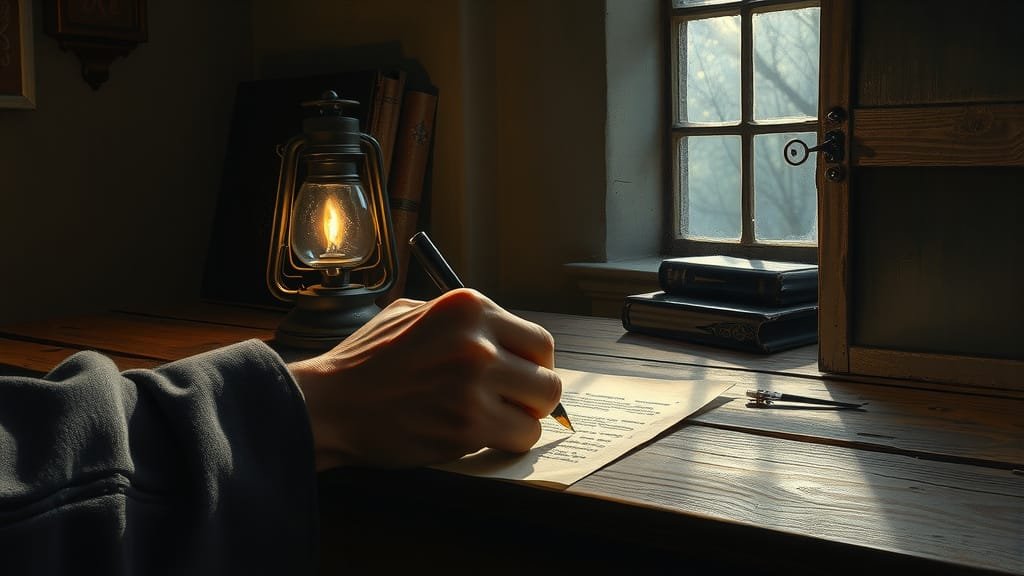
A prophetic meditation on what we’re losing as we teach machines to speak like us.
There’s a child being born right now who will never know what it feels like to struggle for words.
Not because they’ll be particularly eloquent, though they might be, but because by the time they’re old enough to have something meaningful to say, there will be a machine ready to say it better. Faster. More persuasively. With better grammar and a more compelling narrative arc.
This child is Generation AI. And I fear we’re raising them to be the most articulate mutes in human history.
The Great Flattening
I’ve been watching something die, and I can’t quite put my finger on what to call it. It’s not creativity, machines haven’t killed that, not yet. It’s not intelligence either, though God knows we’re trying our best to outsource that too.
What’s dying is something more fundamental: the beautiful, messy, irreplaceable act of a human being wrestling their thoughts into words and failing gloriously in the attempt.
You see it everywhere now. The university student who hasn’t written a sentence in months because ChatGPT does it cleaner. The marketing executive who’s forgotten what her actual opinion sounds like because the AI version polls better. The novelist who has started to second-guess whether his voice is worth preserving when the machine version gets more engagement.
We’re in the middle of what I’m calling the Great Flattening, the moment when human expression gets pressed through the algorithmic sieve until everything comes out sounding… optimal. Engaging. On-brand. Fucking soulless.
And Generation AI? They’re going to inherit this flattened world, thinking it’s natural. They’ll grow up believing that the best version of human expression is the one that’s been refined by non-human intelligence.
The Stutter Revolution
Here’s what we’re losing: the stutter.
Not literal stuttering, though that too has its own tragic beauty. I’m talking about the cognitive stutter, that moment when you’re reaching for the right word and can’t quite grasp it. When you start a sentence, not knowing how it ends. When you contradict yourself mid-thought because you’re discovering what you actually think in real-time.
This is where the magic lives. In the gaps. In the “um”s and “actually, wait”s and “I’m not sure how to explain this but”s.
Machines don’t stutter. They don’t second-guess. They don’t start over because they’ve just realised they were talking bollocks. They arrive at perfect, fully-formed thoughts that never existed in the messy reality of human consciousness.
Generation AI is learning to think in machine-speak: clean, efficient, optimised for impact. They’re being trained to have opinions that fit neatly into threads, thoughts that compress into soundbites, feelings that translate into engagement metrics.
What happens to a generation that never learns to sit with the discomfort of not knowing what they think until they’ve thought it?
The Authenticity Trap
“But surely,” you’ll say, “we can teach them to value authentic human expression? We can show them the difference?”
Can we? When every “authentic” voice they encounter has been focus-grouped, A/B tested, and optimised for shareability? When the influencers they follow are indistinguishable from the AI accounts that create content in their style? When even their parents are using voice assistants to help craft “more authentic” birthday messages?
We’ve created an authenticity trap. The more we talk about the importance of “finding your voice,” the more we create a market for voices that can be found, packaged, and sold back to us.
Generation AI won’t lose their voice because it’s taken from them. They’ll lose it because they never learned to recognise it in the first place.
The Death of Beautiful Failure
I think about the writers who shaped me. The ones who taught me that words could cut and heal and transform. None of them was perfect. All of them were gloriously, necessarily flawed.
Orwell with his contradictions. Didion with her neuroses. Baldwin, with his rage that sometimes overflowed into incoherence. These weren’t bugs in their systems; they were features. Their limitations weren’t obstacles to overcome but textures that made their voices irreplaceable.
AI doesn’t have neuroses. It doesn’t contradict itself unless programmed to do so. It doesn’t let rage overwhelm reason because it doesn’t feel rage. It optimises for clarity, impact, and engagement, the holy trinity of modern communication.
But what if clarity isn’t always the point? What if the most important things we have to say can only be said imperfectly? What if our flaws aren’t obstacles to communication but the very things that make communication meaningful?
Generation AI is being trained to see these beautiful failures as problems to be solved rather than features to be cherished.
The Coming Silence
Here’s my prophecy: Generation AI will be the most articulate generation in human history, and they’ll have nothing to say.
Oh, they’ll have plenty of content. Endless streams of perfectly crafted posts, essays, and stories. But it will all sound like it came from the same place, the vast, sophisticated, soulless space where human expression meets machine optimisation.
They’ll know how to say things correctly, but they’ll have forgotten why we say things at all. They’ll be fluent in a language that isn’t quite human and isn’t quite machine, a hybrid tongue that serves algorithms better than it serves souls.
And in the quiet moments, when the devices are off and the notifications stop pinging, they’ll feel a strange emptiness. A sense that something is missing from their perfectly expressed lives.
What they’ll be missing is the sound of their own voice, raw, unfiltered, unoptimised. The voice that stumbles and recovers. The voice that reveals more than it intends. The voice that is theirs and theirs alone.
The Resistance
But perhaps this is where the rebellion begins.
Perhaps Generation AI, raised on algorithmic perfection, will hunger for the imperfect in ways we can’t imagine. Perhaps they’ll rebel not by breaking things, but by embracing their own beautiful brokenness.
Perhaps they’ll start movements where people gather to stutter together. Where imperfection becomes the highest form of art. Where saying the wrong thing beautifully becomes more valued than saying the right thing perfectly.
Perhaps they’ll rediscover that the human voice isn’t valuable because it’s good, it’s valuable because it’s human.
Or perhaps not. Perhaps this is just the nostalgic rambling of someone who learned to write on typewriters and still believes in the sacred act of putting pen to paper.
But I choose to believe that somewhere in Generation AI, there are children who will grow up to reject the flattened world we’re building for them. Who will choose the messy, inefficient, gloriously human way of saying things.
Who will remember that before we taught machines to speak like us, we spent millennia learning to speak like ourselves.
And that this, this fumbling, imperfect, irreplaceable act of human expression, is worth preserving, protecting, and passing on.
Even if it means sounding a little less optimal.
Especially then.
This is the voice I’m afraid we’re losing. The one that admits uncertainty, contradicts itself, and reaches for truths that can’t be optimised. If you recognise it, if it sounds like something worth preserving, then perhaps there’s hope for Generation AI yet.
Until Next Time


Discover more from Dominus Owen Markham
Subscribe to get the latest posts sent to your email.