
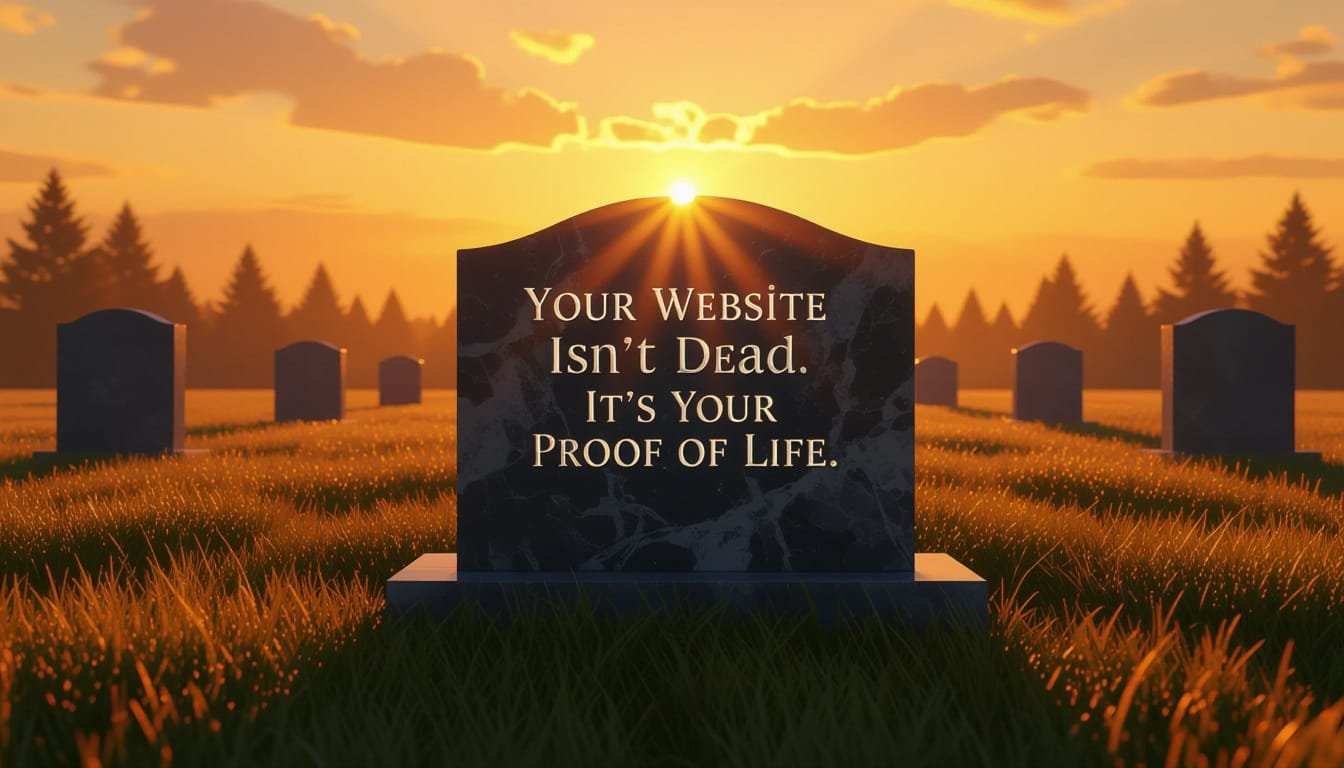
There’s this pervasive myth doing the rounds at the moment—you’ve probably heard it whispered in LinkedIn comments or shouted from the rooftops of some marketing guru’s webinar—that websites are dead.
Dead!
Finished. Over. A relic of the digital stone age, gathering dust whilst everyone’s attention span supposedly shrivelled to three seconds and migrated entirely to TikTok.
And I’ll be honest with you: it’s bollocks.
Complete and utter bollocks.
But I understand why people think this. I do. SEO feels like you’re playing poker with Google, who keeps changing the rules mid-game and occasionally just sets fire to the deck. Social media algorithms are about as predictable as British weather in April. And now we’ve got AI overviews nicking your carefully crafted content and serving it up without so much as a “cheers, mate” in your direction.
Traffic sources are absolutely changing. The how of getting eyeballs has transformed. But here’s what hasn’t changed, and what I suspect won’t change for a very long time: the fundamental human need to verify that you’re real.
The Authenticity Reflex
Let me tell you what actually happens when someone discovers you—whether that’s through a ChatGPT summary, a viral tweet, or ranking number one for “best widgets in Wolverhampton.”
They check.
They always check.
It doesn’t matter if they found you because an AI recommended you, or because your LinkedIn post got 50,000 impressions, or because their mate Dave mentioned you down the pub. At some point—usually quite quickly—there’s this almost involuntary reflex that kicks in. A little voice in their head goes: “Right, but are they actually legit?”
And where do they go to answer that question?
Your website.
Not your Instagram bio. Not your Twitter thread. Not even your LinkedIn profile with its reassuringly professional headshot.
Your website.
Because somewhere deep in our collective digital consciousness, we’ve all agreed that having a proper website means you’re probably not about to vanish into thin air with someone’s money or trust. It’s the digital equivalent of having a shopfront instead of selling “genuine Rolexes” out of the boot of your car.
The Website as Credential
I’ve seen this play out hundreds of times, both in my own analytics and in conversations with other business owners. Someone will tell you their social media is “popping off”—and genuinely, fair play, that’s brilliant. But then they’ll mention, almost as an aside, that their website traffic has actually increased proportionally.
Why?
Because social media is the trailer. The website is where people go to watch the full film.
You can build an audience of thousands on Instagram, but when someone’s genuinely considering working with you, buying from you, trusting you with something important—they’re going to want to see the full picture. They want to poke around. Read your About page. Check if you’ve actually got case studies or if you’re just really good at Canva templates.
The website is your credentials. It’s your receipts. It’s the place where you get to control the narrative completely, without an algorithm deciding that today, actually, they’re only going to show your content to 2% of your followers because Mercury’s in retrograde or whatever.
SEO Isn’t Dead Either (It’s Just Wearing a Disguise)
Yes, Google’s search results look different now. Yes, AI overviews are eating up screen real estate. Yes, the zero-click search is a genuine concern.
But here’s the thing: even when Google gives someone an AI-generated answer, that person still clicks through to sources. Maybe not as often as before, granted. But they do. Particularly for anything that matters—anything involving money, health, major decisions, or trust.
And when they click through, they’re not just looking for the specific answer to their specific question. They’re scanning for signals. Does this site look professional? Has it been updated since 2007? Is there an actual person behind this, or is it content farm nonsense?
Your website is still doing the heavy lifting, even if the journey there has become more circuitous.
The same logic applies to AI chatbots, by the way. When ChatGPT or Claude recommends you as an expert in your field, the savvy user isn’t just taking that at face value. They’re opening a new tab and having a look. Because AI can be confidently wrong, and everyone knows it.
Your website is the fact-checker for the AI age.
Social Media: The Gateway Drug
I’m not anti-social media. Far from it. Social media is brilliant for discovery, for personality, for building relationships at scale. It’s immediate. It’s where conversations happen.
But it’s also ephemeral and fragile.
Platforms change their terms of service. Algorithms shift. Accounts get suspended for reasons that make no sense. I’ve lost count of how many people I know who’ve had Instagram accounts with tens of thousands of followers just… disappear. Poof. Gone. And Instagram’s support is about as helpful as a chocolate teapot.
You don’t own your social media presence. You’re renting. The landlord can kick you out whenever they fancy, and your deposit is your dignity.
But your website? That’s yours. Properly yours. As long as you pay the hosting bill (which is, what, the cost of two fancy coffees a month?), it’s there. It’s not going anywhere. It’s not going to decide that long-form content is out this season, or that your niche is suddenly against community guidelines.
People know this, even if they don’t consciously articulate it. Which is why, when they really want to follow you, support you, or buy from you, they’ll eventually migrate from social media to your website. Your website is the commitment. Social media is just the first date.
The Multi-Touch Reality
Here’s how it actually works in practice, in 2025:
Someone discovers you via an AI search. They’re intrigued. They Google your name. They find your LinkedIn. They scroll through a few posts. They think, “Yeah, this person seems to know their stuff.” Then—and this is the crucial bit—they go to your website to see the full portfolio, read the proper case studies, check the testimonials, and ultimately, make a decision.
Or: Someone sees your tweet go viral. They click your profile. They scroll through your recent tweets to see if you’re consistently interesting or just got lucky once. They like what they see. They click the link in your bio—which goes to your website—because they want to see what you’re actually about beyond 280-character zingers.
Or: An AI tool recommends you as a resource. The user thinks, “I should verify this.” They search for your website. They land on it. They poke around. They subscribe to your newsletter. They become a customer six months later because they’ve been reading your content consistently and trust you.
Every single one of these journeys is different. The traffic source varies. The path is winding. But they all end up in the same place.
Your website.
What Actually Matters Now
So if websites aren’t dead—and they’re not—what should you actually be doing with yours?
First: Stop treating it like a brochure from 1997. Your website should feel alive. That means updating it. Adding content regularly, whether that’s blog posts, case studies, or just updating your About page so it doesn’t sound like you wrote it during the Bush administration (and I mean George W., not George H.W.).
Second: Make it human. People are drowning in AI-generated slop. Your website should sound like you. Not like you’re trying to convince a committee to approve your grant proposal, but like you’re explaining your work to someone you actually like. Personality is your moat.
Third: Make it useful. If someone lands on your website, don’t make them feel like they’ve just walked into a car showroom where a salesperson immediately pounces. Give them something of value. Teach them something. Make them laugh. Make them think. Then you can gently suggest they might want to work with you or buy your thing.
Fourth: Optimise for trust, not just traffic. Yes, SEO matters. But it’s not just about ranking for keywords anymore. It’s about looking credible when someone arrives from anywhere—whether that’s a Google search, a social media link, or an AI recommendation. Social proof, clear contact information, an actual photo of your actual face (not a logo or an AI-generated avatar), and evidence that you know what you’re talking about. These things matter enormously.
Fifth: Own your content. Publish on your website first. Then distribute everywhere else. Social media, Medium, LinkedIn—these are amplification channels, not your home base. Your website is where the canonical version lives. It’s your archive. Your body of work. The thing that survives platform migrations and algorithm apocalypses.
The Long Game
I think part of why people declare websites dead is because they want a silver bullet. A single channel that just works, consistently, forever, without having to think about it.
That doesn’t exist. It never has.
What does exist is this: a solid foundation that you control, coupled with smart distribution across multiple channels, underpinned by actually valuable content that makes people glad they found you.
Your website is that foundation.
It’s not flashy. It’s not going to give you 10,000 followers overnight. It’s not going to make you feel like you’ve cracked the algorithm.
But it’s going to be there when someone Googles you at midnight because they’re trying to decide whether to hire you. It’s going to be there when an AI tool cites you as a source and someone wants to verify you’re not a made-up person. It’s going to be there when your social media account gets hacked, or the platform implodes, or the algorithm decides you’re persona non grata this week.
It’s your proof of life.
It’s your credentials.
It’s your home on the internet.
And no, it’s not dead.
Not even close.
The Habit We Can’t Shake
Here’s the thing about habits: they’re devilishly hard to break, even when we’re told we should.
And the habit of “check the website” is deeply ingrained. It’s been trained into us over decades. Before we book a restaurant, we check the website. Before we hire a plumber, we check the website. Before we buy from an online shop we’ve never heard of, we frantically scroll through their About page looking for signs they’re not going to nick our credit card details and disappear to the Cayman Islands.
We’ve been conditioned to believe that legitimate things have websites. And that belief isn’t going anywhere just because a nineteen-year-old influencer says you can “build your entire business on Instagram.”
You can build a business on Instagram. But the minute that business needs to scale, needs to be taken seriously, needs to convert browsers into buyers, people are going to look for the website.
It’s not conscious. It’s not even always rational. It’s just muscle memory at this point.
And muscle memory is a powerful thing.
So What Now?
If you’ve been neglecting your website because you’ve been told it doesn’t matter anymore, or because you’ve been pouring all your energy into social media or chasing AI traffic, this is your sign to stop.
Not stop doing those things—they matter too. But stop treating your website like the embarrassing relative you hide in the attic when guests come over.
Dust it off. Update it. Make it something you’d actually be proud to send someone to. Make it yours.
Because when someone asks, “Where can I learn more about you?”—or when they don’t ask but go looking anyway, because that’s what people do—your website needs to be ready.
Not perfect. Just ready. Just alive. Just there.
And when it is, you’ll stop worrying about whether websites are dead.
Because you’ll see the traffic. The enquiries. The proof that yes, actually, people still very much care about websites.
They just care about them in the way that matters most: as the place where trust gets built and decisions get made.
Your website isn’t dead.
It’s just evolved.
And if you’ve evolved with it—if you’ve made it human, useful, credible, and genuinely you—then it’s doing exactly what it’s supposed to do.
Quietly, in the background, whilst all the flashy channels get the headlines.
Proving you’re real.
Proving you’re worth paying attention to.
Proving you’re here to stay.
Now, if you’ll excuse me, I need to go update my own About page. Because I just checked, and apparently I’ve been “exploring new directions” since 2019. Which is either admirably consistent or worryingly vague. Probably both.
Until Next Time

Discover more from Dominus Owen Markham
Subscribe to get the latest posts sent to your email.