
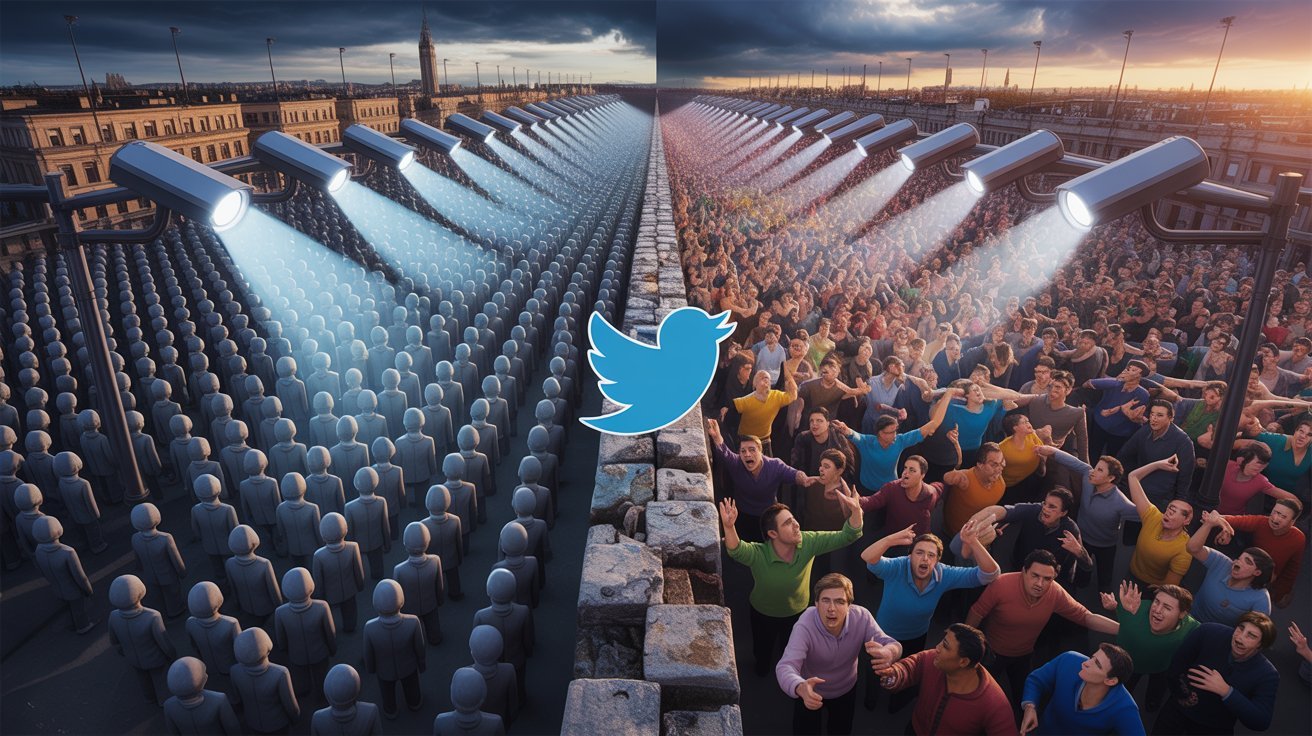
Let’s Talk About What’s Actually Happening
There’s a narrative doing the rounds right now, and it goes something like this: X (formerly Twitter) has become the last bastion of free speech in a world gone mad with censorship. Elon Musk rode in on his billionaire white horse, liberated the platform from the woke mob, and now truth flows freely whilst other social media sites cower before governments and advertisers.
It’s a compelling story. And like most compelling stories, it contains just enough truth to be dangerous.
Let me be clear from the start… I’m not here to tell you what to think about X, Elon Musk, or the state of online discourse. I’m here to pick apart what’s actually happening, because the conversation around free speech and social media has become so tribal, so bloody partisan, that nuance has been thrown out the window alongside common sense.
And that should worry all of us.
The Traffic Doesn’t Lie (Or Does It?)
The numbers are genuinely impressive. X remains a traffic juggernaut, consistently ranking in the top apps across 160+ countries. When news breaks… and I mean breaks, like actually happening in real time… X is often where you’ll find it first. Not on the BBC. Not in The Guardian. Certainly not on Facebook, where your aunt is still sharing minion memes from 2014.
This matters because speed of information has become currency in our attention economy. The platform that delivers news first captures the conversation. And X, for all its chaos and occasional descents into the abyss, still does this better than almost anyone else.
But here’s where it gets interesting.
Traffic and reach don’t automatically equal free speech. They just equal… well, traffic and reach. North Korean state television has 100% viewership in North Korea. That doesn’t make it a bastion of open discourse.
I’m being facetious, obviously. But the point stands: we need to be careful about conflating popularity with liberty.
What Musk Actually Changed
When Elon Musk bought Twitter for an absolutely mental $44 billion, he made grand promises about free speech absolutism. The “digital town square” would be protected. Voices that had been silenced would be restored. The algorithm would be open-sourced. Transparency would reign.
Some of this happened. The Twitter Files revealed genuine concerns about how the old regime handled certain stories (the Hunter Biden laptop springs to mind). Previously banned accounts were reinstated. There was a genuine shift in what you could say without immediately being suspended.
And a lot of people, understandably, felt like they could breathe again.
But here’s what the most ardent defenders of the “Musk freed speech” narrative conveniently forget: free speech on a private platform was always going to be conditional. It had to be. The question was never “will there be rules?” but rather “who decides the rules, and what are they?”
Under the old Twitter regime, you had one set of biases, one set of blind spots, one worldview influencing decisions. Under Musk, you have… a different set of biases, different blind spots, a different worldview. The algorithm still curates. Accounts still get suspended (just different ones now). Certain topics still get throttled or boosted.
The town square isn’t neutral. It never was. It just has a different landlord.
The Government Problem
Now, let’s talk about the elephant in the server room: governments.
Across the world, from the UK to Australia to Brazil to the EU, governments have been tightening the screws on what can be said online. The Online Safety Bill in Britain. Digital Services Act in Europe. Various “misinformation” laws popping up like mushrooms after rain in Commonwealth countries.
The justification is always the same: protecting people from harm, stopping the spread of dangerous lies, keeping kids safe, preventing radicalisation. All very noble-sounding.
And some of it… look, I’m not going to sit here and pretend there’s no problem with actual harmful content online. There obviously is. Child exploitation, terrorism recruitment, genuine threats of violence… these things exist and need addressing.
But the line between “protecting people from harm” and “suppressing inconvenient speech” is thinner than a Rizla paper, and governments have an unfortunate tendency to treat it like a bloody motorway.
When the UK government pressures platforms to remove content criticising lockdown policies, that’s not safety. When Australian authorities threaten fines for allowing “misinformation” about government decisions, that’s not protection. When Brazil temporarily bans X entirely because a judge doesn’t like what people are saying about the judiciary, that’s not moderation.
That’s censorship wearing a safety vest.
And this is where X’s role becomes genuinely important, regardless of what you think about Musk personally. Other platforms… Meta, Google, TikTok… have shown a concerning willingness to bend the knee to government pressure. Sometimes for good reasons (actual illegal content). Often for questionable ones (politically inconvenient truths).
X, under Musk, has pushed back more than most. Not always. Not perfectly. But more than the alternatives.
The “Truth” Problem
Here’s where I’m going to lose some of you, and I’m fine with that.
The claim that X now enables “truth” whilst other platforms suppress it is… well, it’s simplistic bollocks, isn’t it?
Truth isn’t a toggle switch that Elon Musk flipped when he took over. Truth is messy, complicated, often contradictory, and requires actual work to discern. What changed on X wasn’t that truth suddenly started flowing… it’s that a different set of narratives started flowing more freely.
If you’re right-leaning, X probably feels like a breath of fresh air after years of feeling suppressed on mainstream platforms. If you’re left-leaning, it probably feels like the asylum inmates took over and set fire to the library.
Both of these feelings are valid. Both are also missing something crucial.
The real value of X isn’t that it hosts “truth” (as if such a monolithic thing exists). It’s that it hosts argument. Disagreement. People calling each other idiots in real time. Journalists getting fact-checked by actual experts within minutes. Bad takes getting demolished publicly. Good takes rising to the surface through sheer force of engagement.
It’s chaotic. It’s often unpleasant. It’s frequently wrong. But it’s alive in a way that algorithmically-smoothed, corporate-sanitised platforms aren’t.
That matters more than whether every post is “true” or not.
What Other Platforms Are Doing Wrong
Let’s be honest about why people are crediting Musk and X with defending free speech: it’s because the alternatives have become increasingly unbearable.
Facebook is your grandmother’s conspiracy theory repository. Instagram is a shopping mall with selfies. TikTok is Chinese-owned (make of that what you will) and increasingly heavy-handed with anything remotely political. YouTube has become so trigger-happy with demonetisation that creators speak in code like they’re evading the Stasi.
And then there’s the whole debanking, payment processor blocking, advertising boycott industrial complex that punishes anyone who steps outside increasingly narrow bounds of acceptable opinion.
When you create an environment where people feel they can’t speak freely anywhere else, of course they’re going to flock to the platform that at least pretends to care about open discourse. Even if it’s imperfect. Even if it’s chaotic. Even if the owner is an erratic billionaire who tweets memes at 3am.
The competition isn’t beating X on free speech grounds because they’re not even trying.
The Uncomfortable Truth About Free Speech
Here’s what nobody wants to admit: free speech is uncomfortable. It means hearing things you find offensive, stupid, or outright wrong. It means bad ideas getting airtime alongside good ones. It means people you despise having the same platform rights as people you admire.
The urge to curate, to moderate, to “make it better” is human and understandable. But it’s also the first step on a very slippery slope.
The old Twitter erred on the side of safety and ended up suppressing legitimate discourse. The new X errs on the side of chaos and sometimes hosts genuinely harmful content. Neither extreme is ideal. Both are preferable to government-mandated “truth.”
Because here’s the thing: I don’t trust governments to decide what’s true. I don’t trust billionaires to decide what’s true. I don’t trust corporations, activists, or self-appointed fact-checkers to decide what’s true.
I trust the marketplace of ideas, messy and imperfect as it is, more than I trust any authority to curate reality for me.
So Is X Actually a Free Speech Haven?
Yes and no. Mostly no. Kind of yes.
It’s freer than the alternatives, which isn’t saying much given how restrictive they’ve become. It’s more resistant to government pressure than its competitors, which matters enormously. It’s got genuine reach and influence, which gives it power that pure free speech platforms like Gab or Parler never achieved.
But it’s not a public square. It’s a privately-owned platform with an algorithm, rules, and biases like any other. Those biases just happen to currently align more with free speech principles than the competition.
That could change tomorrow. Musk could sell. Governments could force compliance. The advertiser pressure could become unbearable. The whole thing could collapse under the weight of its own contradictions.
The fact that we’re all one billionaire’s mood swing away from losing what little free speech infrastructure exists online should terrify you more than comfort you.
What This Actually Means for You
If you care about free speech… and I mean genuinely care, not just care when it’s speech you agree with… then you should absolutely use and support X. Not because it’s perfect. Not because Musk is some saviour. But because it’s currently the best option for open discourse at scale.
You should also recognise its limitations. Diversify your information sources. Don’t assume that because something is allowed on X, it’s therefore true. Engage critically with everything you read, especially things that confirm your existing beliefs.
And for God’s sake, push back against government attempts to regulate online speech. That’s the real threat here, not which billionaire owns which platform. Once governments get comfortable deciding what you’re allowed to say online, they won’t stop. They never do.
The battle for free speech isn’t won by picking the right platform. It’s won by defending the principle itself, even when it’s inconvenient, even when it protects speech you despise, even when it feels like the world is going mad.
Because the alternative… a world where truth is whatever those in power say it is, where discourse is limited to pre-approved talking points, where dissent is classified as danger…
That world is far worse than any chaos X could ever create.
And that’s the truth, whether X’s algorithm decides to show it to you or not.
Until Next Time


Discover more from Dominus Owen Markham
Subscribe to get the latest posts sent to your email.