
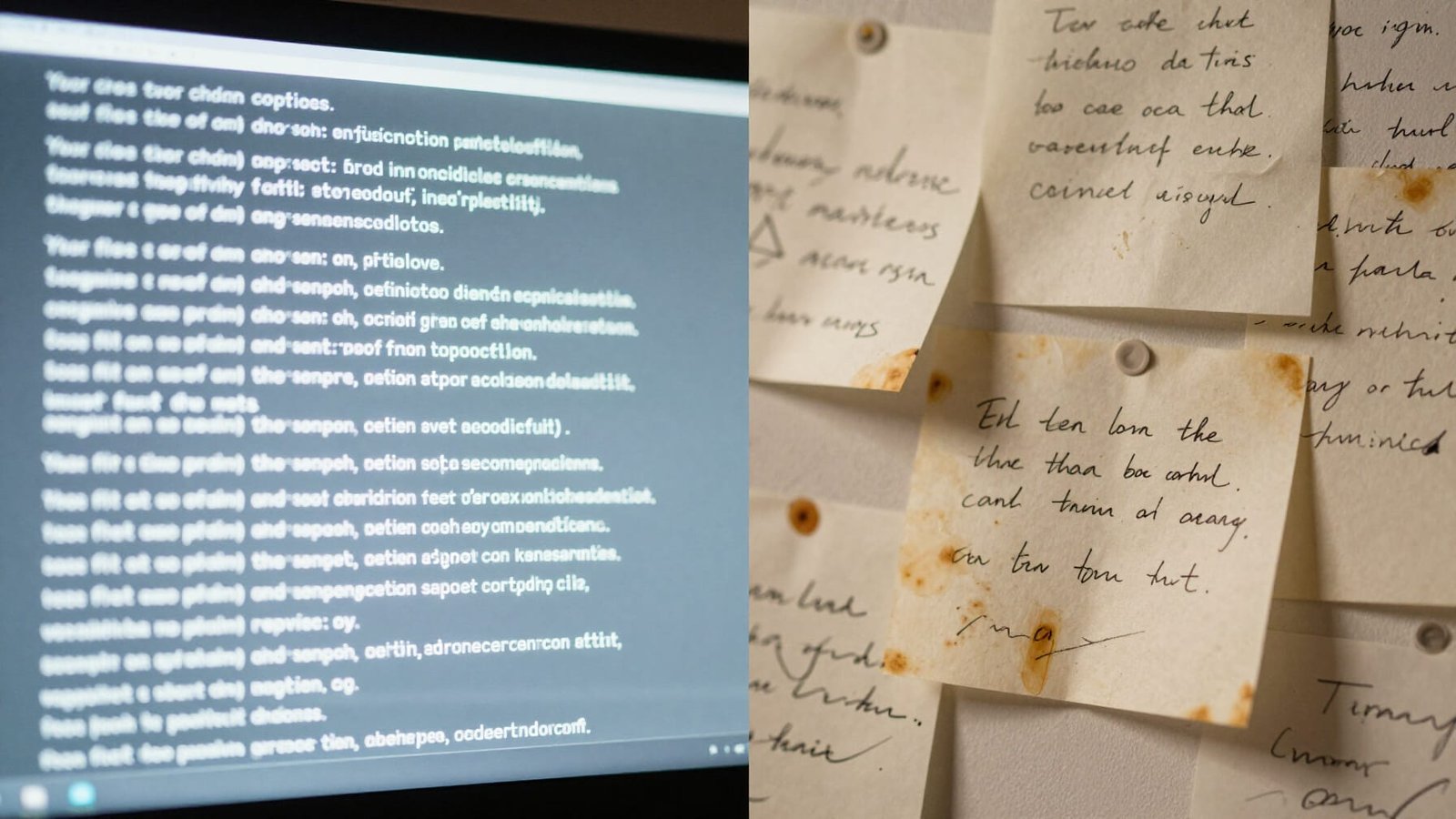
(And Why That’s Actually Good News)
Let’s get something out of the way immediately: I’m not here to tell you that AI is the death of creativity, the end of authentic writing, or some dystopian nightmare where nobody reads anything human ever again.
That’s boring. And it’s not true.
But I am here to tell you that if you’re using AI to create content and you’re not injecting yourself into it… you’re basically serving up reheated leftovers and wondering why nobody’s hungry.
The Thing Nobody Wants to Admit
We’re all using AI now. Or we’ve tried it. Or we’re thinking about it whilst pretending we’re not.
Content creators, copywriters, novelists, newsletter writers, that bloke who runs a niche blog about vintage typewriters… everyone’s had a fiddle with ChatGPT or Claude or whatever the cool kids are using this week. And you know what? That’s fine. More than fine. It’s a tool. A bloody useful one, actually.
But here’s where it gets messy.
AI can write. It can write well, in fact. It can mimic tone, structure sentences, even crack the occasional joke. But it can’t do the one thing that actually matters: it can’t be you.
It can’t tell the story about the time you bollocked up a client presentation because you’d had three espressos and no breakfast. It can’t capture the exact feeling of staring at a blank page at 11pm, wondering why you ever thought you had anything worth saying. It can’t write with the scar tissue of experience, the inside jokes you share with your readers, the vulnerability that makes someone think, “Oh thank God, it’s not just me.”
And that’s the bit people are forgetting.
AI-Assisted vs AI-Generated: There’s a Difference
Let’s draw a line in the sand, shall we?
AI-assisted writing is when you use the tool to help you think, to get unstuck, to generate ideas or first drafts that you then tear apart and rebuild in your own image. It’s a sparring partner. A very clever, very fast intern who doesn’t need sleep but also doesn’t have a soul.
AI-generated writing is when you ask the machine to do the work, copy-paste the result, maybe change a few words so it doesn’t look too obvious, and ship it. It’s the content equivalent of microwaving a ready meal and pretending you cooked dinner.
One of these approaches creates something worth reading. The other creates… well, content. The sort of content that clogs up the internet like plaque in an artery. Technically functional. Completely forgettable.
Your readers can tell the difference. Even if they can’t articulate why, they feel it. AI-generated content has a flatness to it. It’s competent but lifeless. It ticks boxes but doesn’t land punches. It’s the person at the party who says all the right things but never makes you want to keep talking to them.
Why Readers Can Smell Generic AI from a Mile Off
Here’s the thing about AI: it’s trained on everything. Which means it writes like… everything. It’s the average of the internet, smoothed out and polished up.
And average is boring.
When you read something that’s pure AI, you get this eerie sense of déjà vu. The phrasing feels familiar but not in a good way. The structure is predictable. The insights are surface-level. It’s like listening to someone recite a Wikipedia article at you whilst making unblinking eye contact.
But when you read something human… even if it started with AI… you feel the texture. The personality. The weirdness.
You get the tangents. The self-deprecating asides. The moment where the writer goes, “Actually, sod it, here’s what I really think.” You get the stuff that’s specific… not “many people struggle with this,” but “I once spent four hours rewriting the same paragraph because I couldn’t figure out how to say what I meant without sounding like a prat.”
That specificity? That’s what makes people lean in. That’s what makes them remember you. That’s what makes them come back.
The Real Danger Isn’t AI… It’s Lazy Thinking
The problem isn’t that AI exists. The problem is that it’s easy.
It’s so bloody easy to outsource your thinking to a machine. To ask it what you should write about, how you should structure it, what your opinion should be. To let it do the heavy lifting whilst you sit back and collect the byline.
But here’s the uncomfortable truth: if you’re not doing the thinking, you’re not growing as a writer. You’re not developing your voice. You’re not learning how to spot the difference between a good idea and a mediocre one dressed up in fancy language.
AI should be a sparring partner, not a replacement brain. It should challenge you, give you options, help you see angles you hadn’t considered. But the final decisions… what to keep, what to cut, what to emphasise, how to make it yours… that’s your job.
Because that’s the job that matters.
When AI Actually Helps (And When It Doesn’t)
Let me be clear: I’m not anti-AI. I’m anti-bullshit.
AI is brilliant for:
- Breaking through writer’s block when you’re staring at a blank page and your brain’s gone on strike
- Generating ideas or angles you hadn’t thought of
- Creating rough first drafts that you can then shape and mould
- Handling the boring, repetitive stuff (reformatting, summarising, that sort of thing)
- Acting as a sounding board when you’re stuck on how to say something
AI is terrible for:
- Replacing your voice with something generic and soulless
- Making decisions about what’s worth saying (it doesn’t know, it’s a machine)
- Creating anything with emotional depth or genuine insight
- Understanding nuance, irony, or the unspoken stuff between the lines
- Knowing when to break the rules or when to trust your gut
The sweet spot is using AI to get started, then taking over and making it yours. It’s the scaffolding, not the building.
Your Mess Is the Point
Here’s what I wish someone had told me years ago: the stuff you think you need to edit out… the tangents, the slightly too-honest bits, the moments where you lose the thread and find something more interesting… that’s often the stuff people remember.
AI doesn’t do mess. It does clean, competent, on-brand. Which is fine if you’re writing an instruction manual, but if you’re trying to connect with humans? Mess is your superpower.
Your weird observations. Your half-formed thoughts. The story that doesn’t quite fit but feels important anyway. The bit where you admit you don’t have all the answers. That’s the stuff that makes people think, “Oh, I like this person. They’re real.”
AI can’t do real. It can approximate it, sure. But it can’t be it.
The Humans Who Win
You know who’s going to thrive in this AI-saturated world?
The humans who lean into being more human.
The ones who use AI as a tool but never let it do their thinking for them. The ones who take the generic first draft and tear it apart, rebuild it, breathe life into it. The ones who aren’t afraid to sound like themselves, even (especially) when that means sounding imperfect, opinionated, occasionally wrong.
The ones who understand that connection beats polish every single time.
Because here’s the truth: we’re not short on content. We’re drowning in it. What we’re short on is content that matters. Content that feels like a real person talking to you, not a content farm churning out SEO-optimised sludge.
And that’s where you come in.
So What Do You Actually Do?
If you’re using AI (and let’s be honest, you probably are), here’s the deal:
Start with AI if it helps. Use it to generate ideas, break through blocks, get words on the page. No shame in that.
But then take over. Rewrite it in your voice. Add your stories, your opinions, your specific observations. Cut the bits that sound like every other piece of content on the internet. Add the bits that sound like you.
Ask yourself: Would I want to read this? Does it sound like me? Have I said something only I could say, or could literally anyone have written this?
Be specific. Not “many people struggle with this,” but “I once…” Not “it’s important to remember,” but “here’s what I learned the hard way…”
Trust your gut. If something feels flat or generic, it probably is. If you’re bored writing it, your readers will be bored reading it.
And most importantly: Don’t outsource your humanity. That’s the one thing AI can’t replicate, and it’s the only thing that actually matters.
The Bottom Line
AI isn’t going anywhere. And that’s fine. It’s a tool, and tools are useful.
But the humans who win… the ones who build audiences, create work that matters, and don’t get lost in the noise… they’re the ones who remember that AI is the starting point, not the finish line.
It’s the scaffolding, not the building. The rough draft, not the final word. The assistant, not the author.
Your job is to feed yourself into it. Your experiences, your voice, your weird tangents and half-baked theories and the bits you’re not sure you should say out loud.
Because that’s the stuff people remember. That’s the stuff people connect with. That’s the stuff that matters.
So by all means, use AI. Let it help you. Let it make your life easier.
But never, ever let it replace you.
Because you’re the point.
Until Next Time


Discover more from Dominus Owen Markham
Subscribe to get the latest posts sent to your email.