
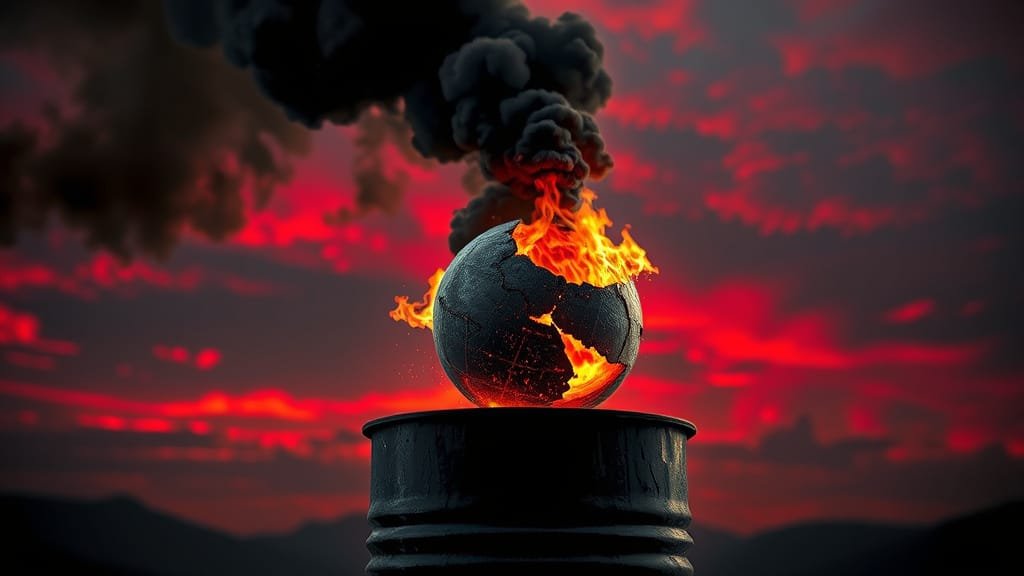
A pessimist’s guide to what happens next… and why you should probably be worried
Let me start with a confession.
I’ve spent years being the person at the dinner table who says “look, it won’t be as bad as all that.” I’ve been the one who calmly explains that markets are resilient, that humans are adaptable, that the world has survived worse. I’ve worn that mild, measured, slightly-smug optimism like a comfortable jumper.
I’m taking the jumper off.
Because on the 28th of February 2026, the United States and Israel launched Operation Epic Fury… a coordinated military assault on Iran that killed Supreme Leader Ali Khamenei, a man who had held the ideological reins of the Islamic Republic for over three decades. And as I sit here reading the incoming reports, watching oil markets spike, watching tankers anchor outside a strait that carries a fifth of the world’s energy… I find that I can no longer locate my comfortable optimism anywhere.
It’s gone. Possibly rerouted around the Cape of Good Hope with the rest of the shipping.
So let’s do something different. Let’s take the pessimistic view seriously. Not for drama. Not for clicks. But because I think the pessimists might actually be right this time, and I’d rather look the possibility in the face than pretend it isn’t standing at the door.
“Peace Was Within Reach.” Remarkable Timing, Really.
Here’s the detail that I keep circling back to, the one that makes everything else worse.
On the 27th of February 2026… the day before the strikes… Oman’s Foreign Minister stood up and announced that a breakthrough had been reached in nuclear negotiations. Iran had apparently agreed to never stockpile enriched uranium. They’d agreed to full verification by the IAEA. They’d agreed to irreversibly downgrade their current stockpiles. The foreign minister said peace was “within reach.”
Twenty-four hours later, the bombs were falling.
Now. I’m not naive enough to take Iranian diplomatic statements at face value, and I’m certainly not suggesting the regime was a benign actor. But I do think that particular sequence of events deserves more scrutiny than it’s getting. Because apparently, while US envoys were holding indirect nuclear talks in Muscat, the US military was simultaneously assembled in the biggest regional force since the 2003 invasion of Iraq.
That’s not negotiating in good faith. That’s negotiating with one hand while the other hand is already reaching for the trigger. And Senator Mark Warner… a man with access to highly classified intelligence briefings… said publicly that he saw no evidence Iran was planning a preemptive strike on the United States. None.
So the justification for a war that is now, by any definition, a war… is already wobbling before we’ve even got to the consequences.
This matters because when the rationale for a conflict is shaky at the start, the strategy that follows tends to be shakier still. And shaky strategy in a region this volatile, involving this much oil, is not an abstract concern for foreign policy wonks. It is a very concrete problem for every single person on this planet who uses energy. Which is everyone. Which is you.
The Strait. The Aorta. The Number You Need To Know.
Let me give you the geography lesson that nobody seems to be teaching clearly enough.
The Strait of Hormuz is a strip of water between Iran and Oman. It is, at its narrowest, 21 miles wide. Through that 21-mile gap passes approximately 20 million barrels of oil every single day. That is roughly one-fifth of all globally traded oil. It also handles about 20% of the world’s liquefied natural gas, almost entirely from Qatar. One analyst described it as “the aorta of the global energy system,” and that is not hyperbole. That is just accurate anatomy.
As of this writing, the IRGC has issued warnings prohibiting vessel passage through the strait. Tanker traffic has dropped by approximately 70%. Over 150 ships are sitting at anchor outside the strait, waiting. The major shipping operators… Maersk, Hapag-Lloyd, CMA CGM… have suspended operations through the corridor. War-risk insurance premiums have surged by up to 50%, and what insurers haven’t outright refused, they’ve priced so prohibitively that it barely matters.
The Strait is not formally closed. It is simply, functionally, not open.
Brent crude jumped 9% on Monday morning. From $73 to just under $80 in a single trading session. Analysts are forecasting $85 to $90 in the near term, with some scenarios placing the intraday high above $88 before the end of the week. If the disruption persists… and here is the important word, persists… the projections go to $100 per barrel or higher.
One former White House energy advisor put it plainly: “A prolonged closure of the Strait of Hormuz is a guaranteed global recession.”
Not a risk. Not a possibility. Guaranteed.
That’s not a commentator on a YouTube channel. That’s a man who has sat in rooms where these decisions get made, talking to CNBC with the weary certainty of someone who knows exactly what the data says.
The Saudi Problem Nobody’s Talking About Loudly Enough
Here’s where it gets worse. And I do mean worse.
Saudi Arabia’s oil export infrastructure centres on a facility called Ras Tanura. It is the largest offshore oil loading facility in the world. It processes an almost incomprehensible amount of crude every single day. And Iran has been firing missiles at Gulf state infrastructure… UAE, Saudi Arabia, Bahrain, Kuwait… since the strikes began.
Should Ras Tanura sustain significant damage, the supply impact would not be a price spike. It would be something closer to a structural collapse of global energy availability. Because here’s the additional problem: the specialised equipment in Saudi oil facilities cannot simply be ordered from a catalogue and replaced in a matter of weeks. When a similar facility in Abqaiq was attacked back in 2019, energy analysts quietly noted that the replacement parts were the kind of things you can’t just order from a general supplier. You wait. Potentially for a very long time.
The world’s spare oil capacity sits in Gulf states. If the Strait is closed, that spare capacity can’t get out anyway. And if the infrastructure itself is damaged? There is no backup plan.
This is the tail risk that polite financial reporting is mentioning briefly before moving on to the next bullet point. I’d like to park here for a moment, because I think it deserves the discomfort.
Not Just Petrol. Your Food.
Here is the part that I genuinely think is being underreported in the mainstream coverage.
One third of the world’s fertiliser trade passes through the Strait of Hormuz.
Read that again. A third. Not oil. Fertiliser. The stuff that goes on the ground so that food grows. Egypt’s urea prices have already surged to $505 per tonne in the immediate aftermath of the strikes. Freight rates on Middle East to Asia routes have already tripled this year. Nitrogen fertilisers depend heavily on natural gas markets, which are now significantly disrupted.
Both energy and agricultural supply chains were already destabilised by the Ukraine war. They never fully recovered. They are now being hit again, from a different direction, with an additional shock on top of a system that was already strained.
If oil reaches $100 per barrel… and multiple serious analysts consider this plausible, not merely theoretical… global inflation could rise by up to 0.7 percentage points. In an environment where central banks are already walking a tightrope between growth and inflation, where household budgets across Europe and North America are still bruised from the 2021 to 2023 inflation spike, where food bank usage has been quietly climbing for years… that additional pressure is not absorbed smoothly. It is felt. In supermarkets. In energy bills. In the quiet, grinding desperation of families who are already at the edge of what they can manage.
The developing world takes this even harder. India imports roughly half its crude oil through the Strait of Hormuz. China gets the bulk of its Iranian oil through the same passage. Asian economies were already scrambling the moment the IRGC started broadcasting vessel warnings. Their scramble to secure alternative supplies from other sources pushes prices up further for everyone else.
Globalisation, as that Zimbabwean analyst noted rather pointedly, ensures that wars no longer remain regional events. The bomb that drops in Tehran lands in your weekly shop. Maybe not immediately. Maybe not in a way you’d directly connect. But it lands.
The Regime Change Fantasy
Let’s talk about the stated aim of all of this: regime change.
Regime change is not a strategy. It is a destination with no map, no sat-nav, and a worrying tendency to arrive somewhere completely different from where you intended.
We know this. We have done this before. Iraq, 2003. Libya, 2011. The pattern is familiar enough to have become something like dark comedy if the consequences weren’t so permanent. You remove the thing that was holding a fragile, fractured society together… even if that thing was brutal and illegitimate… and what rushes in to fill the space is rarely a functioning liberal democracy grateful for the intervention.
Iran is not a small, peripheral state. It has a population of around 85 million people. It has deep roots across the region… in Lebanon through Hezbollah, in Yemen through the Houthis, in Iraq through the Popular Mobilisation Forces. Those roots don’t disappear because Khamenei is dead. If anything, in the short term, they harden. Because nothing unifies fractured movements like a common enemy, and the US just handed every Iranian proxy in the region a very clear common enemy.
The optimistic version of this story is that the Iranian people… exhausted, impoverished, bruised by their own government’s violence during the January 2026 protests… rise up, take over their institutions as Trump urged them to, and form a functioning government that integrates peacefully into the international community.
That would be genuinely wonderful. I hope it happens.
But the realistic version, informed by every comparable situation in modern history, is messier. Factions. Power struggles. A security vacuum. Iran’s neighbours, already battered by Iranian missile strikes, now facing the question of what Iran looks like without a central authority capable of making binding decisions. The Houthis, who survived years of US, UK, and Israeli strikes and still hold power across most of Yemen, now operating without the overhead guidance that at least gave their actions some strategic coherence.
Chaos, in short. Not liberation. Chaos.
And chaos in the country that sits on one side of the world’s most important oil chokepoint is not the kind of chaos that resolves itself quietly in a few weeks.
The Constitution Nobody Mentioned
There is one more thing. Smaller, perhaps, in the context of regional war and oil crises. But I don’t think it should be left out.
The US Congress has not authorised this military action. The Constitution is fairly clear that the power to declare war sits with Congress, not the President. Senior legal figures have described Trump’s action as having no plausible legal justification, standing apart even from recent decades of increasingly unilateral executive military action, because of its scale and likely repercussions.
A war launched without authorisation, without a public debate, without a clear legal basis… is a war that is harder to end with political consensus. Because there is no political consensus behind it. There’s a President who moved faster than the institutions designed to check him. That may suit the current moment. It stores up enormous problems for everything that comes after.
So, Where Does This End?
I genuinely don’t know. And I’d be suspicious of anyone who tells you they do.
What I can tell you is that the pessimistic scenario… the one that doesn’t get the airtime because it’s uncomfortable and because markets prefer optimism… involves a grinding conflict that nobody wins, but nobody ends quickly. It involves oil disruption measured in months, not weeks. It involves food prices rising on top of energy prices rising on top of supply chains that were already under strain. It involves Asian economies hoarding energy. Gulf state infrastructure under sustained threat. A fractured Iran producing not democracy but power struggles and proxy chaos.
It involves, quite possibly, a global recession. Not because anyone wanted one. But because recessions, like wars, have a habit of arriving anyway when enough of the preconditions are met. And most of the preconditions are currently being met, simultaneously, in a 21-mile-wide strait between Iran and Oman.
The jumper is off. I’m sitting with the discomfort.
I think you should probably sit with it too.
Written 2nd March 2026. All facts current at time of writing. This situation is developing rapidly. Check back. Unfortunately.
Until Next Time

Discover more from Dominus Owen Markham
Subscribe to get the latest posts sent to your email.