
(And Apparently That’s Our Problem)
Now there’s a sentence I never expected to type in my lifetime, and yet here we are: Spanish teenagers are dressing up as wolves and gathering in public squares, and the tabloids want to know if this means the West is finished.
Spoiler: it doesn’t. But let’s have a proper look anyway, shall we? Because there’s something genuinely fascinating buried underneath all the pearl-clutching, and I’d rather we dig for it than stand on the surface shrieking at the foxes.
First, What’s Actually Happening
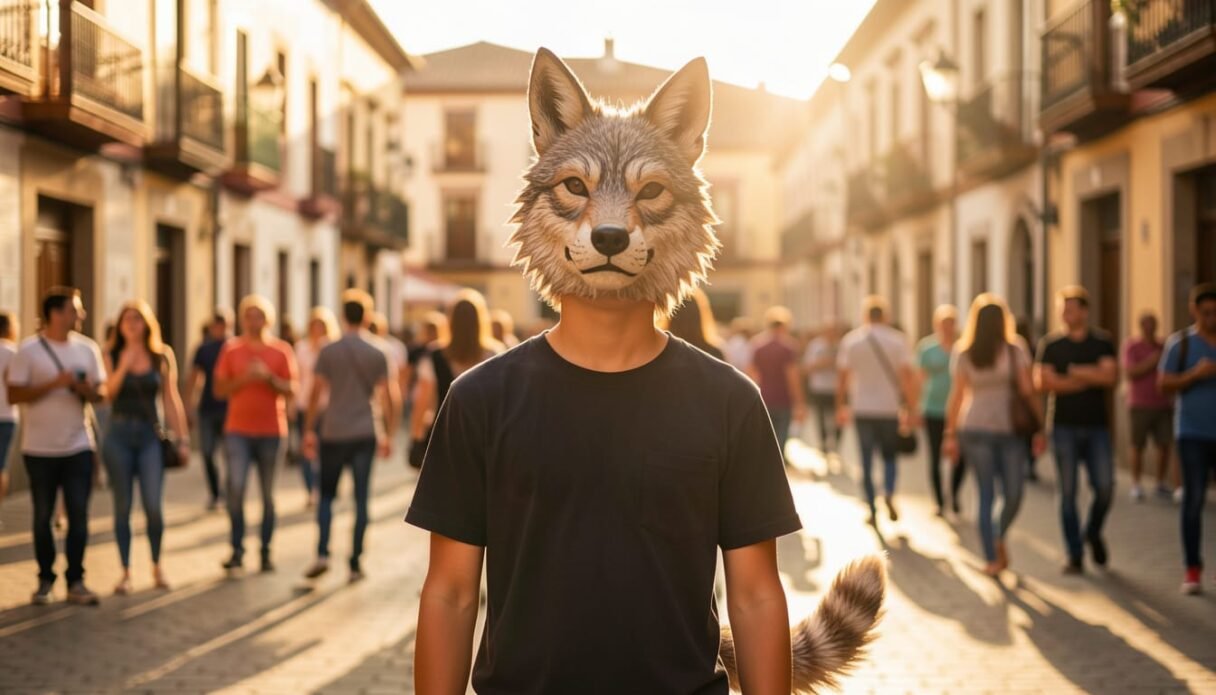
A small subculture called therians has existed quietly online since roughly the 1990s. These are people, mostly teenagers, who feel a deep psychological or spiritual connection to a particular animal. Not in a “I quite like otters” way. More in a “the grey albino wolf is my core identity and I need you to understand that” way.
They wear ears. They wear tails. Some wear full masks. Some move on all fours in parks. Some use leashes. They mimic animal sounds. And they’ve been doing this, largely unbothered, in the quieter corners of the internet for decades.
Then TikTok happened.
And suddenly what was once niche forum weirdness became a shareable aesthetic with hashtags and a million curious onlookers, and meet-ups started being announced in Barcelona, Bilbao, Pamplona, Málaga, Girona… and the press discovered it and lost their collective minds.
One event in Barcelona reportedly drew around 3,000 people. Which sounds alarming until you clock that the vast majority were not, in fact, committed wolf-souls seeking their pack. They were curious teenagers, meme-hunters, and people who’d seen the TikTok and thought, “Well, I’ve got nothing on Saturday.”
Police did intervene at one point. Not, I should stress, because of the wolf masks. But because of the alcohol-and-teenagers reasons that have caused police intervention at gatherings since the invention of both teenagers and alcohol.
The Boy Called Fin
One of the more humanising details to emerge from Spanish media coverage is a teenager named Fin, who describes feeling a genuine connection to a grey albino wolf. He makes his own mask. He wears ears and a tail. He goes out like this because it feels meaningful to him.
He also, and I respect his honesty here, enjoys people’s reactions.
And you know what? That combination… the authentic and the performative existing happily side by side… is more emotionally intelligent than most adults give teenagers credit for. He’s not confused. He knows he’s human. He just feels wolf-adjacent in some way that matters to him, and he’s chosen to express it rather than swallow it.
I’ve met fifty-year-old men who still haven’t managed that level of self-awareness. They just buy a sports car and call it a midlife recalibration.
Why the Panic?
Here’s the thing about moral panics: they are not really about the thing they claim to be about.
They’re about the adults watching.
Every generation produces a youth subculture that makes the previous generation genuinely believe civilisation is ending. Flappers. Rockers. Punks. Ravers. Emos. Goths. K-pop stans. Each one arrives, each one is declared the death knell of everything good and decent, and each one eventually becomes a nostalgia documentary on Channel 4 with a warm, affectionate voiceover.
The pattern here is identical. Just with tails.
What’s actually happening, if you squint past the tabloid framing, is this: teenagers are using identity, aesthetics, and online community to figure out who they are and where they belong. Which is, I’m fairly certain, what teenagers have always done. They’ve just swapped the grim 1990s shopping centre for TikTok and swapped the band T-shirt for wolf ears.
The genuine psychological insight here, and Spanish psychologists have been fairly clear on this, is that for a small core of actual therians, this is meaningful identity work. It gives them language for feeling different. It gives them a community. It is not, according to professionals who understand these things, a mental disorder. It’s adolescent identity-seeking with a very specific aesthetic.
For the much larger ring of kids turning up to these meet-ups? It’s cosplay. It’s memes. It’s a day out. They’ll move on when the algorithm does.
The Actually Interesting Questions
The stupid question is: “Are the kids doomed?”
The interesting question is: “What does it mean to grow up inside TikTok rather than in a village square?”
When I was a teenager, subcultural identity spread slowly. You had to find your people through zines, local record shops, and word of mouth. Your aesthetic was hard-won. The distance between “I’ve heard of this thing” and “I’m doing this thing publicly” was months, sometimes years.
Now it’s a weekend.
A kid in Pamplona can watch a video on Monday, find a community on Tuesday, order the ears on Wednesday, and attend a meet-up on Saturday. The speed at which online identity experiments collapse into offline public spectacle is genuinely new, and it raises questions worth asking: about belonging, about performance, about how much of any identity is authentic versus algorithmic. About what it means to find your tribe in a recommendation engine.
Those are fascinating questions. Questions about whether kids are wolves are not.
A Brief Note on Spain and Animals
There is a delicious irony sitting quietly in the corner of this whole story, and I want to acknowledge it.
Spain is in the middle of a serious, ongoing cultural debate about its relationship with animals. Bullfighting. Hunting. The use of animals in entertainment. And the trajectory of public opinion is clear: most Spaniards now want an end to these traditions. The ethics of how humans relate to animals is a live, meaningful conversation.
Against that backdrop… a few teenagers in wolf masks gathering in public squares is not a crisis. It’s a surreal footnote. If anything, it’s the most harmless animal-adjacent thing to happen in a Spanish city in quite some time.
So. End of Western Civilisation?
No.
It’s the end of western civilisation in the same way that every previous youth subculture was the end of western civilisation, which is to say: it isn’t, it won’t be, and in fifteen years someone will be making a very affectionate podcast about the Great Spanish Therian Summer of 2026 and everyone will claim they were there.
What it is, genuinely, is a useful little lens through which to examine some bigger things: the speed of online-to-offline identity contagion, the way media weaponises generational anxiety, the discomfort adults have with anything that blurs categories they thought were fixed, and the entirely human need to belong to something, even if that something involves a homemade wolf mask and a Saturday afternoon in a Barcelona park.
The kids are not wolves. But they are, in their own chaotic way, figuring out how to be human.
Which, honestly, is more than can be said for most of the tabloid journalists covering them.
Until Next Time

Discover more from Dominus Owen Markham
Subscribe to get the latest posts sent to your email.