
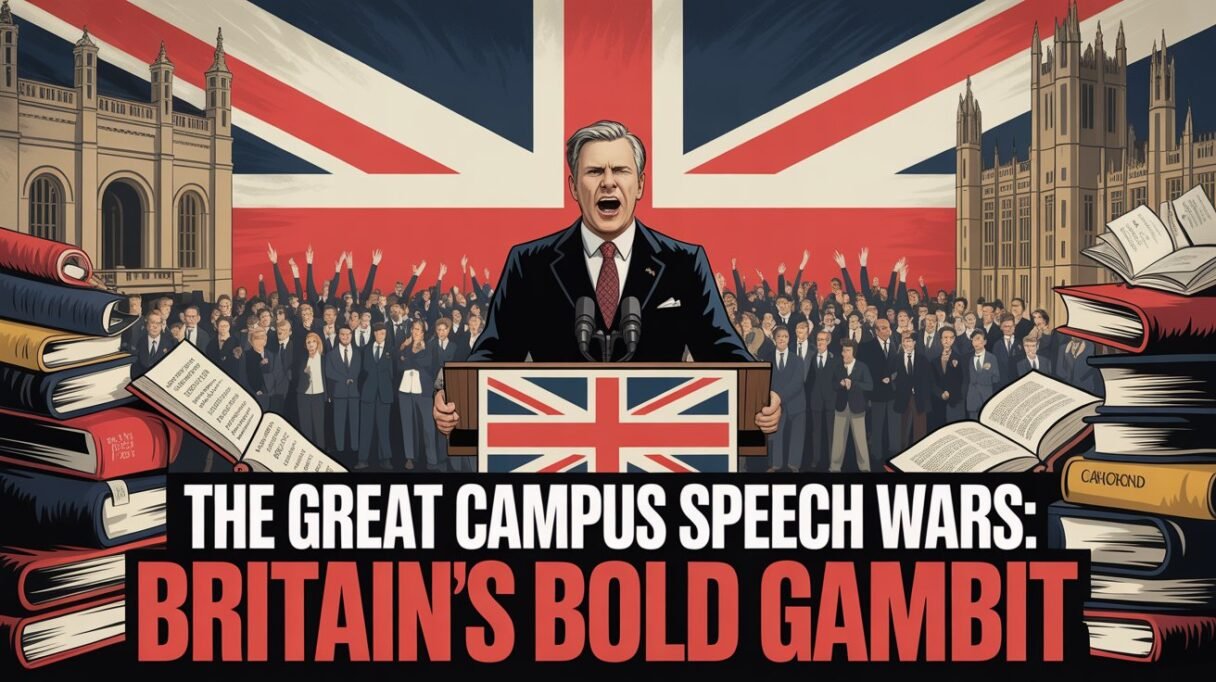
Or: How the government decided to legislate intellectual courage into existence
There’s something deliciously British about trying to solve a cultural problem with paperwork. This August, whilst most of us were still nursing sunburnt shoulders from that one good weekend we had in July, universities across the UK quietly implemented some of the toughest free speech rules in the world. Not content with simply asking nicely for more open debate, the government has basically said: “Right then, universities. You will promote academic freedom, or we’ll fine you into submission.”
It’s the Higher Education (Freedom of Speech) Act 2023, finally coming into force, and it represents either a bold stroke of genius or the most expensive way imaginable to miss the point entirely. I’m genuinely not sure which.
The Rules of Engagement
Let’s be clear about what we’re dealing with here. These aren’t gentle suggestions wrapped in academic politeness. Universities must now actively promote free speech and academic freedom. Not just tolerate it, promote it. Think of it as the difference between not kicking someone out of your party and actually inviting them to give a speech.
The Office for Students, our higher education regulator, now has proper teeth. They can issue fines. They can demand action plans. They can make life thoroughly unpleasant for any institution that fails to meet their standards of intellectual openness. Meanwhile, non-disclosure agreements, those convenient little silencers that have been used to hush up campus controversies, are now banned when it comes to matters of academic freedom.
It’s bureaucratic muscle with a progressive agenda, which is either wonderfully paradoxical or completely bonkers, depending on your perspective.
The Problem That Wouldn’t Go Away
The thing is, this legislation didn’t materialise from thin air. British campuses have spent the last decade tied in knots over what can and can’t be said. We’ve had lecturers investigated for showing historical images in art history classes. We’ve seen speakers disinvited because their presence might cause “harm.” We’ve watched as perfectly reasonable academic debates got shut down faster than a pub at closing time.
I remember chatting with a philosophy professor a couple of years ago who told me she’d stopped assigning certain texts, not because they weren’t academically valuable, but because the administrative hassle of defending them wasn’t worth it. “I’ve got research to do,” she said. “I can’t spend half my time explaining why reading Mill’s On Liberty isn’t a microaggression.”
That’s the crux of it, really. The problem isn’t necessarily that universities have become hotbeds of authoritarian censorship, though some certainly have. The problem is that the mere possibility of controversy has created a climate where intellectual risk-taking feels professionally suicidal.
The Sceptic’s Corner
But here’s where I start getting twitchy about this whole enterprise. Can you really legislate courage into existence? Can bureaucratic pressure create genuine intellectual boldness?
I suspect what we’re about to see is a masterclass in unintended consequences. Universities, faced with the prospect of fines, will likely do what they always do: create more committees, more policies, more procedures. We’ll get “Free Speech Officers” and “Academic Freedom Frameworks” and probably a mandatory training module called something like “Promoting Intellectual Diversity in the Modern Campus Environment.”
The danger is that we end up with performative free speech, universities ticking boxes to show they’re promoting open debate, whilst the actual culture remains as risk-averse as ever. It’s like trying to cure social anxiety with a strongly worded memo.
The Deeper Game
What’s really happening here, I think, is a fundamental misunderstanding of how intellectual culture actually works. Free speech isn’t something you can impose from above any more than you can mandate friendship or legislate love. It emerges from trust, from shared commitment to truth-seeking, from the kind of intellectual generosity that allows us to engage seriously with ideas we find uncomfortable.
The best academic conversations I’ve ever witnessed weren’t happening because someone had insisted they must happen. They were happening because the participants genuinely believed that engaging with challenging ideas was worthwhile, even when, especially when those ideas made them squirm.
The American Lesson
Look across the Atlantic, and you’ll see what happens when campus speech becomes primarily a legal and procedural matter. American universities have spent decades navigating First Amendment law, creating elaborate frameworks for when and how speech can be restricted. The result? Some of the most litigious, paranoid, and intellectually sterile campus environments in the democratic world.
I’m not saying the American approach is entirely wrong, but it’s worth noting that having clear legal protections for speech doesn’t automatically create vibrant intellectual communities. Sometimes it just creates more lawyers.
What Actually Matters
If we’re serious about restoring British campuses as “gritty, discussion-rich spaces”, and God, I love that phrase, then we need to think beyond legislation. We need academics who are willing to model intellectual courage. We need students who understand that being challenged isn’t the same as being attacked. We need administrators who see their role as supporting rather than managing intellectual risk-taking.
Most importantly, we need to remember that the goal isn’t free speech for its own sake. The goal is better thinking, deeper understanding, and more rigorous scholarship. Free speech is valuable because it serves those ends, not because it’s some abstract right that exists in isolation.
The Verdict (Such As It Is)
Will these new rules work? Honestly, I’m not holding my breath. Bureaucratic solutions to cultural problems have a pretty dismal track record. But I’m also not writing them off entirely. Sometimes external pressure can create space for internal change. Sometimes the threat of fines can concentrate institutional minds wonderfully.
What I am fairly certain of is this: if these rules succeed, it won’t be because they forced universities to promote free speech. It’ll be because they created conditions where academics and students felt safe enough to start taking intellectual risks again.
And if they fail? Well, at least we’ll have generated some excellent case studies for future researchers writing about the limits of legislative solutions to cultural problems. That’s got to be worth something.
The real test isn’t whether universities comply with these new rules, it’s whether anyone notices when they do. The best free speech cultures are the ones where intellectual freedom feels so natural that you hardly think about it. We’re a long way from that right now, but perhaps these clunky new regulations might just be the scaffolding we need to build something better.
Whether we actually will remains to be seen.
Until Next Time

Discover more from Dominus Owen Markham
Subscribe to get the latest posts sent to your email.