
(And What Might)
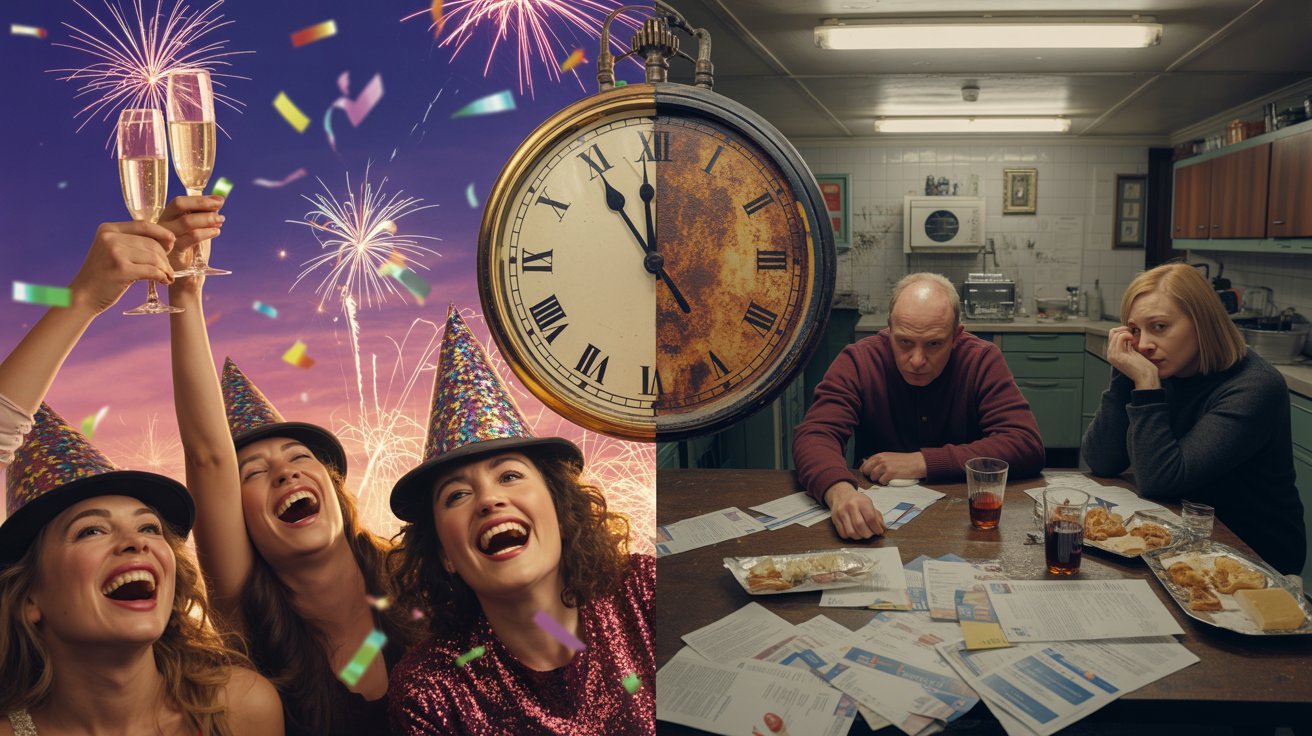
Christmas is coming. The goose is getting fat, as the song goes, though mostly it’s us getting fat on mince pies and existential dread. The fairy lights are up, the Mariah Carey industrial complex has activated for its annual pillaging of our sanity, and everywhere you look, people are already half-drunk on that most potent of seasonal cocktails: the promise of a fresh start.
New Year, New Me.
New Year, New Hope.
New Year, New… what, exactly?
Because here’s the thing nobody wants to say whilst clutching their third glass of prosecco at 11:47pm on December 31st: absolutely nothing changes when the clock strikes midnight. Not really. The debt doesn’t vanish. The government doesn’t suddenly become competent. Your boss doesn’t transform into a reasonable human being. The systems that govern your life, that dictate whether you can afford heating or whether your rent will go up again or whether the NHS will still exist in any meaningful form, those systems don’t give a toss about your calendar.
2026 arrives whether you’re ready or not. And it arrives with the same structural problems, the same rigged game, the same people in power who were there in 2025.
So what are we really celebrating?
The Annual Reset Button That Doesn’t Reset Anything
There’s something beautifully absurd about the collective delusion we engage in every January. We pretend that an arbitrary division of time, a cultural construct we all agreed to honour, somehow grants us magical powers of transformation. We’ll go to the gym. We’ll save money. We’ll be kinder, more patient, more disciplined.
And look, I’m not mocking genuine attempts at self-improvement. If you want to run a 5K or learn Spanish or finally read War and Peace, brilliant. Genuinely. But let’s not confuse personal lifestyle adjustments with meaningful change.
Because whilst you’re sweating on a treadmill in January (before giving up in February, statistically speaking), the people who actually run things are making decisions that will affect your life far more than whether you ate carbs after 6pm. They’re setting interest rates. They’re cutting public services. They’re awarding themselves pay rises whilst telling you there’s no money in the pot. They’re writing legislation that will make you poorer, less free, and more dependent on systems designed to extract value from you.
Your resolution to drink more water won’t change that.
Your vision board won’t legislate against it.
Your manifestation journal won’t redistribute wealth or hold power to account.
The Constraints We Don’t Talk About
Here’s what makes me properly cynical about the New Year’s Hope industry: it places all the burden of change on the individual whilst carefully ignoring the structural constraints that make individual change either difficult or entirely beside the point.
Can’t afford a house? Must be because you’re not working hard enough, not because an entire generation has been priced out of property ownership by a system that treats housing as an investment vehicle rather than a human right.
Struggling with mental health? Must be because you’re not doing enough yoga, not because living under late-stage capitalism whilst watching the planet burn and democracy crumble is inherently distressing.
Feel powerless about the state of the world? Must be because you’re not thinking positively enough, not because the levers of power are genuinely out of reach for most people.
The self-improvement narrative is comforting because it gives us something to control. If the problem is me, then the solution is also me. I can fix this. I can optimise myself. I can hustle harder, think better, be more resilient.
But what if the problem isn’t you?
What if the problem is a political and economic system designed to concentrate wealth and power in fewer and fewer hands whilst convincing everyone else that their struggles are personal failures rather than systemic features?
What if your inability to get ahead isn’t a character flaw but the intended outcome of policies deliberately crafted to benefit a tiny minority?
What changes in 2026 that addresses that?
The Question Nobody Wants to Answer
So we arrive at the uncomfortable bit. The bit where we stop pretending that buying organic vegetables or starting a meditation practice constitutes meaningful engagement with the forces that actually shape our lives.
What would real change look like?
And more importantly, are we willing to do what it takes?
Because here’s the truth that makes people deeply uncomfortable: real change requires action beyond the personal sphere. It requires collective organising. It requires speaking up even when it’s awkward. It requires making choices that might cost you something in the short term.
It requires you to be, in the eyes of the system, difficult.
And most people don’t want to be difficult. We’ve been trained, quite deliberately, to be compliant. To not make a fuss. To trust that the adults in the room know what they’re doing (they don’t). To believe that if we just work hard and follow the rules, things will work out (they won’t, not for most of us).
The system depends on your silence. It depends on your exhaustion. It depends on you believing that politics is something that happens somewhere else, to other people, and that your role is simply to cope with whatever decisions are made on your behalf.
So when I ask what changes in 2026, I’m really asking: will you?
What Individual Action Actually Looks Like
Now, before this becomes entirely bleak, let’s talk about what individuals can do. Because whilst I’m sceptical of self-help culture’s ability to address systemic problems, I’m not suggesting we’re all powerless.
But the actions that matter aren’t the ones sold to us in aspirational Instagram posts.
Speaking up matters. When someone says something cruel, bigoted, or just wrong at the dinner table, in the office, in the pub… do you challenge it, or do you let it slide because confrontation is awkward? Every time you let something slide, you’re voting for the world to stay exactly as it is.
Where you put your money matters. Not in some vague “vote with your wallet” sense, but in the boring, practical sense of: are you banking with institutions that fund fossil fuels? Are you investing your pension (if you’re lucky enough to have one) in companies whose practices you’d find abhorrent if you actually looked?
Your attention matters. What media are you consuming? Whose perspectives are you hearing? Are you trapped in an algorithmic bubble that confirms everything you already believe, or are you genuinely engaging with ideas that challenge you?
Your time matters. Are you part of anything? A union, a community group, a campaign, a collective? Or are you just… existing in isolation, consuming, working, sleeping, repeat?
Your vote matters. Yes, even when all the options seem terrible. Even when you feel disillusioned. Because the people who benefit from the current system are absolutely delighted when you disengage. Your apathy is their victory.
But here’s the thing about all of these: they’re uncomfortable. They require you to stick your head above the parapet. They require you to have awkward conversations, to sacrifice convenience, to spend time on things that don’t immediately benefit you.
They require you to live as though you believe your actions have consequences.
The Rebellion of Small Things
I keep thinking about this idea that real change comes from people refusing to play along with systems that harm them. Not in some grand, revolutionary sense (though I’m not opposed), but in the accumulation of small refusals.
Refusing to work yourself to death for a company that would replace you in a week.
Refusing to stay silent when you witness injustice.
Refusing to accept that “this is just how things are.”
Refusing to believe that you’re powerless.
These refusals don’t feel significant in the moment. They don’t come with fanfare or immediate reward. Often, they come with consequences. You might be thought of as difficult. As political. As someone who “makes everything about that.”
Good.
Because the people who want you quiet, compliant, and focused solely on your own tiny sphere of personal optimisation are the same people who benefit from things staying exactly as they are.
So What About 2026?
Will things change in 2026? Almost certainly not in any meaningful way unless enough people decide to stop participating in the delusion that we can self-improve our way out of systemic rot.
The economic system isn’t going to voluntarily become more equitable. Political power isn’t going to redistribute itself out of the goodness of its heart. The climate isn’t going to stop changing because we all bought reusable coffee cups.
Change happens when people organise. When they demand better. When they refuse to accept crumbs and call it progress. When they recognise that their individual struggles are connected to everyone else’s individual struggles, and that collective problems require collective solutions.
It happens when people stop asking permission to exist with dignity and start insisting on it.
It happens when enough people decide that being difficult is preferable to being complicit in their own diminishment.
The Real Resolution
So here’s my suggestion for your New Year’s resolution, if you must have one:
Stop pretending that personal optimisation is a substitute for political engagement.
Stop accepting that the way things are is the way things must be.
Stop waiting for someone else to fix the systems that are failing you.
And start asking yourself, genuinely: what am I willing to do differently? Not just in my own life, but in the world?
Because 2026 won’t save you. No year will.
But you, collectively, acting in concert with others who are also tired of this charade?
That might actually change something.
The champagne will still go flat. The resolutions will still fail. The debt will still exist, the systems will still grind on, and Mariah Carey will still be inescapable.
But if enough people decide to stop playing along with a game rigged against them, well…
That’s when things get interesting.
Happy New Year. Now do something about it.
Until Next Time


Discover more from Dominus Owen Markham
Subscribe to get the latest posts sent to your email.