
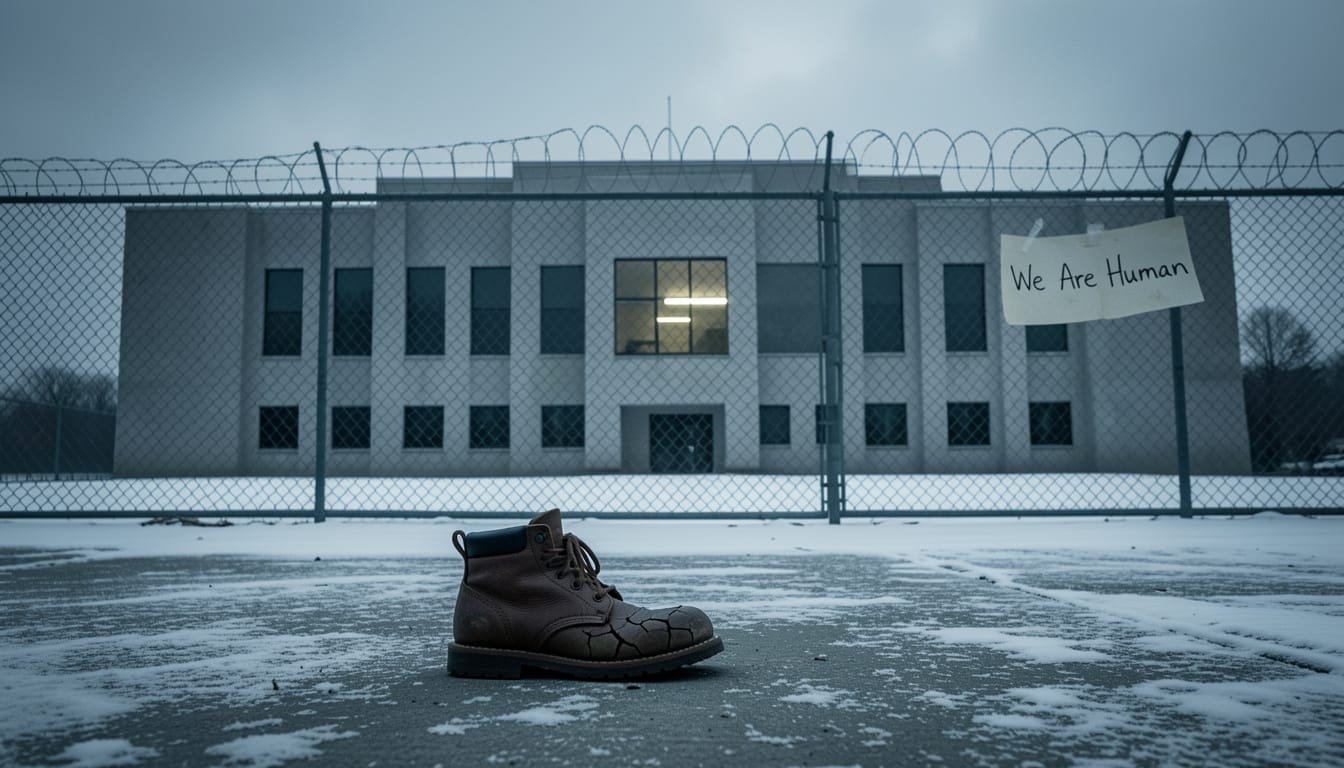
The Story America Is Barely Watching
There’s something quietly unsettling about watching a story of this magnitude get nudged off the front page. The current Iran situation has swallowed the oxygen in most newsrooms, and I understand why. War has a way of demanding your full attention. But I’ve been watching something else unfold across America over the past couple of months, something that I think deserves more than a footnote, and I can’t stay quiet about it any longer.
This is the ICE OUT story. And it’s a lot messier, more complex, and more human than any single headline is going to tell you.
A Red Carpet Becomes a Battleground
Let’s start at the Grammys, because that’s where it broke through into the mainstream consciousness most visibly.
On the 1st of February 2026, at the 68th Annual Grammy Awards in Los Angeles, something rather remarkable happened. Dozens of artists walked the red carpet wearing small pins that read “ICE OUT.” Not exactly Marlon Brando refusing his Oscar on behalf of Native Americans, but in the context of modern celebrity culture, where the biggest risk most stars take is posting an ambiguous Instagram caption, it was a statement.
More than thirty artists wore the pins. Billie Eilish. Carole King. Justin and Hailey Bieber, who reportedly don’t usually touch American politics with a bargepole. Joni Mitchell. The list went on. And then the speeches started, and things got considerably less polite.
Bad Bunny, on the night he made Grammy history by becoming the first Spanish-language album to win Album of the Year, opened his acceptance speech with something other than gratitude. “Before I say thanks to God, I’m gonna say: ICE out.” The crowd erupted. He continued: “We’re not savage. We’re not animals. We’re not aliens. We are humans, and we are Americans.”
Billie Eilish, accepting Song of the Year, said simply that “no one is illegal on stolen land,” before adding, in a bleeped expletive, her feelings about ICE directly. Kehlani managed multiple expletives. Olivia Dean, a British soul singer winning Best New Artist, spoke quietly about being the granddaughter of an immigrant. That one, honestly, hit differently.
Trump, watching from wherever Trump watches things he doesn’t like, took to Truth Social to call the Grammys “virtually unwatchable.” Which is, at this point, practically an endorsement.
Now… I’ll be honest with you. Part of me looked at the pins and the speeches and felt that particular British scepticism kick in. The kind that arrives whenever wealthy, famous people perform solidarity from a podium before being whisked away in black SUVs to their Bel Air compounds. A critic writing for the UCSD Guardian articulated it well, noting that the Grammys are, at their core, “an elitist showcase of wealth and power in the music industry,” and that a badge of protest worn against that backdrop risks becoming what they called a “shallow symbolic gesture.”
That’s a fair point. It’s a point worth sitting with.
But here’s the other fair point: the campaign that put those pins on those lapels reached an estimated 15 to 20 million television viewers in the United States in a single evening. The activist group Maremoto, a Latino advocacy organisation run by Jess Morales Rocketto, had spent weeks working with artists’ teams, navigating record labels, managers, corporate fashion partners, and the vanity economics of award-show dressing, just to get those small metal circles onto those specific bodies. Rocketto noted before the show that “these pins are about so much more than a red carpet moment,” and specifically chose the Grammys over Hollywood’s more polished events because, as she put it, musicians are “known for six-stage shows, crazy costumes, being kind of rebellious, punk rock.”
She was right. The Grammys gave a level of cultural reach that no traditional protest march could replicate. Grammy-related content generated roughly 2.3 million social media mentions per day during the peak of award season. Moments like Bad Bunny’s speech and Billie Eilish’s “stolen land” line trended across every platform simultaneously. And the story didn’t just live in entertainment media. It landed in CNN, in newspapers, in broadcast news segments that normally wouldn’t cover celebrity activism for more than thirty seconds.
Whether pins change policy is a separate and genuinely debated question. What they clearly did was make it briefly impossible to watch the biggest music night of the year without confronting a question: what, exactly, is happening with ICE?
Minnesota: Where It Gets Very Dark, Very Fast
The Grammys were the cultural moment. But the substance, the real, visceral reason those pins exist, is rooted in something far more serious.
Let me take you to Minnesota.
In December 2025, the Trump administration launched what they called Operation Metro Surge, deploying around 2,000 federal agents, including ICE and Border Patrol, into the Minneapolis-Saint Paul metropolitan area. It was, by the administration’s own description, the largest immigration enforcement operation ever carried out. The stated justification was a welfare fraud scandal that had been bubbling in Minnesota for some time, centred on a pandemic-era food programme called Feeding Our Future, through which dozens of people, the majority of them Somali, had been charged with falsely claiming to be providing meals to needy children. By late 2025, 37 defendants had pleaded guilty.
The scandal was real. Fraud of public money is real, and it matters. Anyone who tells you otherwise is being intellectually dishonest for political reasons, and I’ve got no time for that, regardless of which side of this they’re on.
But here is where things began to unravel with a particular, ugly messiness.
A YouTuber named Nick Shirley posted a video in which he wandered round several Minneapolis daycare centres on a weekday, found some of them empty, and implied widespread, ongoing fraud. JD Vance reposted it on social media, describing Shirley as doing more useful journalism than Pulitzer Prize winners. The White House picked up the energy. Federal child care funds to Minnesota were frozen, affecting roughly 19,000 children. State officials noted that investigators had visited all the centres featured in the video and found them operating normally. The investigations were ongoing, yes… but the funding freeze happened first, before evidence supported it.
Governor Tim Walz, facing political pressure he couldn’t survive, dropped his bid for re-election. The administration announced it would audit all of Minnesota’s Medicaid bills. More agents arrived.
And then people started dying.
On the 7th of January 2026, a 37-year-old American woman named Renée Good was fatally shot by an ICE agent named Jonathan Ross in Minneapolis. She was in her car. The sequence of events is disputed, as these things always are when official bodies are accountable only to themselves, but video footage captured by witnesses left many Americans unconvinced by the official account that the agent acted in self-defence. On the 24th of January, another Minnesotan, Alex Pretti, a 37-year-old nurse, was shot and killed by federal agents. Governor Walz called it “a campaign of organised brutality against the people of our state.”
A Republican candidate for governor, a man named Chris Madel, withdrew from the race shortly after, saying he could not “support the national Republicans’ stated retribution on the citizens of our state,” and adding: “I have to look my daughters in the eye and tell them, ‘I believe I did what was right.'” That’s not nothing. That’s a man in a party that was supposed to be celebrating this moment, walking away from it in public.
It’s also worth noting what the operation actually produced. Of roughly 2,000 arrests, ICE reported that about 103, or around 5 percent, had records of violent crimes. A review of the arrest list showed that several individuals listed hadn’t actually been detained during the operation at all, but had been transferred from state custody before it even began. One transfer dated to 2003. The lead federal prosecutor on the Feeding Our Future fraud case, along with five colleagues, resigned in the wake of the ICE surge. The Minnesota House Democratic leader noted, with some bitterness, that this “crippled our fraud response.” The anti-fraud operation, in other words, made pursuing fraud considerably harder.
There were reports of ICE agents detaining restaurant workers, airport employees, Target staff, children, families, Native Americans, students, and commuters. Some of those detained were US citizens. Some were legal residents with work authorisation. Some were asylum seekers. There were lawsuits filed for wrongful detention. Journalists were arrested covering protests. Federal agents reportedly used tear gas, pepper spray, chemical irritants, flashbangs, and long-range acoustic devices against people who turned up to observe or protest.
Hundreds of businesses across Minnesota closed in solidarity with residents on the day of the statewide protests on the 23rd of January. Organizers estimated tens of thousands attended demonstrations in subzero temperatures. A subsequent poll suggested roughly one in four Minnesota voters either participated themselves or had a close family member who did.
The Tax Revolt Side of the Coin
Here’s where it gets politically interesting, and I want to be fair about this, because easy narratives are for people who’ve stopped thinking.
While all of this was happening, there was a parallel energy on the conservative side of the country, specifically around fraud, around government spending, and around who exactly American tax money is going to.
In late December 2025, Congresswoman Marjorie Taylor Greene wrote on X that “almost every Trump voter I see on X is so fed up they are planning a 2026 tax revolt.” She linked the frustration explicitly to what she framed as tax dollars “consistently given to foreign countries, foreign wars, and foreigners the U.S. government has brought/allowed into America.” Conservative activists scheduled tax strike rallies in multiple states for early January 2026. The sentiment spread quickly in MAGA-aligned social media spaces.
Now, I think Marjorie Taylor Greene is, to deploy a phrase I rarely get to use in polite company, a political performance artist with the policy depth of a decorative pond. But… I’d be a fool to dismiss the underlying frustration that she’s channelling, even when I think she’s channelling it into a dead end.
There are Americans who are genuinely struggling. Who work hard, pay taxes, and feel that those taxes disappear into a machine that serves everyone but them. That frustration is real. The problem is when that legitimate frustration gets pointed at immigrants, or at Somali daycare centres, rather than at the structural economic conditions and political failures that actually created the squeeze. It’s an old trick, and it works reliably because it provides a face, a community, a visible “them” to absorb the anger that might otherwise be directed at policy and power.
The Feeding Our Future fraud was real. The individuals convicted should face consequences. But deploying 2,000 agents, freezing 19,000 children’s childcare funding, killing two American citizens, and arresting journalists… in pursuit of a fraud that predates most of those affected by the operation… that’s not justice. That’s something else dressed up in the language of justice.
What This Is Actually About
The “Abolish ICE” conversation is not new. It surfaced in 2018 during the family separation scandal. It faded. It returned. The difference in 2026 is that it’s no longer fringe.
A January 2026 poll by The Economist and YouGov, taken shortly after Renée Good’s killing, found that 46 percent of Americans supported abolishing ICE, while 43 percent opposed. Compare that to August 2024, when support for abolishing the agency sat at just 20 percent. That is an extraordinary shift in an extraordinarily short period.
The “ICE OUT” movement isn’t simply asking for the agency to disappear into nothing. Critics and policy thinkers point out that US Customs and Border Protection, not ICE, is actually responsible for border enforcement. ICE’s primary domestic role is enforcement and removal operations. The conversation, when it’s had seriously rather than by people shouting at each other across social media, is about what a humane, accountable immigration enforcement system actually looks like, and whether the current agency, in its current form, under its current mandate, is capable of being that.
It’s a fair question. It’s the kind of question that should be asked without the answer being predetermined by which team you support.
What I find myself returning to, standing here as a British observer with a deep and complicated relationship with my own country’s immigration politics, is this: the debate in America right now isn’t really about fraud. It isn’t really about open borders versus closed borders. It’s about whether human beings are legible as human beings at all within the machinery of the state, or whether certain people become, as Bad Bunny put it from a Grammy stage that would have seemed an absurd venue for this kind of statement, “savage,” “animals,” “aliens.”
He said: “We are humans, and we are Americans.”
That’s not a radical statement. It shouldn’t be a radical statement. The fact that it landed with the force of rebellion in that room, and sparked fury from a president watching at home, tells you everything about where the needle has been moved to.
The Iran Shadow
I said at the outset that this story is being overshadowed by the conflict with Iran. And I want to acknowledge something about that, too.
We are not good at holding multiple serious things in our attention simultaneously. As news consumers, as citizens, as human beings processing information in a fragmented and overwhelming media environment. The Iran situation is grave. Real. Deserving of serious attention and serious journalism.
But the stories aren’t disconnected. The impulse to define who is American enough to deserve protection, the machinery of enforcement deployed against communities that have been rhetorically positioned as threats, the question of what a state owes its people and what it is permitted to take from them in the name of security… these things live in the same philosophical neighbourhood. They draw from the same well of questions about power, legitimacy, and the bodies that get sacrificed when governments make decisions at speed, in anger, for politics.
Renée Good was 37. Alex Pretti was 37. Both Americans. Both gone now, their names on protest signs and court documents and a Wikipedia page that will outlast all of us.
A five-year-old named Liam Conejo Ramos was detained along with his father. A judge eventually ordered their release. His age was reported, repeatedly, in every major news outlet. Five years old.
These are the details that don’t fit neatly into a debate about immigration policy. Which is, I suspect, exactly why they keep getting mentioned by the people on one side and explained away by the people on the other.
Where This Leaves Us
I’m not going to tell you what to think about immigration. That would be arrogant, and the specifics of US immigration law, enforcement history, and constitutional debate are genuinely complicated in ways that deserve more than a neat editorial conclusion.
What I will tell you is that a Grammy red carpet became a political front line because people felt there was nowhere else left to look. That tens of thousands of people stood in subzero Minneapolis temperatures because they had no other way to say “stop.” That a Republican man running for governor walked away from his party’s most visible moment because he couldn’t stomach what it meant in practice.
And that all of this is happening right now, in the same country that is also watching Iran, watching markets, watching everything else… and maybe, just maybe, not watching this quite closely enough.
The pins said ICE OUT. Whether you agree with that position or not, the conditions that put those pins on those lapels are conditions that deserve your eyes.
Because the question underneath all of it, the one that never really goes away, is the one Bad Bunny asked from a stage draped in gold and surrounded by the music industry’s most powerful people, in a room that had no idea it was about to become a symbol of something much larger than music:
What, exactly, does it mean to be human in the eyes of the state?
And who decides.
Dominus Owen Markham writes on culture, politics, and the gap between how things are and how we’d prefer to believe they are. He is British by birth, cynical by experience, and still occasionally surprised.
Until Next Time

Discover more from Dominus Owen Markham
Subscribe to get the latest posts sent to your email.