
By Dominus Owen Markham
Most people assume wars arrive loudly.
They imagine the moment as something obvious and dramatic… a declaration, a broadcast interruption, a headline so large it seems to swallow the rest of the news cycle. But the truth is rather less theatrical. Wars often reach ordinary life quietly, slipping into the background of everyday routines long before anyone consciously registers what is happening.
How Global Conflicts Quietly Enter Everyday Economies
One of the first places they appear is not on a battlefield at all, but in the small calculations people make at home. A glance at the petrol pump. A raised eyebrow at the energy bill. A quick mental adjustment while standing in the supermarket aisle. Somewhere in that moment, a decision forms almost unconsciously… perhaps we skip the restaurant this week, perhaps the weekend trip can wait.
And that is how distant geopolitical tensions begin their slow migration into the European economy.
When analysts talk about conflicts in the Middle East or elsewhere, the immediate focus tends to fall on military strategy and diplomatic manoeuvres. Yet beneath those conversations lies a far more predictable chain reaction. Energy markets react first. Oil prices shift, sometimes sharply. Transport costs follow. Supply chains absorb the shock and pass it forward. Within weeks the effects start appearing in household budgets across Europe.
Why Europe’s Service Sector Feels the Shock First
It is here that the service sector begins to feel the pressure.
Restaurants, cafés, small hotels, tourism operators and local retailers all rely heavily on discretionary spending. They are not sustained by necessity but by comfort… by the willingness of people to treat themselves, to meet friends, to travel, to step briefly outside the routine of daily life. The moment that comfort begins to wobble, spending changes almost immediately. No announcement is required; millions of individual choices quietly adjust the economic landscape.
For those who work in hospitality, the pattern is familiar. The pandemic years provided a harsh lesson in just how fragile the service economy can be. Tables that once filled effortlessly suddenly sat empty. The rhythm of city life stalled. Staff who had built careers in restaurants, bars and hotels found themselves wondering whether the industry they loved would recover at all.
The situation today is different, but the echo is difficult to ignore.
COVID closed the service economy through force. Governments imposed restrictions, travel halted, and entire industries paused overnight. What we may be witnessing now is subtler but potentially just as consequential: a gradual erosion of confidence. No lockdowns, no regulations… simply millions of households tightening their spending in response to uncertainty, rising energy costs and the uneasy sense that global events are once again pushing prices upward.
The Lesson from the 1970s Oil Crisis
History offers an instructive comparison. During the oil crises of the 1970s, Western economies experienced a similar chain reaction when geopolitical tensions disrupted energy supply. The sudden surge in oil prices triggered inflation across Europe and North America. Fuel costs rose sharply, transport became more expensive, and household budgets were squeezed in ways that felt unfamiliar to a generation that had grown accustomed to steady growth.
Governments spoke about macroeconomics and global markets, but the experience for ordinary people was far simpler. Daily life became more expensive, and discretionary spending shrank. The hospitality industry felt it almost immediately. Restaurants saw fewer customers. Travel slowed. Leisure spending tightened as households prioritised essentials. The phenomenon even acquired its own economic vocabulary at the time… stagflation… a stubborn mix of rising prices and sluggish growth that left policymakers struggling to respond.
Looking back now, the similarities are striking. Energy remains the first domino in moments of geopolitical disruption, and service-based economies remain particularly sensitive to the ripple effects.
The Quiet Silence
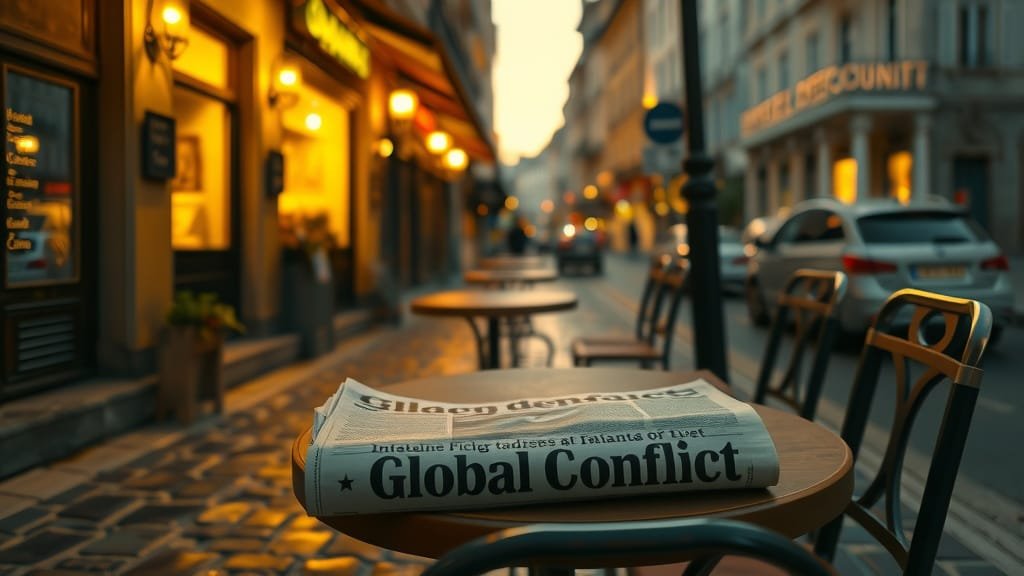
There is a particular kind of silence that appears when economies begin to tighten. It is not dramatic, and it rarely announces itself loudly enough to become news. Instead, it settles slowly over everyday life. The café still opens in the morning. The lights still glow in restaurant windows. The hotel reception desk remains staffed. Yet something subtle has shifted. Conversations are shorter, bookings arrive more cautiously, and the steady hum of customers that once filled the room begins to thin.
In modern conflicts, the distance between battlefield and breakfast table is far shorter than most people realise. Wars today rarely arrive with sirens or declarations. Instead they travel through the quieter mechanisms of everyday life… energy markets, supply chains, rising prices and the small financial decisions made by millions of households. By the time the consequences become visible, they are already sitting in places no strategist ever planned for: the local café with half its tables empty, the hotel struggling to fill a weekend, the restaurant quietly cutting staff hours.
This is how distant instability reveals itself in ordinary places. Not through spectacle, but through absence. A missing reservation here, a cancelled trip there, a Friday evening that feels strangely subdued compared with a year ago. None of these moments appear significant on their own, yet together they form the early signals of an economy adjusting to pressures most people never voted for and cannot control.
Europe today is deeply shaped by its service sector. Tourism, hospitality and urban leisure are woven into the economic and cultural fabric of European cities. Walk through almost any historic centre and the pattern reveals itself immediately: cafés spilling onto pavements, small restaurants tucked into narrow streets, boutique hotels occupying centuries-old buildings. These places do more than generate revenue. They create atmosphere, identity and community.
Yet they are also extraordinarily vulnerable.
A factory can continue operating even during periods of economic uncertainty. A café, by contrast, depends on the steady presence of customers choosing to sit down, order something, and linger a while. When confidence falters, the absence becomes visible almost immediately. The tables remain, the chairs remain, the lights remain… but the quiet space between them begins to grow.
The irony of modern geopolitical instability is that the people who carry much of the economic burden are rarely those shaping the events themselves. Decisions made in distant political arenas ripple outward until they arrive in the most ordinary professions. The waiter notices fewer bookings. The taxi driver sees shorter queues outside restaurants. The hotel receptionist observes that weekends are not filling as quickly as they once did.
These changes rarely make headlines. They accumulate slowly, almost invisibly, until the effects become unmistakable.
It is easy in moments like this to become cynical about leadership. Contemporary politics often appears preoccupied with performance… announcements, press conferences and carefully choreographed statements designed for the evening news. Meanwhile, the structural vulnerabilities of modern economies remain largely untouched. Energy dependence persists, supply chains remain exposed, and service-heavy local economies continue to absorb shocks generated far beyond their control.
Yet amid these large forces, there remains something quietly powerful within the control of ordinary people.
During the pandemic, many communities rediscovered the importance of supporting local businesses. It was not simply a sentimental gesture. Small cafés, independent restaurants and neighbourhood services operate on margins far thinner than most customers realise. A handful of additional tables filled each evening can determine whether staff remain employed and whether doors remain open.
Choosing where to spend money becomes, in its own modest way, a civic act.
A meal in a local restaurant circulates through the community. Wages are paid, suppliers are supported, rent is covered, and a small corner of economic life continues functioning. These choices do not solve geopolitical crises, but they do strengthen the fragile networks that make towns and cities feel alive.
Wars, after all, do not always arrive as history books describe them. Sometimes they seep gradually into everyday life, carried on the back of rising prices and uncertain futures. They alter behaviour long before they alter borders.
Which is why the true impact of distant conflicts is often measured not in strategic briefings or political speeches, but in quieter places… the local café that notices fewer regulars, the restaurant where a once-busy evening feels strangely subdued.
Long before wars are recorded by historians, they tend to appear first in the places where the tables used to be full.
In modern conflicts, the distance between battlefield and breakfast table is far shorter than most people realise. Wars today rarely arrive with sirens or declarations. Instead they travel through the quieter mechanisms of everyday life… energy markets, supply chains, rising prices and the small financial decisions made by millions of households. By the time the consequences become obvious, they are already sitting in places no strategist ever planned for: the local café with half its tables empty, the hotel struggling to fill a weekend, the restaurant quietly cutting staff hours. The first casualties of distant wars are often not soldiers at all, but the fragile economies of ordinary streets.
During the pandemic, many communities rediscovered the importance of supporting local businesses. It was not simply a sentimental gesture. Small cafés, independent restaurants and neighbourhood services operate on margins far thinner than most customers realise. A handful of additional tables filled each evening can determine whether staff remain employed and whether doors remain open.
Choosing where to spend money becomes, in its own modest way, a civic act.
A meal in a local restaurant circulates through the community. Wages are paid, suppliers are supported, rent is covered, and a small corner of economic life continues functioning. These choices do not solve geopolitical crises, but they do strengthen the fragile networks that make towns and cities feel alive.
The uncomfortable truth, of course, is that the wider conditions shaping these moments rarely emerge by accident. Energy dependency, fragile supply chains and economies overly reliant on consumer confidence are not acts of nature. They are the accumulated result of political choices made over decades… choices often presented as progress at the time, but rarely stress-tested against the realities of global instability.
When the world becomes uncertain, the weaknesses in those choices begin to show.
Yet history also reminds us that societies are not simply passengers drifting through events. Communities have always found ways to support themselves even when national leadership appears distracted or ineffective. Local economies survive not through speeches or press conferences, but through the everyday decisions of ordinary people who understand that a town, a neighbourhood, even a single street is held together by more than economics alone.
Wars, after all, do not always arrive as history books describe them. Sometimes they seep gradually into daily life, carried on the back of rising prices and uncertain futures. They alter behaviour long before they alter borders.
Which is why the true impact of distant conflicts is often measured not in strategic briefings or political speeches, but in quieter places… the local café that notices fewer regulars, the restaurant where a once-busy evening feels strangely subdued.
And perhaps that is where resilience must begin as well.
Long before wars are recorded by historians, they tend to appear first in the quiet spaces where the tables used to be full.
Until Next Time


Discover more from Dominus Owen Markham
Subscribe to get the latest posts sent to your email.