
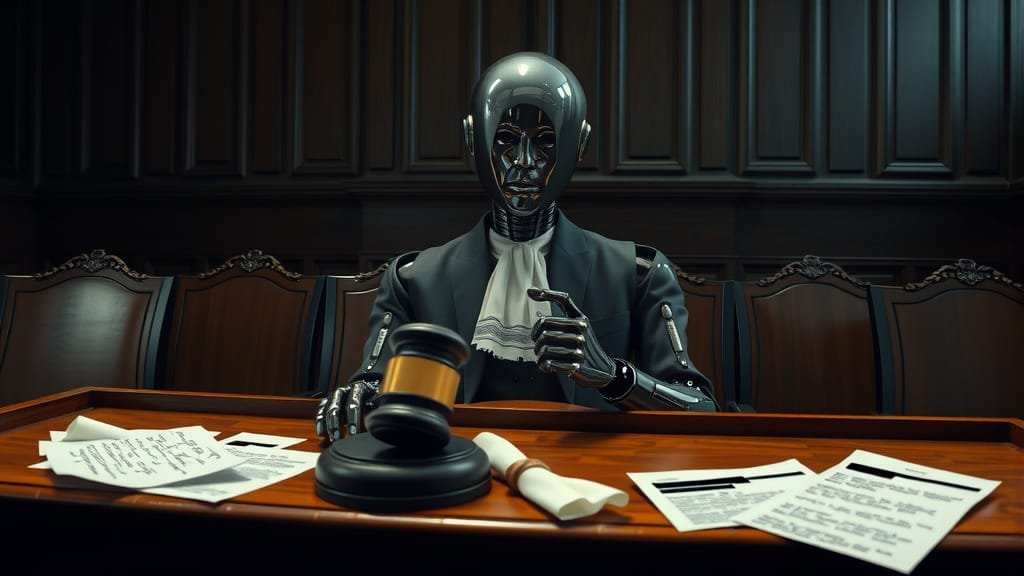
There’s an overriding sense of powerlessness that comes with being censored by a machine.
A human censor, at least, you can argue with. You can appeal to their reason, their sense of fairness, maybe even their sense of humour. But an algorithm? An algorithm doesn’t care. It doesn’t understand context. It can’t detect irony. It just runs its pattern-matching subroutines and decides, in a fraction of a second, whether your words are acceptable or not.
And here’s the thing nobody’s quite saying out loud yet: we’ve handed the keys to public discourse over to systems we don’t understand, built by people we didn’t elect, enforcing rules we never agreed to.
Welcome to the age of AI-driven content moderation, where freedom of speech meets its strangest, most bureaucratic death yet.
The Algorithm Doesn’t Get the Joke
Let me give you an example, because this stuff only makes sense when it’s real.
A few years back, Facebook’s AI flagged and removed a post from a cancer research charity. The post? Educational content about breast cancer awareness. The reason? The algorithm detected nudity. Specifically, it detected an illustration of breast anatomy in a medical context and decided it violated community standards.
No human reviewed it beforehand. No human understood that “breast” in a medical diagram isn’t the same as “breast” in a lads’ mag. The machine just saw a pattern it had been trained to identify as problematic and hit delete.
Now multiply that by millions. Satire flagged as misinformation. Holocaust education posts removed for hate speech. Mental health support groups shut down for discussing self-harm. Medical advice censored because it mentions a pharmaceutical that’s also used recreationally.
The machines are very, very good at spotting patterns. They’re spectacularly bad at understanding meaning.
And yet, this is what we’ve chosen. Or rather, this is what’s been chosen for us.
The Regulators Who Don’t Understand the Internet
Here’s where it gets properly absurd.
Governments, understandably concerned about the spread of misinformation, terrorism, child abuse imagery, and all manner of genuine harms online, have decided to Do Something. The EU’s Digital Services Act. The UK’s Online Safety Bill. Similar legislation popping up across the democratic world.
Noble intentions, mostly. But here’s the problem: these laws are being written by people who fundamentally don’t understand how the internet works.
I don’t mean that as a cheap shot. I mean it literally. Watch any parliamentary hearing on tech regulation and you’ll see MPs asking whether they can “delete the internet” orconfusing websites with apps. These are the people drafting laws that will govern how billions of people communicate.
And what do these laws typically demand? That platforms take down “harmful content” quickly. That they be proactive in identifying and removing problematic material. That they err on the side of caution.
Now, if you’re a platform with three billion users, how do you comply with that? You can’t hire three billion human moderators. So you train an AI to do it. You feed it examples of what’s bad and what’s good, you optimise it to minimise risk, and you let it loose.
The result? An automated system designed not to be accurate, but to be defensible. Better to remove a thousand legitimate posts than let one genuinely harmful one slip through and face regulatory penalties.
The regulations, written by people who don’t understand the technology, are enforced by technology that doesn’t understand humans.
It’s like asking a colour-blind person to paint by numbers, then being surprised when they get it wrong.
The Accountability Black Hole
And here’s the really clever bit, from the platforms’ perspective: nobody’s responsible anymore.
When your post gets removed, your account suspended, your reach mysteriously throttled, there’s nobody to blame. It was the algorithm. Sorry. Must have been a false positive. We’re working on it. Thanks for your patience.
The platforms get to offshore all accountability to “the AI” while governments get to say they’re taking online harms seriously. It’s a perfect symbiosis of buck-passing.
Meanwhile, you… the person whose words just vanished into the digital ether… you don’t get an explanation. You don’t get a human review (or if you do, it takes weeks). You don’t get to understand what rule you broke, because often there isn’t a rule, there’s just a probability score that fell on the wrong side of a threshold.
Try appealing that. I dare you.
I’ve seen people locked out of their Instagram accounts for posting historical war photographs. YouTubers demonetised for discussing current events because the AI couldn’t distinguish between reporting violence and promoting it. Writers on Medium having essays about censorship… censored.
The irony would be funny if it wasn’t so Kafkaesque.
The Datasets We’re Not Allowed to See
Let’s talk about how these systems learn, because this is where it gets genuinely dystopian.
AI content moderation tools are trained on massive datasets. Examples of hate speech, misinformation, violent content, sexual content, and so on. The machines learn to recognise patterns in language, image, and context that correlate with these categories.
But here’s the question nobody’s asking: who decided what went into those datasets?
Because whoever curated that training data… whoever decided which posts were “hate speech” and which were “legitimate criticism,” which images were “harmful” and which were “educational”… those people’s biases are now baked into the system. Forever. At scale.
And you don’t get to see that dataset. It’s proprietary. Trade secret. Commercially sensitive.
So you’re being judged by a standard you can’t examine, applied by a system you can’t audit, based on training data you’re not allowed to see.
If a human judge operated like this, we’d call it tyranny. When an algorithm does it, we call it “trust and safety.”
Context is Dead, Long Live the Pattern
The fundamental problem with AI moderation is this: language is context-dependent, but pattern-matching isn’t.
The word “queer” could be a slur or an identity, depending on who’s saying it and why. A photo of a starving child could be journalism or exploitation, depending on intent and framing. A discussion of suicide could be harmful or life-saving, depending on tone and purpose.
Humans can navigate this. We understand subtext, we read between the lines, we get sarcasm. Machines don’t.
So what happens? The machines do what they’re designed to do: they optimise for certainty. They look for clear, unambiguous signals. And in doing so, they flatten all nuance.
The result is a sort of enforced blandness. A smoothing out of sharp edges. Because if you write with any complexity, any irony, any cultural reference that might be misread… you risk tripping the algorithm.
And slowly, subtly, people learn to self-censor. Not because a government’s forcing them to, but because they know the robot’s watching.
The People Who Actually Suffer
And let’s be clear about who this hurts most.
It’s not the extremists. They’ve already moved to platforms that don’t moderate. They’ve learned the workarounds, the coded language, the visual dogwhistles that slip past the AI.
No, the people getting caught in this net are the ordinary ones. The sex educators flagged for pornography. The domestic abuse survivors whose support groups get shut down for discussing violence. The historians whose archival photos violate content policies. The comedians whose satire gets mistaken for the thing it’s satirising.
It’s the people operating in good faith, trying to communicate clearly, who find themselves suddenly invisible.
And here’s the cruel irony: the AI’s bias towards safety makes the platforms less safe for the people who need them most.
Because when you can’t discuss abuse, you can’t escape it. When you can’t share medical information, you can’t get help. When you can’t name the thing that’s hurting you, you can’t heal from it.
So What Now?
I don’t have a tidy answer to this. I wish I did.
The harms are real. Nobody wants a completely unmoderated internet… we’ve seen what that looks like, and it’s grim. Child abuse imagery, terrorist recruitment, targeted harassment… these things exist, and they’re genuinely awful.
But the solution we’ve stumbled into, this bizarre hybrid of incompetent regulation and opaque automation, isn’t working either.
What I do know is this: we need to stop pretending that algorithms are neutral arbiters of truth and safety. They’re not. They’re tools, built by humans, reflecting human choices and human biases, and we should be able to interrogate those choices the same way we interrogate any other form of power.
That means transparency about how these systems work. Meaningful appeals processes. Human review for edge cases. And a willingness to admit that maybe, just maybe, we can’t automate our way out of every difficult decision about what should and shouldn’t be said.
Because right now, we’re living in a world where a machine can decide you’ve broken a rule you didn’t know existed, for reasons it can’t explain, with consequences you can’t appeal.
And if that doesn’t bother you, it probably should.
The robots aren’t coming for your freedom of speech. They’re already here. And they don’t even know what freedom means.
Until Next Time


Discover more from Dominus Owen Markham
Subscribe to get the latest posts sent to your email.