
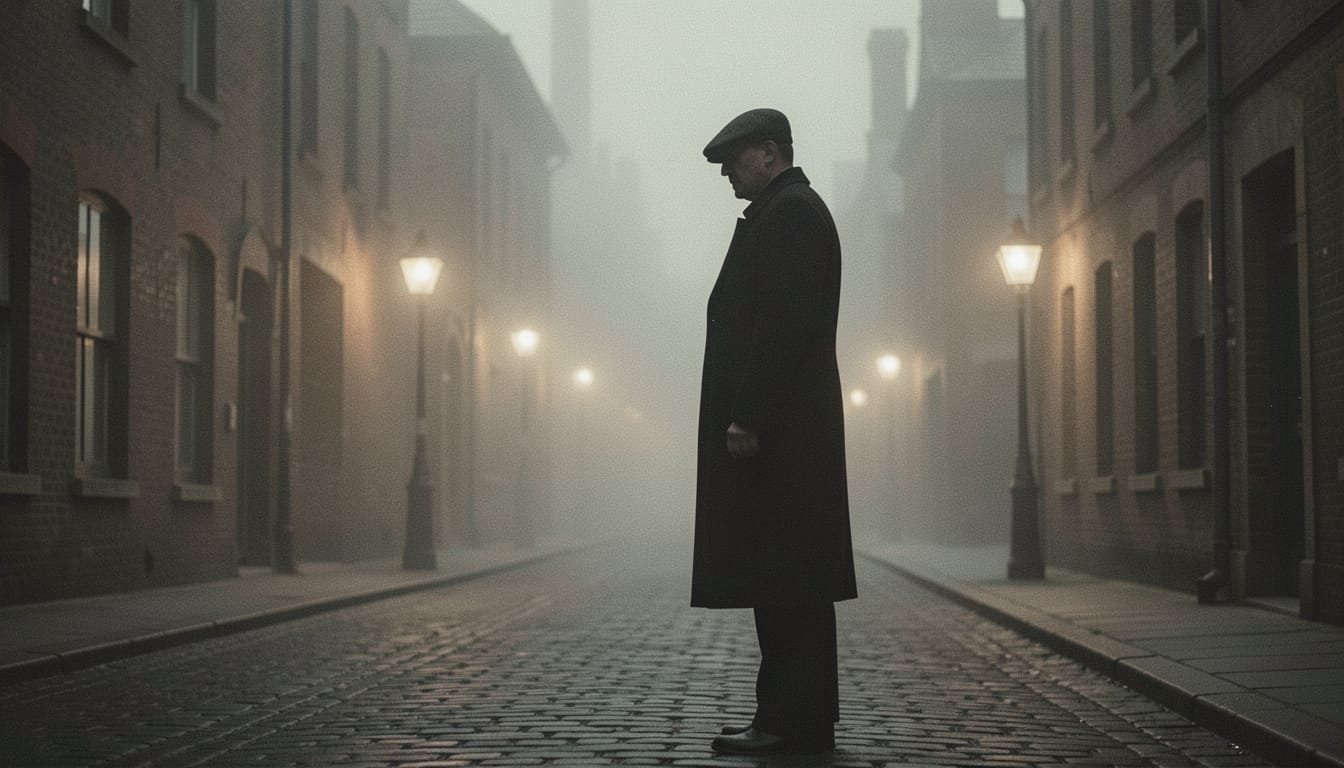
Editor’s note: This piece listens for the moment power moves indoors, where it becomes quieter, cleaner, and harder to see.
There’s a moment when fiction stops being a story and starts behaving more like a message.
Not a moral lesson. Not a lecture. More like a quiet knock on the inside of your skull.
Peaky Blinders did that for me.
On the surface, it’s familiar territory. Post-war grit. Men coming home hollowed out by conflict. Power vacuums. Crime as a substitute for broken systems. We’ve seen this shape before. We’re comfortable with it. That’s important.
Because comfort is how ideas slip past the guard dog.
What struck me, watching it not as drama but as signal, is how clearly it marks a turning point. Not just for its characters, but for society itself. A moment where power begins to professionalise. Where violence becomes administrative. Where chaos is no longer wild, but managed.
The Blinders aren’t the end of an era. They’re the beginning of a new one.
The Birth of Managed Power
Before men like Tommy Shelby, power was loud and clumsy. Kings, generals, factory owners. You knew where it sat because it sat visibly on top of you.
Peaky Blinders shows the transition. Power slipping off the throne and into the back room.
The show isn’t really about crime. Crime is just the delivery mechanism. What it’s actually obsessed with is organisation. Systems. Leverage. Information. Favour trading. The slow replacement of brute force with structure.
Tommy’s real talent isn’t violence… it’s pattern recognition.
He understands that control doesn’t come from being the strongest man in the room. It comes from being the one who knows how the room works. Who owes whom. Who fears exposure. Who needs plausible deniability.
This is the pivot point. When society stops being ruled by fists and starts being ruled by ledgers.
And once you see it, you can’t unsee it.
War Didn’t End… It Went Indoors
One of the cleverest things the show does is never letting the war truly end.
The guns might be lowered, but the mindset continues.
The trauma doesn’t disappear. It gets repurposed.
What Peaky Blinders quietly suggests is that modern systems are built by people who have learned to live permanently switched on. Permanently scanning. Permanently prepared to act. War taught them how to detach emotion from decision making.
That’s not villainy. It’s efficiency.
And efficiency, once normalised, becomes policy.
This is where the show starts to feel less historical and more prophetic. Because what it’s really charting is the psychological foundation of controlled societies. The acceptance that human cost is just another variable. That order matters more than fairness. That stability is worth almost any price… especially when someone else is paying it.
The Seduction of Order
Here’s the uncomfortable part.
The world does become safer under structured control.
Streets get quieter. Chaos retreats. Randomness is reduced. And most people, most of the time, welcome that trade.
Peaky Blinders understands this deeply. That’s why Tommy is compelling. He’s not a madman. He’s not even cruel by intention. He believes he’s bringing order to disorder. Predictability to violence. Rules to madness.
And in many ways, he’s right.
That’s the danger.
Because control doesn’t arrive wearing a villain’s mask. It arrives wearing competence.
The show captures that inflection point where society begins to prefer managed oppression to unmanaged freedom. Where the question quietly shifts from “Is this right?” to “Does this work?”
Once that shift happens, there’s no clean way back.
From Back Alley to Boardroom
Strip away the accents, the razors, the smoke… and what you’re left with is a blueprint.
Modern corporations. Political machines. Data systems. Surveillance economies.
Different tools. Same logic.
The Peaky Blinders are a prototype. A transitional species. They still use violence, but they’re already thinking in abstractions. Territory. Influence. Optics. Narrative control.
By the end, the street gang is almost incidental. What matters is access. Legitimacy. Proximity to institutions.
That’s the real arc.
Power doesn’t disappear as societies modernise. It just becomes less visible. Less personal. More defensible. Harder to challenge because it no longer looks like domination… it looks like administration.
Why This Still Matters Now
This is why Peaky Blinders lands differently when watched with adult eyes, in a managed world.
We live downstream from that turning point.
We inhabit systems built by people who learned, long ago, that control works best when it feels inevitable. When resistance seems impractical. When alternatives look chaotic by comparison.
The show isn’t saying this is good or evil. It’s saying this is how it happened.
And maybe that’s the real value of fiction like this. Not to entertain us, but to remind us that systems were chosen. Designed. Built by people with specific beliefs about order, power, and sacrifice.
Which means… they can be questioned.
A Quiet Signal, Not a Rallying Cry
Peaky Blinders isn’t a call to rebellion. It’s subtler than that.
It’s a reminder to pay attention to moments of transition. To notice when “keeping things running” quietly replaces “doing what’s right.” To recognise how easily competence can become control if left unexamined.
It doesn’t shout.
It mutters.
And for anyone listening closely, that mutter sounds an awful lot like a warning.
Until Next Time

Discover more from Dominus Owen Markham
Subscribe to get the latest posts sent to your email.