
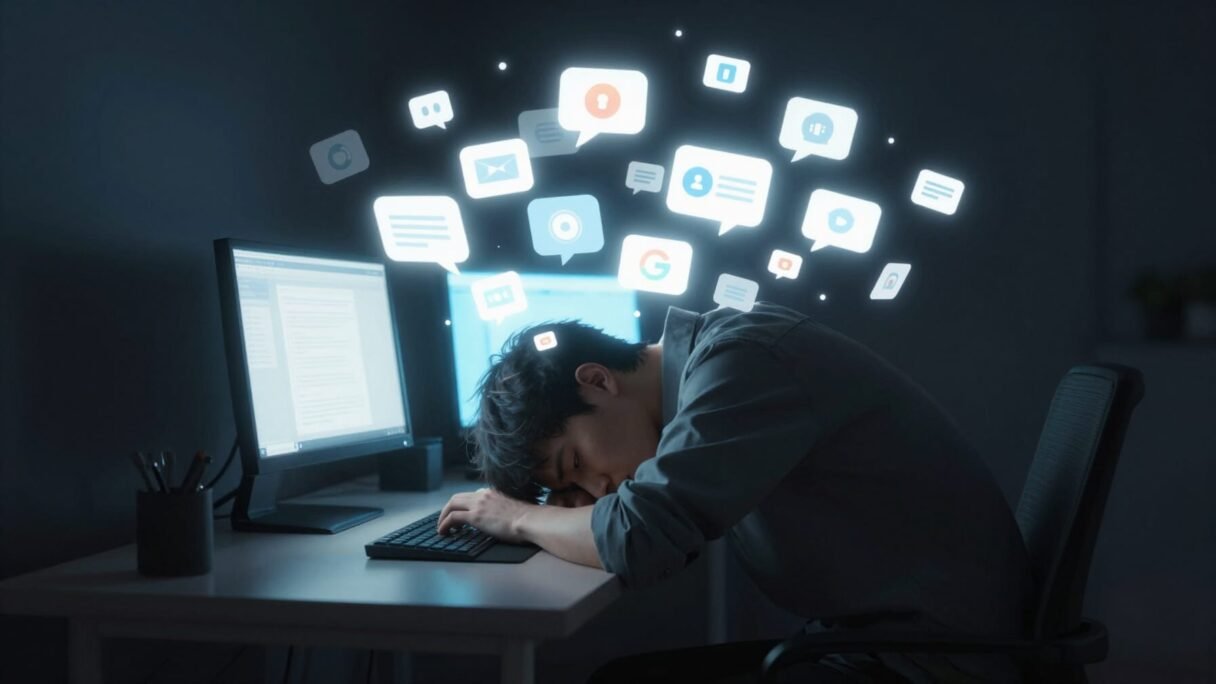
(And We’re Too Addicted to Stop)
Everyone’s talking about burnout like it’s some noble badge of honour. “I’m so burnt out,” we say, as if we’ve been mining coal for fourteen hours straight rather than refreshing Twitter whilst pretending to work on a Google Doc.
Here’s the uncomfortable truth nobody wants to hear: we’re not burning out from too much work. We’re burning out from too much of everything else.
And we’re lying to ourselves about it.
The Great Burnout Con
The narrative goes like this: modern work culture is toxic, capitalism is grinding us into dust, our bosses are demanding too much, and we’re all one Slack notification away from a total breakdown.
It’s a tidy story. It gives us a villain. It absolves us of responsibility.
It’s also mostly bollocks.
Don’t get me wrong… There are people genuinely overworked. Healthcare workers are doing double shifts. Single parents working two jobs to keep the lights on. People are in genuinely exploitative conditions. This isn’t about them, and if you’re one of them, you have my complete solidarity.
But for the vast majority of us sitting in our ergonomic chairs, sipping our oat milk lattes, complaining about burnout on LinkedIn… the problem isn’t the work. It’s everything we’re doing around the work.
Count the Tabs
Right now, as you read this, how many browser tabs do you have open? How many apps are sending you notifications? When was the last time you went an entire hour without checking your phone?
Here’s what a “normal” day looks like for most knowledge workers:
Wake up, check phone (seventeen notifications overnight). Scroll Instagram whilst making coffee. Listen to a podcast whilst getting ready. Check emails on the commute. Open laptop, immediately open Slack, Twitter, WhatsApp Web, Spotify, and maybe… eventually… the thing you’re supposed to be working on.
Work for twelve minutes. Get a Slack message. Respond. See a notification from LinkedIn. Check it. Someone’s posting about their burnout. Read it. Feel validated. Post your own burnout content. Check the engagement. Feel a tiny dopamine hit.
Back to work. Eight minutes this time. Email notification. Deal with it. Remember something you needed to Amazon. Quick browse. Thirty minutes gone. Feel guilty. Check Twitter to avoid the guilt. Forty-five minutes gone.
Lunch. Scroll TikTok. Watch someone’s “day in the life” whilst eating your sad desk salad. Feel inadequate. Open Instagram. Everyone’s on holiday. Feel more inadequate. Check work Slack in case something urgent came up. It didn’t. Scroll anyway.
Afternoon. Manage maybe ninety minutes of actual focus across three hours. Fill the gaps with Reddit, group chats, news sites, more Slack, more email, more… everything.
By the time you finish “work,” you’re absolutely shattered. And you’ve done maybe three hours of actual work. The rest? Pure, unfiltered, voluntary overstimulation.
And we call this burnout.
The Addiction We Won’t Name
Here’s what nobody wants to admit: we’re not victims of our devices. We’re addicts.
Full-blown, can’t-go-five-minutes-without-a-hit, lying-to-ourselves-about-it addicts.
We know this. The research is clear. Social media platforms are engineered to be addictive. Variable reward schedules. Infinite scroll. Notifications designed by behavioural psychologists. We know all this.
And yet we act shocked when we can’t concentrate. We act bewildered when we’re exhausted despite doing relatively little actual work. We blame our jobs, our bosses, “the system”… anything except the thing we’re actively choosing to do every seven minutes.
I see people posting about their burnout on Twitter at two in the morning. Mate, you’re not burnt out from work. You’re burnt out because you’re choosing to be on Twitter at two in the fucking morning.
The most revolutionary thing you could do for your mental health isn’t joining a union or demanding a four-day work week (though both are good ideas). It’s deleting Instagram.
But we won’t. Because we’re addicted.
The Performative Exhaustion Economy
And here’s where it gets really dark: we’ve turned burnout into content. Into a personality. Into a brand.
There’s this whole economy now of people who make their living talking about how exhausted they are. LinkedIn is full of hustle-culture dropouts who’ve simply switched to burnout-culture grifting. Same addiction to engagement, different angle.
“I’m so burnt out I can barely function,” they type, into the void, at midnight, having spent six hours online that day not working.
We’ve gamified exhaustion. We compete over who’s more tired, more overwhelmed, more at their limit. It’s the Oppression Olympics, but for the privileged.
And the worst part? It feels real. When you’re overstimulated to the point of cognitive collapse, when your nervous system is fried from constant context-switching and dopamine hits, when you haven’t had a single genuine thought uninterrupted by a notification in three years… that exhaustion is real.
But it’s not from work. It’s from everything else.
It’s self-inflicted.
What Actually Happened to Us
Twenty years ago, if you were bored at work, you stared at the wall. Or doodled. Or daydreamed. Your brain got actual rest.
Now? Now we fill every microsecond of potential boredom with stimulation. Waiting for a file to download? Check Twitter. Between meetings? Scroll Instagram. Walking to the loo? TikTok.
We’ve eliminated boredom entirely. And in doing so, we’ve eliminated the mental rest that made sustained focus possible.
Then we wonder why we can’t write a simple email without it taking forty-five minutes and requiring three different productivity apps, two browser extensions, and a crisis of existential dread.
Our brains aren’t designed for this. We’re running a 1970s operating system on 2025 inputs. And instead of admitting that maybe, just maybe, we should reduce the inputs… we blame the work.
The Solution Nobody Wants to Hear
You know what would fix most people’s “burnout”?
Not a four-day work week. Not meditation apps. Not expensive therapy or wellness retreats.
Just… stop. Stop scrolling. Stop context-switching. Stop filling every silence with noise.
Delete the apps. All of them. Yes, even that one. Especially that one.
Turn off notifications. All of them. Yes, even Slack. Your job will survive. If it won’t, you have bigger problems.
Put your phone in another room when you work. Use a browser extension that blocks distracting sites. Better yet, use a separate computer for work that doesn’t have any of that shite on it.
Read a book. A whole book. Start to finish. Without checking your phone.
Go for a walk without headphones. Let yourself be bored. Let your mind wander.
Do nothing. Actual nothing. Not “scrolling whilst calling it rest”, nothing. Not “watching Netflix whilst online shopping,” nothing. Sitting-on-a-bench-staring-at-trees nothing.
This sounds like boomer advice, I know. It sounds like “back in my day” nonsense. It sounds like exactly the kind of out-of-touch drivel that ignores the very real structural problems in modern work culture.
But I’m not saying those structural problems don’t exist. I’m saying we’re using them as an excuse to avoid confronting our own complicity in our exhaustion.
The Uncomfortable Mirror
The reason this is controversial isn’t that it’s wrong. It’s because it’s a mirror.
And we don’t like what we see.
We see someone who claims to be too burnt out to cook dinner but somehow finds the energy to scroll for three hours before bed. We see someone who says they can’t focus on work but can hyperfocus on Twitter drama for forty-five minutes straight. We see someone who blames their job for their exhaustion, whilst actively choosing, hundreds of times per day, to fragment their own attention.
We see an addict. And addicts don’t like being called addicts.
So we dress it up. We intellectualise it. We create elaborate theories about capitalism and productivity culture, and toxic work environments. All of which have some truth to them. But it also conveniently let us off the hook for our own choices.
The honest version? “I’m exhausted because I spent seven hours today voluntarily exposing myself to engineered addiction mechanisms whilst simultaneously trying to do cognitive work, and my brain is now in tatters.”
But that’s not as catchy as “burnout culture.”
What Happens Next
Look, I’m not unsympathetic. I’ve been there. I am there, more often than I’d like to admit. This isn’t written from some place of superiority. It’s written from the trenches of my own ongoing battle with this shite.
But we have to start being honest. Because the current conversation about burnout is letting tech companies completely off the hook. It’s letting us completely off the hook.
If we keep pretending the problem is “too much work” when the actual problem is “too much voluntary overstimulation,” nothing changes. The platforms keep extracting our attention. We keep giving it freely. And we keep wondering why we’re exhausted.
The real question isn’t “how do we fix burnout culture?”
It’s “are we willing to give up our addiction to fix it?”
And I think we all know the answer.
We’re not.
We’ll keep scrolling. We’ll keep switching. We’ll keep filling every moment with something. And we’ll keep calling it burnout when what it really is… is a choice.
A shite choice. But a choice nonetheless.
So here’s my challenge: after you finish reading this, close all your tabs. Put your phone in a drawer. And do one hour of actual work. Just one hour. No interruptions. No distractions. No “just quickly checking.”
If you can’t do it, or if the thought of it makes you anxious… maybe that tells you something.
And if you immediately want to share this article on social media to show everyone how self-aware you are about this issue… well, that tells you something too, doesn’t it?
Until Next Time

Discover more from Dominus Owen Markham
Subscribe to get the latest posts sent to your email.