
— And That Should Terrify You
A long-form essay on the Iran ceasefire, the theatre of American resolve, and why the fog of war never really lifted
Let me ask you something genuinely simple.
If you signed a contract with someone… and the very next day you couldn’t agree on what the contract said… would you call that a deal? Would you sleep well, hand it to the lawyers, pop a bottle? Or would you sit there quietly wondering what on earth you’d actually just signed?
Because that’s where we are with this Iran ceasefire. Right now. Today. The ink is barely dry, the press conferences were still echoing across cable news, and already nobody can agree on what was actually agreed.
Not a minor detail, either. Not quibbling over punctuation. We’re talking about whether a whole country…Lebanon…is inside or outside the terms of the deal. We’re talking about whether the Strait of Hormuz is open, closed, or open-with-a-toll-booth depending on which hour you’re asking. We’re talking about a United States administration that simultaneously accepted an Iranian 10-point plan and denied it was the Iranian 10-point plan.
This is not diplomacy. This is a West End farce. And people are dying in it.
The Deal That Wasn’t Quite a Deal
Here’s the version of events Washington would like you to accept: Trump played hardball, Iran blinked, and a ceasefire was reached hours before a catastrophic escalation. Victory. Big day for world peace. Markets surged.
Here’s what actually happened.
About ninety minutes before Trump’s deadline…after which he’d promised to reduce a civilisation to rubble…a 10-point proposal arrived from Tehran via Pakistani intermediaries. Trump declared it “a workable basis on which to negotiate,” announced the ceasefire on Truth Social, and the White House immediately hailed it as a decisive American victory.
The problem? Nobody in Washington could explain what they’d actually agreed to. And it’s not as if they were being cagey for strategic reasons. They genuinely couldn’t get their stories straight.
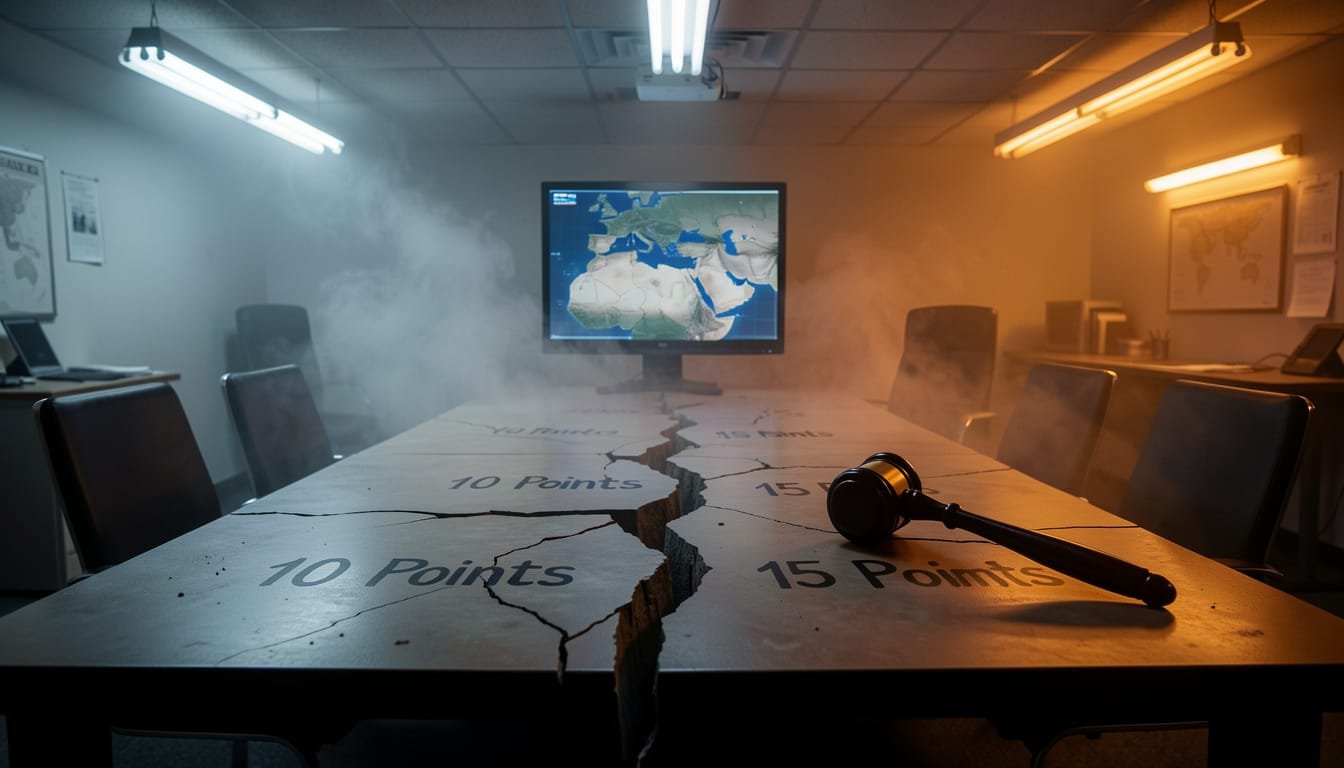
Trump said Iran’s 10-point plan was the basis for the deal. Then he posted again on Truth Social, this time referencing the US 15-point proposal…the one Iran had previously rejected…claiming agreement on many of those points. The White House press secretary, Karoline Leavitt, then told reporters that the 10-point plan Iran had published publicly didn’t match the version the Trump administration had received. Vice President Vance added cheerfully that there were, in fact, three different 10-point proposals floating around, which had, he explained, “contributed to confusion.”
Three versions of the same 10-point plan. The basis on which a war was supposedly ended. That’s not confusion. That’s a structural problem that will surface every single time anyone sits down to negotiate the next step.
And if you’re wondering what’s actually in these rival documents… you’re in good company. No official ceasefire agreement has been released to the public. Trump announced the whole thing in a social media post. The Strait of Hormuz…the waterway through which 20% of the world’s oil flows…had its status declared by a man typing on his phone at what appears to have been somewhere past midnight, US time.
The Lebanon Black Hole
Right, so let’s talk about Lebanon. Because this is where the architecture of Washington’s “resolve” really collapses.
Pakistan brokered the deal. Pakistan’s Prime Minister Shehbaz Sharif announced it. And Sharif stated clearly, publicly, on record: the ceasefire covers all fronts, including Lebanon.
Israel said no. Lebanon is not included.
Trump said Lebanon is not included. He told PBS directly that it was excluded “because of Hezbollah.”
Iran said Lebanon absolutely is included, and that excluding it was a violation of the terms they’d agreed to.
So within hours of the ceasefire taking effect, the mediator’s version of what had been agreed directly contradicted both the US and Israeli positions. And the US… said nothing clarifying. Leavitt was asked directly whether Washington would like to see Lebanon covered by the ceasefire. She dodged it. Said it “would likely be discussed going forward.”
Going forward. After Israeli forces had already launched what the IDF itself described as its largest coordinated strike on Lebanon since the war began…100 targets in the span of 10 minutes, across Beirut, southern Lebanon, and the Bekaa Valley, killing over 250 people on the first day of this so-called ceasefire, with over a thousand wounded. Lebanon declared a national day of mourning. The UN Secretary-General condemned it. European leaders condemned it. The leaders of Germany, France, Italy, the UK, Spain and Canada signed a joint statement calling for Lebanon to be covered by the agreement.
Washington’s position? JD Vance called it “a legitimate misunderstanding.”
A legitimate misunderstanding.
Over 250 people died in Lebanon on April 8th, 2026…the first day of peace…and the Vice President of the United States described the ambiguity that enabled it as a legitimate misunderstanding. That is a remarkable sentence for a senior official to say out loud. It suggests either catastrophic incompetence in how the deal was drafted, or deliberate vagueness that served Israeli military objectives while offering Iran just enough cover to claim the war was paused.
Neither interpretation is reassuring.
The Strait That’s Open, Closed, Open, Closed
Then there’s the Strait of Hormuz. The waterway. The one Trump said was the entire basis of his ceasefire condition. The one he declared immediately open. The one that was not, in fact, immediately open.
Iran’s Foreign Minister said, post-ceasefire, that ships would need to “obtain permission” from Iran before passing. Two tankers got through on the first morning…both reportedly with links to Iran. Then the IRGC shut it down again in response to Israel’s Lebanon strikes. Trump posted that the US would be “helping with the traffic buildup.” The White House denied reports it was closed. Lloyds List, tracking maritime data, said three ships had passed. Tehran said it was shut. Washington said it was open.
The world’s most critical energy chokepoint had its status determined by competing social media posts.
Meanwhile, Iranian officials floated the idea of charging ships up to $2 million per transit…a toll system that would, if formalised, represent Iran extracting permanent economic benefit from having blockaded the strait in the first place. Trump apparently told ABC that the US and Iran might jointly operate a toll system. His hawkish Republican allies immediately went pale.
Here is the core absurdity of this moment: the US went to war…a war of questionable legality, a war that killed thousands and displaced millions…ostensibly to neutralise Iran’s nuclear capabilities and break its regional influence. The ceasefire, as it stands, neither confirms the destruction of Iran’s nuclear programme nor diminishes its stranglehold over the world’s most important oil route. Ben Rhodes, a former senior Obama administration foreign policy official, put it with surgical precision: in the best case scenario, Trump struck a deal to reopen a strait that was open before the war he started, with the IRGC potentially extracting fees and sanctions relief in return.
Read that again. Let it settle.
The Resolve That Wasn’t There
This is what strikes me most about all of this. Not the chaos…chaos is almost expected in conflicts this complex. What strikes me is the specific, identifiable absence of clarity from Washington at every single decision point.
Trump threatened to wipe out a civilisation. Then accepted a 10-point plan that doesn’t clearly address any of the core US objectives. Then denied he’d accepted that 10-point plan. His generals stood at a Pentagon podium and called it a “pause.” His Defence Secretary said Iranian attacks continued because of “poor command and control,” with commanders “out of reach due to communications issues”…which is either true and terrifying, or a face-saving explanation for the fact that the ceasefire was already creaking before the press conference ended.
Hegseth also said…and this deserves its own paragraph…that the US military would do “something like” the nuclear strikes from last summer if Iran refused to surrender its enriched uranium voluntarily. Iran has not confirmed it will surrender its enriched uranium. The Farsi version of Iran’s ceasefire plan included “acceptance of enrichment” as a core condition. The English version shared with journalists did not. Two versions of the same document. Different words on the most critical issue in the entire conflict.
Washington’s response to this discrepancy? Silence. Then a fresh Truth Social post.
Senator Lindsey Graham, no peacenik, described the publicly circulated Iranian terms as having “some troubling aspects” and called on the architects of the proposal to come to Congress and explain how any of this meets US national security objectives. Even Trump’s own Senate allies don’t know what was agreed. Netanyahu publicly stated the ceasefire is “not the end” of the military campaign against Iran…calling it “a stop on the way to achieving all of our objectives, either by agreement, or by resuming the fighting.”
That’s the Israeli Prime Minister telling you, on the day of the ceasefire, that the ceasefire is conditional and temporary and that resuming the fighting remains very much on the table. This is not a secret. He said it publicly.
And Washington? Did not push back. Did not clarify. Did not set out a coherent position on what happens if the Islamabad talks collapse.
Two Weeks to Figure Out What You Already Agreed
Here is where we actually stand, as of now.
Talks are scheduled in Islamabad, with JD Vance leading the US delegation…the most senior American official to visit Pakistan since 2011. Iran’s delegation is travelling. The basis for negotiations is… contested. The 10-point Iranian plan includes lifting all sanctions, US military withdrawal from the region, Iranian control of the Strait, the right to enrich uranium, and financial compensation for the war. The US 15-point plan reportedly includes Iran committing to no nuclear weapons, surrendering enriched uranium stockpiles, ending support for regional proxy groups, and reopening the strait without conditions or tolls. These two documents are not a Venn diagram with a comfortable overlap. They are, on most substantive points, fundamentally incompatible.
The people of Tehran have had some relief from the bombardment. That matters. Nobody should dismiss the human value of pausing a conflict that had killed thousands and sent ten million people living in fear across a major city. People in Beirut, though, have no such relief…because Lebanon was left in the ceasefire’s ambiguous shadow, and Israel has been very clear about how it intends to operate in that shadow.
The Strait remains barely functional. Oil is back above $97 a barrel. Shipping analysts say it will take months for the disruption to subside regardless of what is agreed politically. The global economy absorbed a historic oil supply shock…the largest on record, with 12 to 15 million barrels a day choked off…and is now waiting to see whether Islamabad produces anything durable enough to put it right.
Meanwhile, Trump has posted that US warships will remain “in place” around Iran until the “real agreement” is fully complied with. Adding, with his characteristic gift for reassurance: “If for any reason it is not, which is highly unlikely, then the ‘Shootin’ Starts,’ bigger and better and stronger than anyone has ever seen before.”
Bigger. And better. And stronger.
What Washington’s Incoherence Actually Tells Us
I want to be honest about something, because I think it gets lost in the noise.
This isn’t just about Trump. It isn’t only about the particular chaos of this administration, though that chaos is real and consequential. This is about a deeper, structural problem with how American power has chosen to exercise itself in this region for decades.
Washington went to war without a clear legal mandate. Spanish Prime Minister Pedro Sánchez called the strikes “reckless and illegal” and refused to allow US forces to use Spanish military bases for offensive operations. The Spanish government would not be complicit, they said, in “something that is bad for the world.” That is an extraordinary thing for a NATO ally to say about a US military operation. And yet the conflict happened anyway, without Congressional authorisation that would have been constitutionally required, carried forward on executive power and a kind of geopolitical momentum that nobody seemed able…or willing…to stop.
And now, at the ceasefire stage, the same pattern holds. Nobody in Washington can clearly articulate what victory looks like. They can’t agree on what they signed. They can’t explain why Lebanon was excluded. They can’t confirm whether Iran’s nuclear capabilities have been meaningfully degraded or merely paused. They can’t tell you if the Strait will genuinely be open, or open under Iranian supervision at $2 million per ship.
What they can do is claim victory loudly, quickly, and from multiple conflicting directions simultaneously.
Trump called it “total and complete victory.” The White House called it “a victory for the US.” Netanyahu called it “historic.” Iran’s Supreme National Security Council called it “an enduring defeat” for Washington. Everyone won. Nobody can tell you what the prize was.
The Honest Question Nobody in Washington Is Answering
Here it is. The question that should be asked at every briefing, every press conference, every foreign affairs committee session until it gets a straight answer:
What, specifically, is different now about Iran’s nuclear capability, its regional influence, and its control of the Strait of Hormuz compared to February 27th, 2026…the day before this war began?
Because if the answer is “not much,” then the lives lost, the cities bombed, the global economy rattled, and the legal norms shredded all happened for a ceasefire that put us roughly back where we started… but angrier, poorer, and less stable.
That isn’t defeatism. That’s accountability. And accountability is the one thing that has been conspicuously, consistently, deliberately absent from Washington’s handling of every stage of this conflict.
The ceasefire is two weeks. The talks are in Islamabad. The world is watching.
But the question isn’t whether peace is possible. The question is whether the people in the room actually know what they want from it.
Right now, based on the evidence? I’m not convinced they do.
Written 9th April 2026
Until Next Time


Discover more from Dominus Owen Markham
Subscribe to get the latest posts sent to your email.