
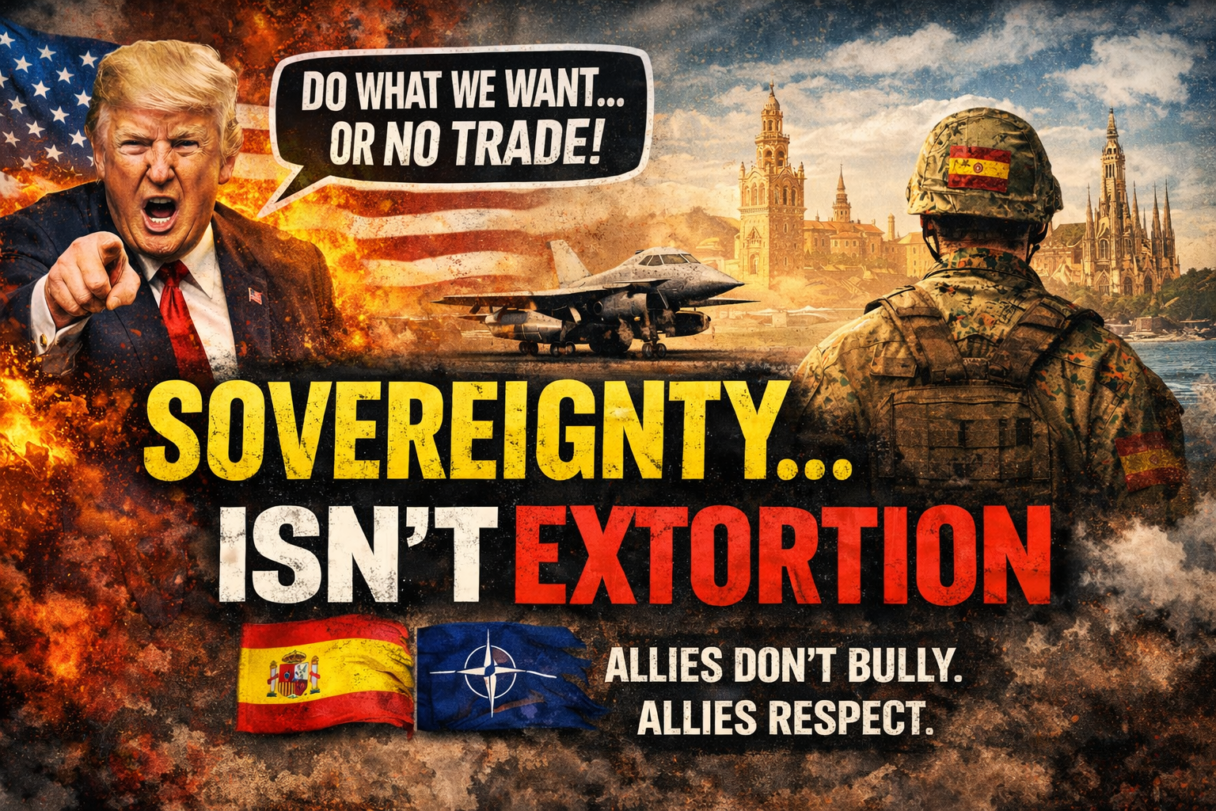
There’s something fascinating about watching power throw a tantrum.
Apparently the latest diplomatic strategy coming out of Washington is this: Do what we want militarily… or we’ll stop trading with you.
That’s the gist of the latest threat from Donald Trump, who has reportedly floated the idea of a full trade embargo on Spain after the Spanish government declined to allow U.S. forces to use the naval base at Naval Station Rota and the air base at Morón Air Base for potential strikes on Iran.
Let’s pause there for a second.
A sovereign country says: “No, we’re not comfortable facilitating military strikes that could escalate a war.”
And the response is essentially: “Fine… we’ll punish you economically.”
That isn’t diplomacy.
That’s playground geopolitics.
Spain’s position, articulated by Prime Minister Pedro Sánchez and Defence Minister Margarita Robles, is actually rather mundane in the world of international law. Governments are allowed… in fact expected… to consider civilian protection, escalation risk, and the legal basis for military action before allowing their territory to be used as a launchpad for war.
That’s not radical.
That’s literally the job.
But here’s where the rhetoric gets particularly theatrical.
Trump reportedly claimed the United States “needs nothing from Spain” and could access the bases regardless. Which is an interesting argument, because if you genuinely don’t need something… threatening to cut it off feels like an oddly elaborate performance.
The reality, of course, is that international alliances aren’t feudal systems where one country simply commands and the others salute.
NATO is a military alliance, not a landlord-tenant arrangement.
Members cooperate.
They consult.
And occasionally they disagree.
That disagreement isn’t weakness. It’s actually one of the few signs that the alliance is still made up of sovereign democracies rather than administrative provinces.
And let’s also be clear about the broader point here.
Refusing to facilitate military escalation does not make a country anti-American.
It makes that country cautious about war.
Those are not the same thing.
Spain isn’t breaking alliances.
Spain is exercising judgment.
Even within the United States, figures like Lindsey Graham have reportedly pushed back on the notion that allies should be economically threatened for declining to participate in a specific military action. Meanwhile, neighbouring Portugal has stepped forward offering alternative base access, which rather neatly illustrates the point that alliances function through negotiation… not intimidation.
If every disagreement is treated like betrayal, alliances stop being alliances. They become compliance tests.
And historically speaking, compliance tests rarely end well for the people administering them.
What makes this episode particularly telling is the tone of it. The framing suggests that cooperation is something owed… rather than something earned and maintained through mutual respect.
But geopolitics doesn’t work like a property deal where someone “owns” the airspace over Europe.
Countries have agency.
Governments have legal obligations.
And sometimes the responsible decision is simply to say no.
Whether you agree with Spain’s call or not, the principle at stake here is pretty simple:
A sovereign nation declining to participate in a military operation is not an act of hostility.
It’s an act of sovereignty.
And if alliances can’t survive that… then what exactly were they built on in the first place?
Until Next Time

Discover more from Dominus Owen Markham
Subscribe to get the latest posts sent to your email.