
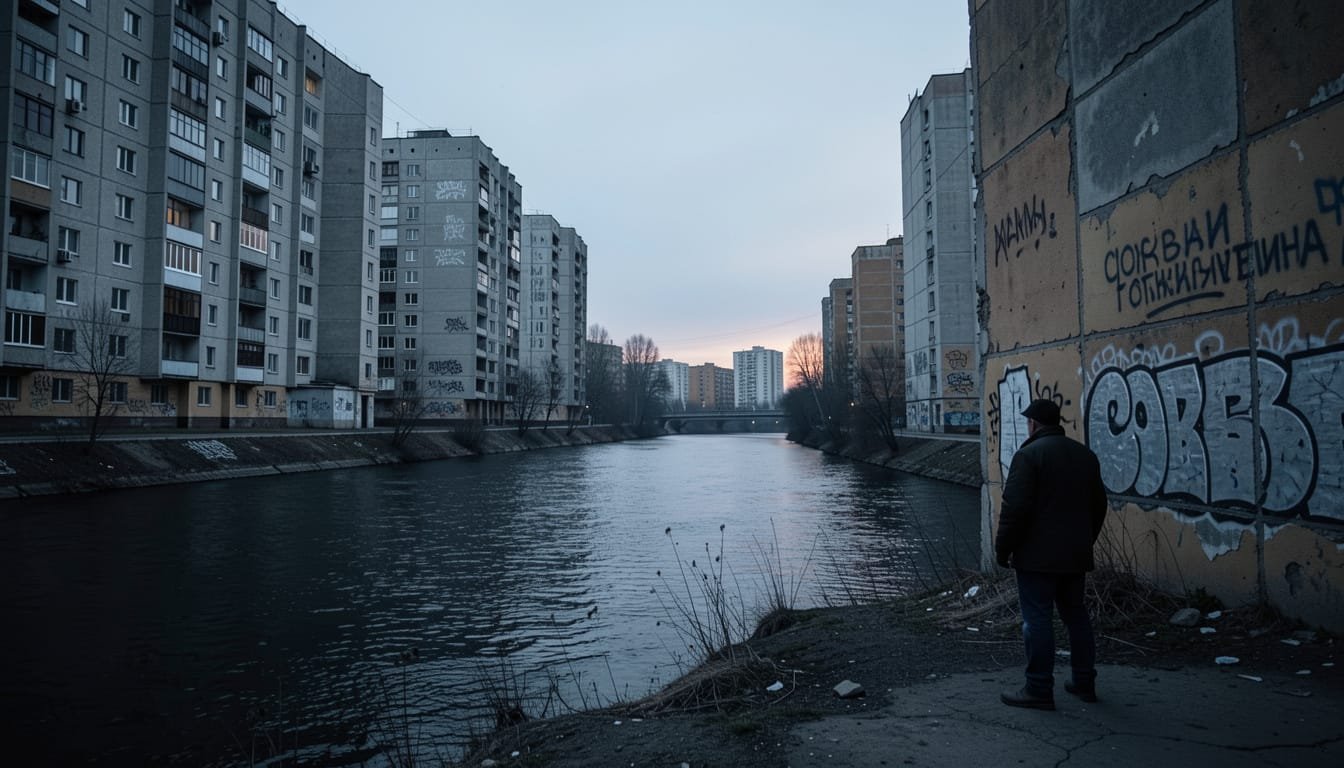
There’s a city called Narva sitting on the eastern edge of Estonia. Population fifty thousand, give or take. It sits right on the border with Russia. Around ninety percent of its residents speak Russian as their first language. And right now, across Telegram, VKontakte, and TikTok, a campaign is quietly building that calls it something else entirely… the “Narva People’s Republic.”
Sound familiar? It should.
Slogans are appearing. “Russians, we are not alone.” Maps are being shared. Flags of the supposed republic. Videos of masked figures encouraging supporters to “act together.” There is even a Facebook group whose name translates, without any real effort at subtlety, to: “We are waiting for Russia.”
We are waiting for Russia.
Say that out loud. Let it sit in the air for a moment.
This is not fringe activity buried in the dark corners of the internet. This is a coordinated information operation spreading across mainstream social platforms in a NATO member state, and it is using language that should make every European’s blood run cold. Because the term “People’s Republic” is not random. It is not an accident of translation. It is the exact same terminology Russia applied to the Ukrainian regions of Donetsk and Luhansk before absorbing them as Russian territory. The language is the architecture. It always has been.
The playbook is not new. It is not even particularly sophisticated. What it is, is patient.
Russia’s escalation toward full-scale war in Ukraine followed years of gradual grey zone tactics… covert seizure, proxy conflict, and eventually invasion. These tactics grew increasingly audacious over time. Crimea did not happen overnight. Donbas did not happen overnight. What happened was a long, slow, methodical construction of a narrative. Russian speakers are oppressed. Russian culture is under threat. Russia has a humanitarian duty to act. And then… the little green men appeared, and the world stood around asking each other whether this was really happening.
It was really happening.
The plan, as intercepted communications later confirmed, involved fomenting widespread unrest using pro-Russian agents on the ground, then orchestrating uprisings that would announce rigged referendums about joining Russia, similar to what took place in Crimea in 2014. They had a name for it. Project Novorossiya. New Russia. They were not shy about the ambition. They were just counting on the West being too slow, too distracted, or too cowardly to respond in time.
So here we are in 2026. Ukraine is grinding through a war that has consumed hundreds of thousands of lives and redrawn the map of Europe’s security architecture. Peace talks are happening without the Ukrainians fully at the table. The world’s attention is drifting toward Iran. And in a quiet Estonian border city, someone is seeding separatist content and waiting to see what takes root.
An Estonian intelligence source told BILD the campaign’s timing may not be accidental. “It is no coincidence that this campaign is starting now, when the world’s attention is turning toward Iran,” the source said. “However, we cannot rule out that it is meant to prepare a Russian incursion similar to what happened in Ukraine in 2014.”
Can’t rule it out. Diplomat-speak for: we’re watching a lit match and we’d rather not say the word fire yet.
Estonia’s security police agency, KAPO, have been more direct. Their spokesperson Marta Tuule described the posts as part of a disinformation effort aimed at undermining stability. She noted that these techniques have been used before in Estonia and elsewhere, calling it a simple and inexpensive method to create insecurity and intimidate society. She also made clear that participation in it may carry criminal consequences. Good. Someone should be naming it plainly.
Since early March, some messages have encouraged followers to spread propaganda materials and prepare for acts of disruption, with online calls urging residents to declare the republic and defend it by force against the Estonian state.
Defend it by force. Against the Estonian state. Which is a NATO member.
Let that breathe.
Because here is the thing that gets lost when we talk about hybrid warfare and information operations and grey zone tactics as if they are abstract strategic concepts studied in think-tanks. These are not abstract. They are messages landing on people’s phones in Narva right now. They are targeted at a community that already feels the tension of living at the intersection of two worlds, Russian-speaking in a country that has every reason to be wary of Russian influence, trying to live a normal life while geopolitics uses their city as a chess piece.
And the target audience is not just the people of Narva. The target is the rest of us. The target is our attention span, our capacity for outrage, our ability to maintain a coherent response when the threats keep multiplying. European officials have reported more than 150 suspected hybrid attacks linked to Russia over the past four years, including sabotage, arson, and attempted bombings. One hundred and fifty. Not incidents. Not rumours. Suspected attacks. That is a sustained, deliberate campaign against the stability of the European continent, running quietly alongside the open war in Ukraine, designed to stretch NATO’s capacity and patience to breaking point.
The potential rewards for continued Russian aggression include enhanced prestige for Putin’s regime, a stronger geostrategic position along Russia’s periphery, a damaging blow to NATO, and the severing of the transatlantic link. That is not analysis from a hawk. That is a sober accounting of incentives. Putin does not need to take Narva to win something from this. He needs to make Estonia nervous, make NATO hesitate, make European populations feel like they are perpetually on the edge of something they cannot quite name.
That feeling is the weapon. The Telegram posts are the delivery mechanism.
The question worth asking is not whether Putin is “preparing a new Crimea.” That framing is already too slow. It imagines a future event we might still prevent, when what we should be asking is: what does the response look like when the event is not a tank column crossing a border but a thousand social media posts, and a city that is ninety percent Russian-speaking, and a world too busy watching another war to notice the quiet work being done in the margins?
Because we have seen this film. We know the third act.
The ending is not inevitable. But it will not change itself.
Until Next Time

Discover more from Dominus Owen Markham
Subscribe to get the latest posts sent to your email.