
I have noticed something curious over the past few years.
Not something dramatic… nothing you would expect to see flashing across the news channels with dramatic music and a breaking banner. Nothing quite that theatrical.
It is quieter than that.
In conversations with friends. In passing comments online. In the tone people use when politics comes up at the pub or around a dinner table.
There is a certain shrug in the air.
A sense that the whole thing is happening somewhere else… run by other people… in rooms we are not invited into.
And the phrase I hear more than any other is this one:
“It doesn’t make any difference anyway.”
Now that sentence might sound harmless enough. Just a bit of everyday frustration. But if you sit with it for a moment, it carries a rather large implication.
Because democracies were never built on the belief that nothing makes any difference.
They were built on the slightly stubborn idea that ordinary citizens should have some influence over the direction of their society.
Not perfect influence, mind you. Democracies have always been messy beasts. Slow moving. Frustrating. Occasionally baffling.
But they were never supposed to be silent.
And that is where the unease creeps in for me.
The silence.
When People Start Tuning Out
There was a time when political discussion was part of everyday life.
Not necessarily polite… but certainly present.
People argued about policy in cafés. They debated decisions in workplaces. They cared enough to get animated about the direction things were heading.
These days the energy feels different.
Many people have simply switched off.
You see it in small ways.
A quick change of subject when politics comes up.
A weary laugh followed by “they’re all the same anyway”.
A kind of quiet withdrawal from the whole business.
And I understand why that happens.
Modern politics can feel like an endless loop of outrage and performance. The same arguments recycled. The same personalities dominating the headlines. The same dramatic declarations appearing every few hours on social media.
After a while people become tired of it.
So they step back.
Not out of rebellion.
Out of fatigue.
The Problem With Stepping Back
Here is the small detail that tends to get overlooked.
When citizens step back from public life, public life does not pause to wait for them.
Decisions still get made.
Policies still get written.
Budgets still get negotiated in offices and committee rooms.
Governments do not stop governing simply because the public has grown weary of the spectacle.
The machinery keeps moving.
The only difference is that fewer voices are present when those decisions are shaped.
And that is how influence quietly concentrates itself.
Not necessarily through some grand conspiracy or dramatic power grab… but through absence.
When fewer people show up, the room becomes smaller.
When the room becomes smaller, fewer perspectives are heard.
And over time the distance between citizens and decision makers grows wider.
The Comfort of Cynicism
There is another thing I have noticed.
Cynicism has become fashionable.
It gives people the feeling of being worldly… as if they have seen through the illusion and stepped outside the theatre of politics.
“It’s all rigged anyway.”
“Nothing ever changes.”
“You can’t trust any of them.”
Now, to be fair, politics has earned some of that suspicion. History is full of broken promises and questionable decisions.
But cynicism carries a hidden side effect.
It encourages people to withdraw.
To disengage.
To surrender the small but meaningful influence they still possess.
And the strange irony is this… when enough citizens do that, the system really does begin to drift further away from them.
Cynicism becomes a self-fulfilling prophecy.
Democracy Was Never Meant to Be Passive
Somewhere along the way democracy started being treated like a service.
Something delivered to citizens rather than something sustained by them.
As though governance were a kind of subscription model. You check in occasionally, complain about the quality, and then return to your normal life.
But that was never the original idea.
Democracy was always meant to be participatory.
It assumed that citizens would remain curious about what was happening around them. That they would ask questions. That they would involve themselves in conversations about the direction of their communities.
Not every day.
Not every hour.
But often enough that the system remained connected to the people it was supposed to represent.
The Public Voice
That connection depends on something simple.
The public voice.
Not the loudest voices on television panels or social media feeds… but the quieter, steadier voice of ordinary citizens who pay attention to what is happening around them.
People who still care enough to speak up when something does not seem right.
People who ask questions rather than simply scrolling past the headline.
People who understand that participation is not about shouting the loudest… it is about showing up.
Because when enough citizens do that, something interesting happens.
Power spreads out.
Influence becomes more balanced.
Decisions are shaped by a wider range of perspectives.
And democracy begins to function the way it was originally intended.
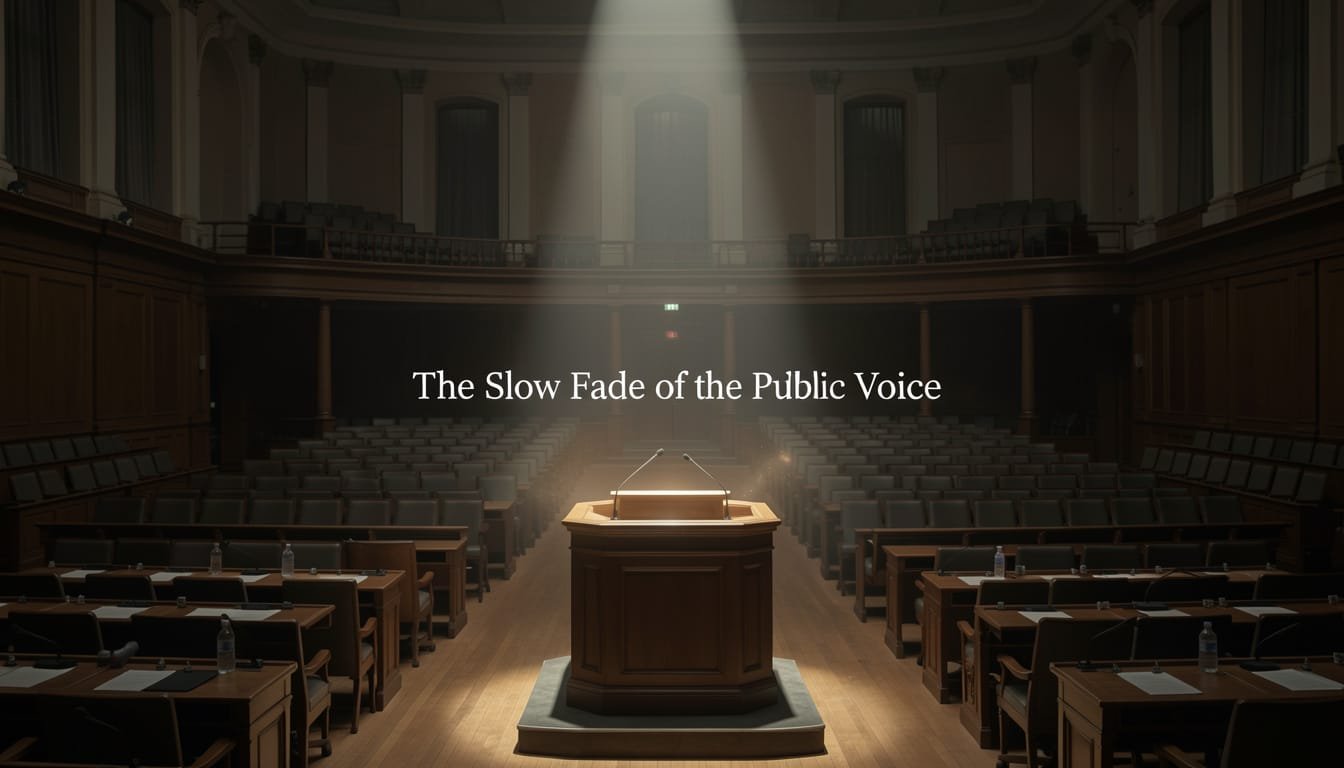
The Slow Fade
What concerns me today is not the sudden collapse of democratic systems.
History shows that kind of thing usually arrives with plenty of warning signs.
What concerns me is something quieter.
A gradual fading of public participation.
A slow shift from engagement to spectatorship.
A growing sense among citizens that the whole process is happening somewhere beyond their reach.
Because when that feeling takes hold widely enough, the public voice does not disappear all at once.
It simply grows fainter.
And when the voice of citizens fades, governance does not stop.
It just becomes the conversation of fewer and fewer people.
The Choice That Remains
But here is the part worth remembering.
The fading of the public voice is not inevitable.
It is the result of millions of small choices made by individuals.
The choice to disengage.
The choice to stop paying attention.
The choice to believe that participation no longer matters.
And choices can change.
Citizens can decide to re-engage with the systems that shape their lives.
Not through constant outrage or endless online arguments… but through attention.
Through curiosity.
Through the simple act of remembering that democracy was never meant to run quietly in the background while everyone else gets on with their day.
It was always meant to involve the public.
Which means the public voice only fades if we allow it to.
And that, perhaps, is the most important detail of all.
Until Next Time

Discover more from Dominus Owen Markham
Subscribe to get the latest posts sent to your email.