
A mainstream media kind of erasure happens all too often, and that doesn’t announce itself. It doesn’t come with a boot to the face or a document stamped DENIED. It’s quieter than that, and in some ways more insidious. It happens in the language of military briefings and cable news chyrons. It happens in the choice of which questions a journalist decides to ask and which ones they quietly set aside. It happens when a government tweets “Kharg Island Obliterated” and nobody in a studio anywhere thinks to ask: right, but what about the people who live there?
I’ve been sitting with this piece from Truthout for a few days now, written by Séamus Malekafzali, and I can’t shake it. Not because it tells me something I’ve never suspected about how Western governments and media treat civilian populations in countries they’ve decided to be at war with. I have suspected it, often, and been depressed by it, often. What gets me this time is the sheer brazenness of the omission. The casualness of it. The way you can apparently go on American television in 2026 and say, without blinking, that Kharg Island has “no civilian population centre” and “really is just oil infrastructure,” and nobody cuts your microphone.
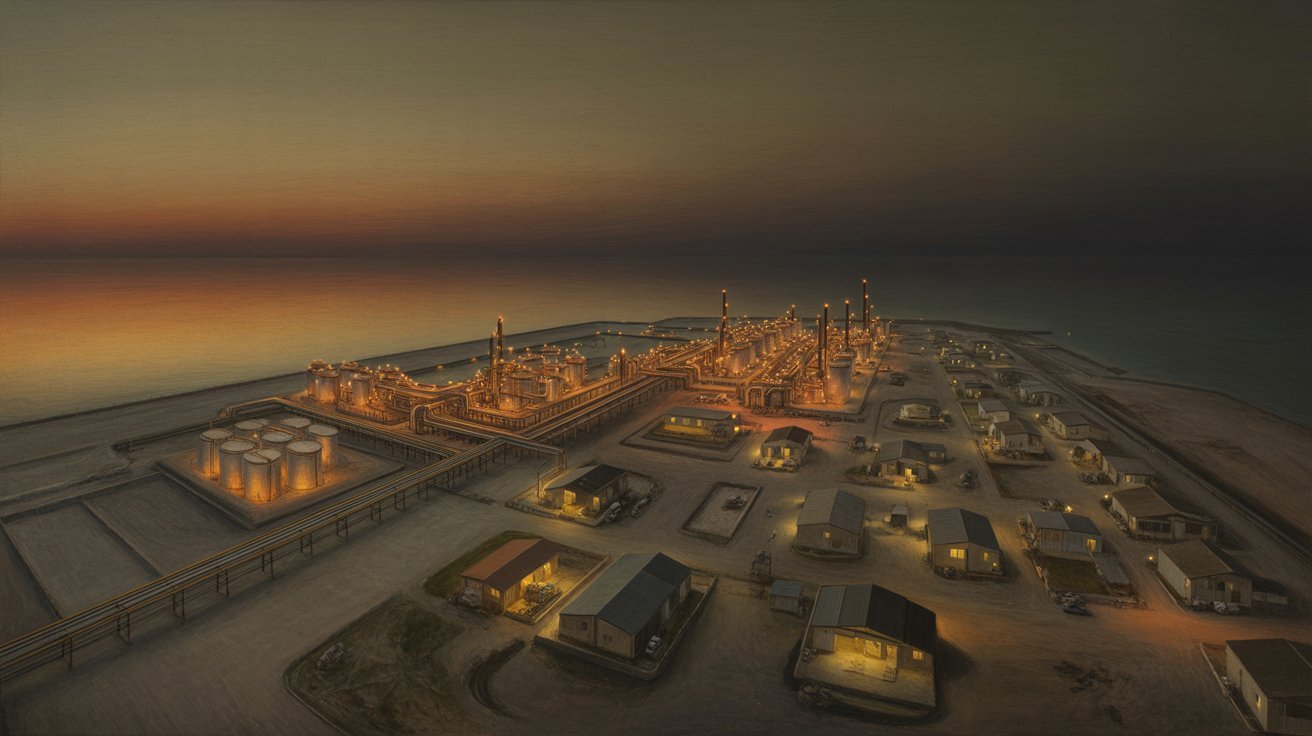
There are more than 8,000 permanent residents on Kharg Island. Thousands more have made their way there to work in the oil industry. These are people with homes. With families. With routines and corner shops and memories bound up in the soil beneath their feet. And yet, in the American media ecosystem currently covering the possibility of a US ground invasion of that island, those people are functionally invisible, or worse, they’re mentioned briefly as a logistical inconvenience: bodies that US paratroopers will “have to account for.”
Let’s just sit with that for a moment.
When People Become Footnotes
I grew up in a country that has its own complicated relationship with the idea of collateral. Britain has been involved in enough military adventures over the centuries, and in my lifetime, to know the rhythm of it. You establish the strategic importance of the target. You talk about “precision.” You use phrases like “surgical strikes” and “minimal civilian impact” right up until the moment the pictures come through and the pictures tell a different story. Then you pivot to “this is war, these things happen, the enemy is to blame for situating themselves near civilians.”
The script doesn’t change. Only the geography does.
What Malekafzali’s reporting makes clear is that in the case of Kharg Island, the script hasn’t even needed updating because the civilians haven’t been acknowledged in the first place. When CBS brings on a Hudson Institute analyst to describe the island as empty of civilian life, that’s not an honest mistake, a researcher who somehow missed the 8,000-plus people living there. That’s a choice. When Fox’s Jesse Watters hosts a Medal of Honor recipient who tells viewers that civilians “aren’t even allowed” on Kharg Island, that is either spectacular incompetence or it’s narrative construction. And I know which one I think it is.
The function of that kind of coverage isn’t to inform. It’s to pre-emptively launder a potential atrocity. If you can establish in the public mind that a place is devoid of civilians, then whatever happens to those civilians later becomes easier to absorb. The shock is managed in advance. The outrage never quite forms, because the foundations for outrage, the basic recognition that real human beings live there and might be harmed, have been quietly dismantled before the first paratrooper hits the ground.
“We Did Iwo Jima. We Can Do This.”
Senator Lindsey Graham, on Fox News, on the 22nd of March 2026.
I’ve thought about that sentence more than I’d like to admit. There’s something in it that tells you everything you need to know about the psychological distance required to advocate for military invasion as a foreign policy tool. Iwo Jima, for those not immersed in Second World War history, was one of the bloodiest battles in the Pacific campaign. Nearly 7,000 American Marines died there. The Japanese garrison fought almost to the last man. It was a grinding, horrific, months-long battle for a volcanic island that the US military considered strategically essential.
And Lindsey Graham invokes it on cable news, breezily, as proof of concept. We did it before, we can do it again. As if the point of Iwo Jima was to demonstrate American capability rather than to mark a catastrophic human cost. As if the lesson of that battle, or indeed of Iraq, or Afghanistan, or Libya, was simply: yes, we can.
The Bloomberg editorial that Malekafzali cites is almost more chilling in its measured, reasonable-sounding tone. James Stavridis, former NATO Supreme Allied Commander, writes about the residents of Kharg as problems requiring management: people “who would need to be contained in their homes or evacuated.” Former NATO Supreme Allied Commander. Contained in their homes. These are the words of someone who has operated at the absolute apex of Western military power, and the civilians of Kharg Island are, in his framing, essentially a complicating factor in an otherwise tractable operation.
I wonder sometimes what it does to a person, spending decades at the summit of institutional military power. Whether it becomes genuinely difficult to see civilians as anything other than variables.
The Language of Obliteration
“Kharg Island Obliterated.”
That was the headline the White House social media team posted after the US struck the island on March 13th. Trump himself spoke of the island as if it had been “totally demolished,” while simultaneously insisting he’d spared the oil infrastructure because he didn’t fancy the economic blowback from blowing up what he actually wanted to seize.
Locals told BBC Persian something rather different. They said the bombs hit deep inside the city of Kharg, where most residents live. They said the island doesn’t really have a military base. They said that when the airport was struck, the one that runs domestic flights back to the Iranian mainland, there was suddenly no way to evacuate. No way out.
“Obliterated.” The White House used that word about a place where thousands of people were still going about their lives, still trying to work out what was happening to them, still wondering whether tomorrow would bring more of the same. The word “obliterated” was a performance for a domestic audience. It was Trump doing what Trump does: performing strength, performing dominance, turning a bombing raid into a brand moment.
The people of Kharg were the backdrop. They weren’t even given the dignity of being the wrong answer to the right question. They simply weren’t in the frame at all.
This Is What Erasure Looks Like in Practice
I want to be precise about something, because I think it’s easy to gesture at “media complicity” or “propaganda” as if those are monolithic things that operate through some grand central conspiracy. They mostly don’t. What makes this kind of erasure so effective is that it’s decentralised. It’s the cumulative result of thousands of individual editorial decisions, each one defensible in isolation, each one pointing in the same direction.
A Reuters correspondent writes up a strategic analysis of Kharg and focuses on the oil terminal and the military logistics because that’s the story that has legs, that’s what their editors want, that’s what makes the piece publishable. The civilian population doesn’t make it past the second paragraph. Not because the journalist is malicious, necessarily, but because the frame has already been set and civilians don’t fit neatly inside it.
A Washington Post analyst quotes the Washington Institute, a think tank with explicit pro-Israel leanings, on the idea that surrounding the island with mines would be “safer” for US forces, and the paper prints it, because the analyst is a named expert and the quote adds colour to the piece. Nobody stops to observe that “safer” in this context means safer for the invaders, and that surrounding an island with 8,000 residents with naval mines is not anyone’s definition of a humanitarian strategy.
Fox News brings on a Medal of Honor recipient to talk tactics and he says civilians can’t even go to Kharg, and nobody in the production team thinks to Google that before the segment airs.
Each decision, on its own, looks like a deadline pressure or a sourcing shortcut or just the shape of how the news cycle works. But look at the aggregate and it’s clear: a story has been told in which the people of Kharg Island simply do not exist. And that story is being told by the most powerful media institutions in the world, in the run-up to a potential military invasion of their home.
The Old Lesson That Never Gets Learnt
The thing is, we’ve been here before. We’ve been here so many times that at this point it feels less like history repeating itself and more like history has simply given up trying to make us listen.
The pitch for the invasion of Iraq in 2003 included, prominently, the welfare of the Iraqi people. We were liberating them. We were going to hand them democracy and prosperity and a future free from Saddam. The fact that approximately 200,000 Iraqi civilians died in the subsequent conflict, with estimates ranging considerably higher depending on methodology, was never really reconciled with that opening sales pitch. It couldn’t be, because to reconcile it would be to acknowledge that the welfare of Iraqi civilians was never genuinely the point. It was a rhetorical device, a moral dressing on a strategic meal.
The Fox Business segment that Malekafzali mentions, where a former Navy SEAL talks about handing the oil “back to the Iranian people once they take over this regime,” is that same rhetorical device in 2026 clothes. We’re doing this for them. Once the regime falls, the people benefit. Trust us.
Trump, to his credit in a purely accidental way, is at least honest enough to contradict this. He said outright that invading Kharg would “mean we had to be there for a while.” He said his favourite thing is to “take the oil in Iran.” There’s no pretence of liberation in that framing. There’s just acquisition. There’s just the ancient logic of empire dressed up in a MAGA hat, and whatever else you think of it, it’s more honest than the think-tank language about what the operation is actually for.
The people of Kharg aren’t going to benefit from any of this. They’re going to be occupied, or they’re going to be bombed, or they’re going to be told to stay in their homes while foreign troops secure the infrastructure around them. Iran’s Speaker of Parliament has promised continuous attacks on vital infrastructure in the region if a ground invasion begins. A resident speaking to Mehr News said that the people of Kharg “will not leave the field” for any invader.
This is going to get worse before it gets better. And the 8,000 people who actually live there are going to be in the middle of it, largely unacknowledged by the same media infrastructure that spent weeks constructing the story of an island with no civilian population.
Why This Matters Here, From Over There
I’m writing this from Europe, which puts me at what feels like a safe geographical remove from the Persian Gulf. I don’t kid myself that this distance is as meaningful as it feels. We are all enmeshed in this, through the economies, through the oil markets, through the alliances that bind European governments to American foreign policy decisions they can see are disastrous but lack the political courage to break from.
I think there’s a specific responsibility on those of us who consume Western media to push back on the framings it offers us. Not because every journalist is lying, not because there’s a single mastermind somewhere deciding which Iranians get to be real people in the public conversation and which ones don’t. But because the default setting of the machine, left unchallenged, erases the people who most need to be seen.
Eight thousand people live on Kharg Island. More than that, when you count the oil workers. They woke up this morning in a place that Donald Trump has called “obliterated,” that analysts have described as devoid of civilian life, that war hawks are eyeing as an asset to be seized. They have names. They have children. They have opinions about this that nobody in a CBS studio is particularly interested in hearing.
The least the rest of us can do is refuse to look away.
This article was prompted by Séamus Malekafzali’s reporting for Truthout: Thousands of Iranians Who Live on Kharg Island Face Possibility of US Invasion. Read it.
Until Next Time

Discover more from Dominus Owen Markham
Subscribe to get the latest posts sent to your email.