
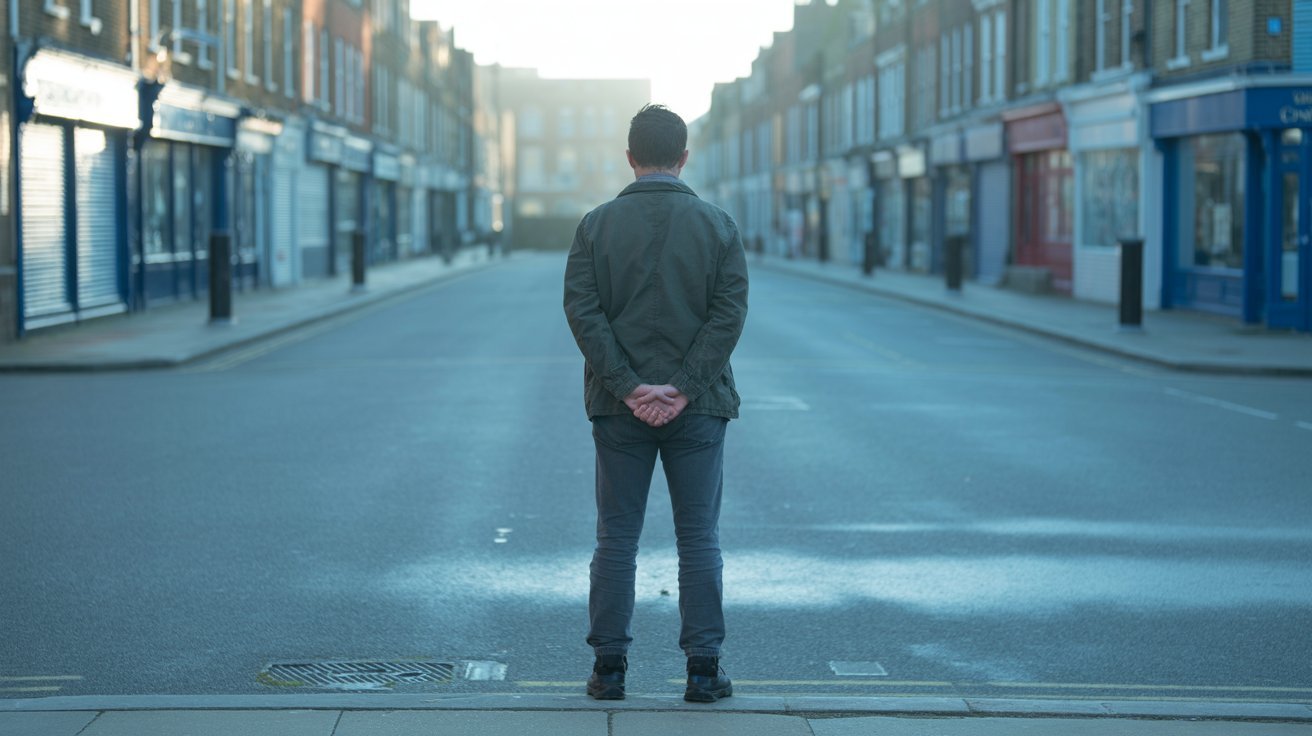
There’s a moment nobody warns you about.
Not the paperwork. Not the resettlement briefings with their PowerPoint slides about “transferable skills” and civilian career pathways. Not even the last time you walk through the gate.
It’s about three weeks after all of that. You’re standing in a supermarket, probably a Tesco, probably on a Tuesday morning when everyone else is at work, and you’re staring at forty-seven varieties of bread. And something in you… just doesn’t compute. You spent years in an environment where decisions mattered. Where the wrong call had consequences you could actually feel. And now you’re paralysed by sourdough.
That’s when it hits you. Not the leaving. The arrived.
I served in the Royal Air Force. I’m not going to dress it up in bunting or turn this into a recruitment poster. It was hard, it was strange, it was sometimes tedious in ways that only the military can make tedious, and it shaped me in ways I’m still finding the edges of twenty years on. What it also was… was the most profoundly connected I have ever felt to other human beings in my entire life.
That’s the part that doesn’t make the leaflets.
There’s a word that gets thrown around a lot in veteran circles. Camaraderie. Civilians hear it and picture blokes having a pint and talking about the old days. A kind of nostalgic warmth. A nice thing to have had.
They’re not wrong. But they’re not right either.
What camaraderie actually is, inside it, is something closer to a nervous system. It’s not friendship in the conventional sense, though friendship lives inside it. It’s the knowledge, bone-deep and unspoken, that the people around you are oriented toward the same thing you are. That when it matters, and sometimes it matters enormously, you will not be alone. Not because they like you. Not because you’ve earned it through charm or social currency. Because that’s simply how it works. Because you are part of something, and the something is real.
You don’t realise how much you’ve been living inside that nervous system until you step outside it.
And then the silence is extraordinary.
Civvy street, as we call it, is not unkind. I want to be clear about that. I’ve met good people. I’ve built a life that, on paper, looks like a reasonable definition of freedom. I answer to no one. I set my own hours. I wear what I like. I have not been shouted at since the early 2000s, which I consider an unambiguous win.
But.
The but is the thing nobody really talks about honestly.
Civilian life is, structurally, quite lonely. Not in the weeping-into-your-cornflakes sense. In a quieter, more architectural sense. People here are managing their own lives, their own anxieties, their own agendas. The workplace has colleagues, not comrades. There’s a difference that sounds semantic until you need it not to be.
Colleagues share a floor. Comrades share a direction.
In the RAF, you could walk into a room full of people you’d never met and within twenty minutes have a functional shorthand. A shared frame. A way of reading each other that cut through all the social preamble that civilians spend years negotiating. You knew where you stood. Not because everyone was your best friend, but because everyone was operating from the same set of values, the same understanding of what mattered.
I’ve been trying to replicate that feeling ever since. I haven’t managed it yet.
The conditioning piece is harder to explain without sounding like a self-help podcast gone wrong.
Service rewires you. Not in the dramatic, Hollywood sense of a man staring into the middle distance while helicopters drone in his memory. In the mundane, daily sense. You wake early because your body still believes something is required of you before the world gets going. You scan rooms. You have a low tolerance for vagueness, for waffle, for people who say they’ll do things and then don’t. You find the civilian habit of treating punctuality as approximate quietly maddening. You’ve worked with people for whom being late could end badly for someone else, and that recalibration doesn’t undo itself just because the stakes are now a 10 o’clock Teams call.
None of this makes you better than anyone. It makes you different from a lot of people, which turns out to be its own particular kind of isolated.
You learn to sand the edges down. To perform a version of yourself that doesn’t unsettle people at dinner parties. To not answer the question “so what was it like?” with anything approaching the truth, because the truth takes too long and requires too much from both of you.
So you say: it was good. Challenging. I learned a lot. Glad I did it.
And you move on to the wine.
The strange thing… the thing I keep coming back to… is that I don’t want to go back.
I want to be honest about that, because the veteran narrative so often collapses into one of two shapes: the broken soldier who never recovered, or the proud warrior who’d do it all again in a heartbeat. Both exist. Both are real. But there’s a third shape that doesn’t get enough airtime.
The person who is genuinely glad they left, who has built something worth having since, who has no particular desire to return to the structure or the hierarchy or the institutional way of doing things… and who still hasn’t found anything in civilian life that comes close to what was in that room. That mess. That flight line. That particular quality of being known without explanation.
That’s the tension I live in. Not tragic. Not heroic. Just… present. A frequency I can’t quite tune out, running underneath whatever I’m doing on any given Tuesday in any given Tesco, standing in front of the bread.
I think what people misunderstand about ex-service life is that the adjustment isn’t primarily about trauma, or danger, or dramatic experience. For most of us, most of the time, it’s about something far more ordinary and far more persistent.
It’s about belonging.
We had it. Completely. In a form that most people spend their entire civilian lives searching for through churches and clubs and friendship groups and online communities and any number of other vessels that almost, but never quite, hold the same volume.
And then one day, by choice or by circumstance or by the simple arithmetic of a contract ending, we walked out of it.
And the world on the other side is fine. It really is. It’s full of possibility and autonomy and nobody making you run in the rain before breakfast.
But it is not, and has never been, and I suspect will never be, the same.
That’s not a complaint. It’s not a plea for sympathy. It’s just the truth of it, said plainly, without the bunting.
Some things you carry not because you can’t put them down. But because, even now, even here, they’re still the best thing you’ve ever held.
If this landed somewhere real for you, share it with someone who’d understand why. And if you’re still serving… you’ll know what you’ve got. Hold it a bit longer than you think you need to.
Until Next Time

Discover more from Dominus Owen Markham
Subscribe to get the latest posts sent to your email.