
So here’s a thing that actually happened.
In February, Russian athletes competed at the Winter Olympics in Milano Cortina. No flag. No anthem. No official team name. Just athletes in blank kits, filed under the bureaucratic poetry of “Individual Neutral Athletes” — as if attaching the word neutral to a human being somehow launders the geopolitics off them.
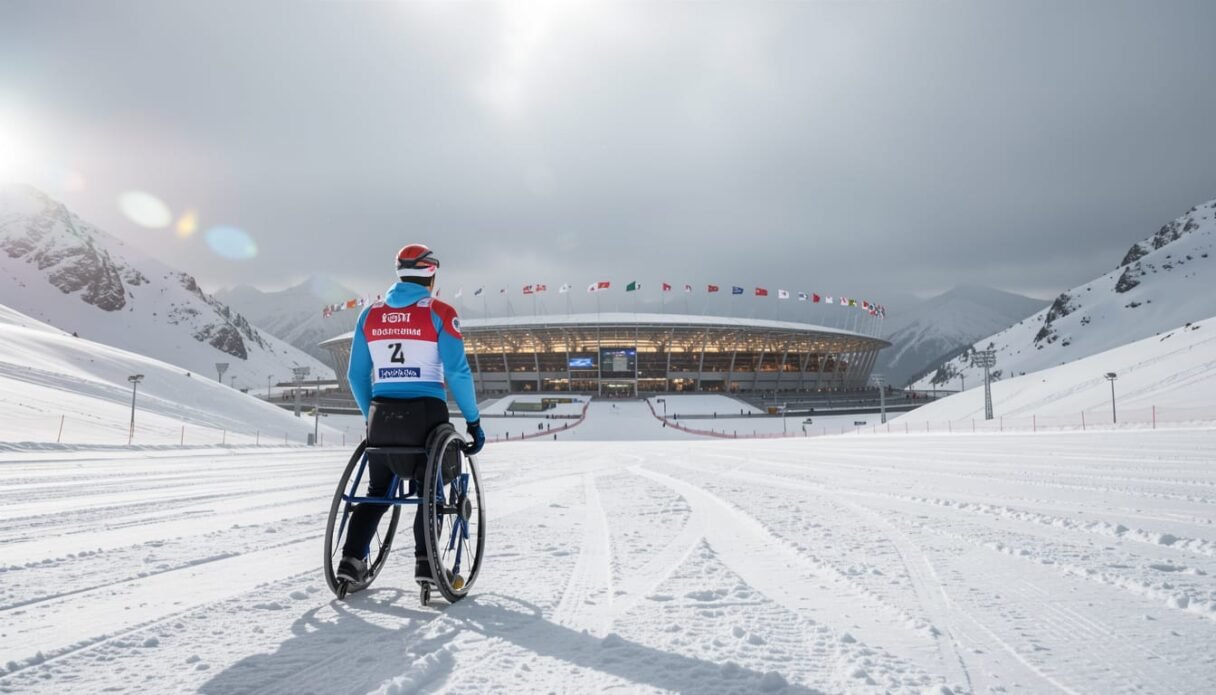
Two weeks later, at the same Games complex, the Paralympics opened. Russia walked in. Flag out. Anthem ready. Ten athletes, fully badged up, representing the nation, are currently conducting what the EU Commissioner for Sport called… and I’m paraphrasing gently here… an ongoing war of aggression.
Ukraine’s Paralympic team, incidentally, includes athletes whose disabilities were sustained on the front lines fighting against that same nation.
But sure. Inclusivity.
Let’s go back to September 2025, because that’s when the fuse was lit.
The IPC held its General Assembly in Seoul. On the agenda: whether to lift the suspension on Russia and Belarus that had been in place since the invasion of Ukraine in 2022. The vote came in at 91 to 77… a majority, technically, though not exactly a thundering mandate. Eighty-six countries looked at the situation and decided the flags could come back out. Seventy-seven looked at the same situation and decided they couldn’t. Democracy, as it turns out, is when the side with four more votes gets to decide whether an invading nation should march into the opening ceremony of an event built to celebrate human resilience.
Five of the six para-sports that make up the Winter Paralympics had bans still in place on Russian and Belarusian athletes. Five independent sporting federations said no. The Court of Arbitration for Sport overruled them in December, clearing the path for six Russian and four Belarusian athletes to compete… under their own flags, with their own anthems… in skiing and snowboarding events.
The IPC called it a democratic process.
The Ukrainian Sports Minister called it “disappointing and outrageous.”
I’ll leave you to decide which description better fits the circumstances.
Now, here’s where it gets properly strange.
The IPC’s reasoning, the actual stated reasoning, was that barring Russia and Belarus had become inconsistent. Inconsistent, specifically, with the fact that Israeli athletes were still competing, given the ongoing conflict in Gaza. The logic being: if we’re not banning everyone involved in a war, we can’t ban anyone. Which sounds almost principled, until you follow it to its conclusion and realise it essentially argues that the only fair response to one injustice is to ignore all the others.
Apolitical, they called it. The IPC wanted the Games to be apolitical.
So they invited a country currently bombing a neighbouring nation to march under its flag in front of a global audience, and framed that as staying out of politics. There’s a word for that kind of neutrality. Several, actually. None of them particularly flattering.
IPC President Andrew Parsons, addressing the press the day before the opening ceremony, expressed what could only be described as genuine puzzlement that the controversy had not simply… gone away. As if the passage of five months between vote and the ceremony should have been enough time for everyone to process their grief about the matter and move on. He described the decision as the result of democracy. He appeared to mean this as reassurance.
What followed was, depending on your perspective, either a principled international stand or an elaborate exercise in showing up and then leaving before the good bit.
Sixteen of the fifty-six participating countries boycotted the opening ceremony. Ukraine, naturally. But also the Czech Republic, Estonia, Finland, Latvia, Lithuania, Poland, Germany, the Netherlands. Countries with long memories, short borders, and a fairly clear view of what a Russian flag at an international sporting event currently represents.
The British government expressed its disappointment. It called the decision wrong. It said Russia should not be competing while the invasion of Ukraine continues.
Then sent its athletes anyway.
To be fair, that’s not entirely a contradiction. Athletes train for years. You don’t pull the rug out from under a Paralympic competitor because the IPC made a decision you disagree with. But there’s something a little British about the whole approach: deeply principled in statement, pragmatically flexible in practice, and quietly relieved when the skiing starts.
Canada’s Paralympic Committee voted against the reinstatement. Spoke out publicly. Then sent its team. The CEO said, with admirable honesty, that once democracy was in play, the decision had been made, and now it was their job to show up and support their athletes. Which is a reasonable position. It is also essentially the position of someone who disagreed with the restaurant’s decision to seat the unpleasant table next to them, complained to the manager, got nowhere, and then quietly got on with their dinner because the food was good and they’d driven a long way.
There’s a detail buried in all of this that I keep coming back to.
In order to compete at the Winter Olympics as a neutral athlete, Russian and Belarusian competitors had to demonstrate no active support for the war in Ukraine. No ties to state or military security agencies. Each athlete vetted individually.
No such vetting applied at the Paralympics.
The flag came back. The anthem came back. The requirement to have not cheered on the invasion, apparently, did not make the trip with them.
You might think: these are ten athletes. Skiers and snowboarders. People who have trained their entire lives and happened to be born in a country with a catastrophically bad government. That is true. It is not nothing. Athletes at this level are rarely the architects of their nation’s foreign policy, and it would be unkind to pretend otherwise.
But that’s not really what anyone is arguing. The argument isn’t about the athletes. It’s about the flag. It’s about the anthem. It’s about the Russian Paralympic Committee president, upon reinstatement, singling out Vladimir Putin for personal praise. It’s about the fact that Russian war veterans are already being mentioned as potential competitors at the 2028 Summer Paralympics, injuries sustained in Ukraine qualifying them, in a perfectly grotesque bureaucratic circle, to represent the nation that started the war at an event meant to honour the human spirit.
The human spirit, presumably, of everyone.
Here is what the IPC has actually done, whether it intended to or not.
It has established that international sporting bodies can be worn down. That if a nation sits out enough cycles, absorbs enough neutral status, files enough appeals with enough courts, eventually the 177-member general assembly will get tired of the argument. That geopolitical bad behaviour has a shelf life in sport, and it is apparently somewhere around three to four years, shorter if you can find a procedural lever and a sympathetic court.
It has also usefully clarified what apolitical means in practice. It means: we will not take sides between an invading nation and the country it is invading. It means: we will apply equal consideration to the flag of the aggressor and the flag of the nation whose athletes trained in bomb shelters and showed up anyway. It means: the ceremony will go ahead, and if you find the optics uncomfortable, perhaps that is your problem for bringing politics into sport.
The neutral jacket got hung up.
The flag came back out.
Same venue. Different rulebook. Same war.
I want to end on something that is not despair, because I don’t think the answer to watching institutions fail is to conclude that nothing matters. It clearly does matter; sixteen countries made sure of that by walking out of a ceremony and planting a flag (so to speak) of their own. The Ukrainian athletes, who came anyway, who competed anyway, who wore their kit with a map of Ukraine that officials tried to ban as a political statement… those people matter enormously.
But there is a creeping logic at work here that is worth naming before it becomes furniture.
The logic that says: if you can’t ban everyone, you must permit everyone. That says: consistency requires inclusion regardless of context. That says: democracy has spoken, move on.
It’s the same logic that slowly drains language of meaning. That makes neutral mean compliant. That makes apolitical mean convenient. That makes inclusive mean we’ve stopped paying attention.
The International Paralympic Committee had a chance to say: not yet. Not while this is happening. Not while Ukrainians are fighting, and dying, and showing up in Cortina to ski on one leg.
Instead, it said: the vote was democratic.
Which, technically, it was.
And technically is doing a lot of heavy lifting in that sentence.
Until Next Time

Discover more from Dominus Owen Markham
Subscribe to get the latest posts sent to your email.