
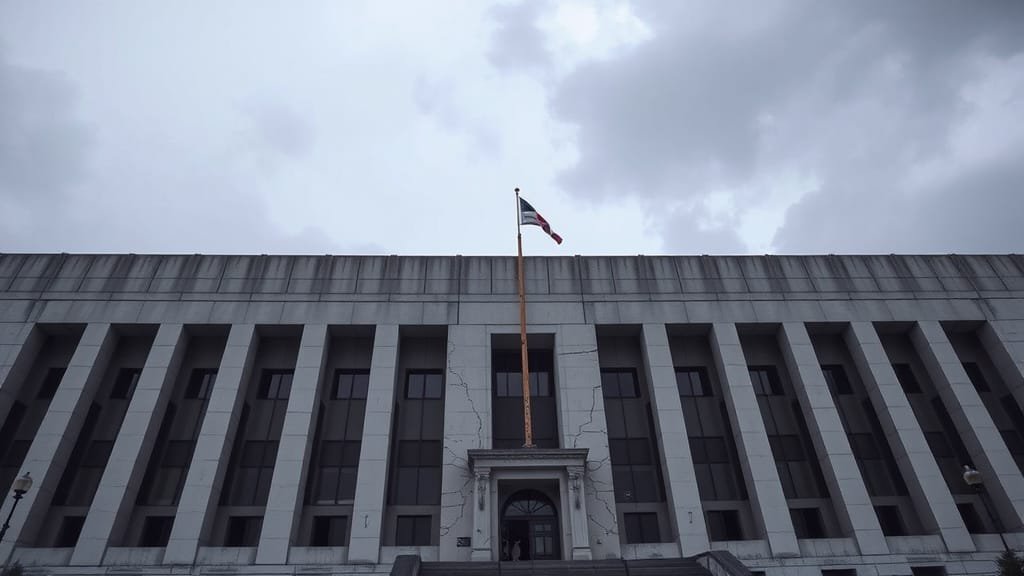
They keep telling you the buildings are structurally sound. You can see the cracks from the street.
There’s a thought experiment doing the rounds in the kind of intellectual circles that don’t have a name because they don’t want one. It goes something like this:
Imagine you inherit a house. The roof leaks. The foundations are compromised. The wiring is a fire hazard and has been for thirty years. Previous owners patched things up with good intentions and very little competence, and every patch made the next problem slightly worse. Now someone’s standing in the front garden with a clipboard, talking to you about reform. Structural renovation. A committee to review the drainage.
At what point, exactly, do you stop listening to the person with the clipboard and start thinking about demolition?
That’s the argument. That’s the whole argument. And the reason it’s gaining traction far beyond the usual fringes is that a growing number of people… have seen the house.
The Idea Nobody Will Say Out Loud
The orthodoxy of our era has always been reform. You don’t tear things down. You improve them. You work within the system. You lobby, you petition, you write strongly worded op-eds, you elect the right people, and the institutions… respond. Gradually. Imperfectly. But they respond.
Except they haven’t. Not really. Not in any way that matters at the pace the world is moving.
The World Health Organisation spent the first weeks of the worst pandemic in living memory parroting Chinese state talking points about human-to-human transmission. The UN Security Council watched Rwanda happen and is currently watching other things happen with the same magnificent inertia. The IMF and World Bank have spent decades exporting economic models to developing nations that enriched creditors and immiserated populations, and they have reformulated these models, and published updated frameworks, and held conferences, and the outcomes have remained instructively similar.
The central banks told us inflation was transitory. It wasn’t.
None of this is new information. What’s new is the intellectual move being made with it. Not “these institutions failed and should be improved.” Not “they need more funding and better leadership.” But something more unsettling: they cannot be reformed, because their dysfunction is not incidental. It is structural. It is, in a very real sense, the point.
The argument, and I’m being careful here because I want you to hear it clearly before you decide what you think of it, goes like this: these institutions were built for a specific historical moment, by specific interests, to serve specific ends. They achieved those ends, more or less. And then the world changed, and they didn’t, and they can’t, because changing would require them to act against the interests that sustain them. Reform is theatre. The clipboard is a prop.
The Demolition Faction
I want to be precise about who is making this argument, because that precision matters.
It is not just the populist right, though the populist right is certainly making it loudly. It’s not just the disillusioned left, though they are making it too, in different language, about different targets, with different proposed replacements. What’s genuinely unusual about the current moment is that the demolition argument is being made across a spectrum that cuts right through the traditional political binary.
You have serious academic economists arguing that the Bretton Woods architecture is not fixable and should be replaced with something built from first principles for a multipolar world. You have international lawyers making the case that the Security Council veto system has rendered the UN structurally unable to respond to precisely the scenarios it was created to address. You have public health scholars whose reputations survived the pandemic writing papers with titles that, a decade ago, would have ended careers.
And then there are the less academic voices, the ones who don’t footnote their arguments but whose reach dwarfs any journal, making the same essential case to audiences who didn’t need convincing that something was wrong, but who are now being handed a framework for what, specifically, they might do about it.
This is the demography of the demolition argument: credentialled sceptics who’ve run out of patience, and a mass audience who never had any. And between them, they are doing something that should make everyone paying attention mildly nervous. They are normalising the idea that the answer to a broken institution is not a better institution. It’s a cleared site.
The End of the Grand Narrative
There’s a philosophical engine underneath all of this, and it’s worth looking at directly.
For the better part of two centuries, Western civilisation has operated on something you might call the Grand Narrative of Progress. The general direction of history is forward. Institutions, however flawed, accumulate wisdom. Democratic systems, however imperfect, self-correct. Science, however contested in the short term, converges on truth. The arc bends toward justice, or at least toward competence.
The argument being made in the demolition camp is that this narrative ended. Not as a rhetorical flourish. As a dateable event. They tend to cluster around the 2008 financial crisis and its aftermath, when the institutions responsible for the crash were bailed out by the people they’d damaged, and then resumed operating in more or less the same way. Or around COVID, when the gap between what institutions said and what was observable from your own kitchen window became impossible to explain away. Or simply around the cumulative weight of things that were supposed to work, not working, for long enough that the optimistic explanations started sounding like a coping strategy.
The demolition people are not, by and large, nihilists. That’s the misreading that the mainstream press tends toward, and it’s a convenient one because it allows dismissal. They are not saying nothing can be built. They are saying something specific: the current architecture is not the last word on how to organise human co-operation. It was a construction, built at a particular moment, by particular people, with particular blind spots. Other constructions are possible. Better ones, potentially. But not while the current wreckage is occupying the site.
You have to clear the ground.
What the Mainstream Can’t Say
Here’s what strikes me about how mainstream commentators engage with this argument. Or rather, fail to engage with it.
The standard response to institutional demolition arguments is to invoke chaos. You tear this down… then what? What comes next? Do you want to live in a world without the WHO, without the UN, without central banks? You’re playing with fire. You don’t know what you’d lose.
And that’s not wrong, exactly. It’s just that it’s also a description of the status quo. Right now, the WHO has a credibility problem that affects public health outcomes across the planet. The UN cannot act on its own founding principles in most of the situations where its founding principles are relevant. Central banks have spent fifteen years managing wealth inequality under the theoretical cover of inflation targeting. We are already living in the world that the reformists promised would result from not having the bad alternative.
The chaos argument works as a rhetorical move. It is much less convincing as an empirical claim.
What the mainstream genuinely cannot say, without conceding too much, is: you might be right about the diagnosis and still wrong about the treatment. That the institutions are failing is, at this point, largely undeniable. The question is whether demolition makes the failure mode better or worse, whether the cleared ground becomes a foundation or just rubble with different debris on it.
That’s the serious version of the argument. It doesn’t get made very often, because making it seriously requires acknowledging the first half.
The Thing I Keep Coming Back To
I’ve been turning this over for a while now. Not because I have a settled view, I want to be honest about that, but because I think the discomfort most people feel around the demolition argument is worth examining.
Some of that discomfort is legitimate. History is not short of examples of what happens when people decide that the existing order needs to be swept away and replaced with something built on purer principles. The track record is not encouraging. The cleared ground does not always become a better foundation. Sometimes it just becomes cleared ground, and then something fills it that you would not have chosen.
But some of that discomfort is something else. It’s the particular vertigo that comes from recognising that the things we’ve been told are stable might not be. That the institutions we were taught to trust might be irretrievably compromised. That the people with clipboards and frameworks and reform proposals might be, at this point, something worse than wrong. Not lying, exactly. Just… unable to see what the building actually is.
I think we are in a moment where the honest position is: I don’t know what comes after. I’m not sure anyone does. But the pretence that what we have is working, that reform is possible if only the right people are in the room, that the Grand Narrative of Progress is merely paused and will resume shortly… that pretence is getting harder to maintain with a straight face.
And the people who’ve stopped maintaining it, across all the ideological vectors, are not a fringe. They are, increasingly, the room.
Wrecking-Ball Politics and What It Costs
Here’s the honest accounting, because this piece would be cheap if it didn’t include one.
Wrecking-ball politics has a cost. It costs stability while the rubble is being sorted. It costs the people who depend most on whatever functional elements remain inside failing institutions, the bits that do work, the programmes that do reach people, the agreements that do hold. It costs the time between demolition and construction, and historically, that time has a habit of being occupied.
The demolition argument is at its weakest when it slides from “this cannot be reformed” to “therefore anything that replaces it will be better.” That’s not logic. That’s wishful thinking dressed in the language of realism.
But it is at its strongest when it asks the question that institutional defenders keep avoiding: what is the reform theory, specifically? What is the mechanism by which the WHO becomes accountable to public health outcomes rather than member state politics? What is the process by which the Security Council stops being a great power veto system dressed up as collective security? What precisely happens inside the central bank framework that has not been tried, that would produce different results?
Show the work. Show the reform pathway. Not the aspiration. Not the committee. The actual mechanism.
Because when you push on that question, what you often get is silence, or something that sounds suspiciously like: trust us, we’re working on it, the alternative is chaos.
Which is, of course, exactly what you’d say if the building was unsalvageable and you needed people to stay inside it a little longer.
The mainstream calls it chaos. The underground calls it clearing the ground.
Both of them might be right. That’s the part nobody wants to sit with.
Until Next Time

Discover more from Dominus Owen Markham
Subscribe to get the latest posts sent to your email.