
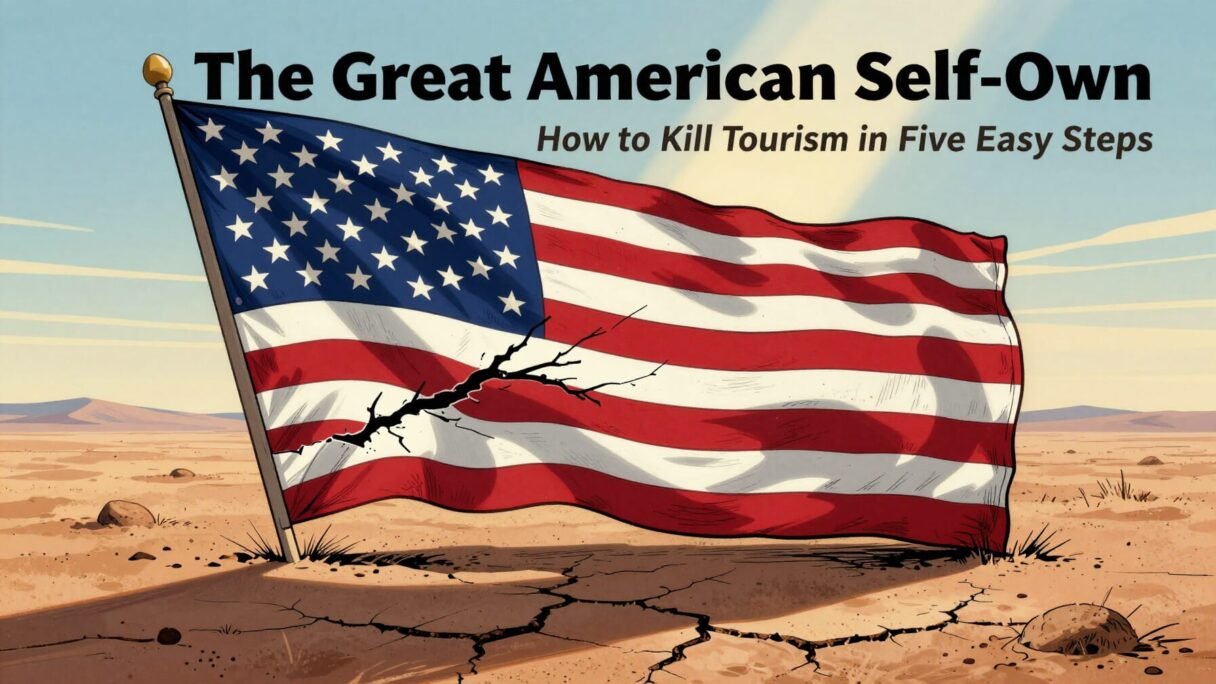
There’s something beautifully absurd about watching a nation famous for its entrepreneurial spirit—a country that will monetise absolutely anything, including cheese in aerosol cans—actively sabotage one of its most lucrative industries. But here we are in December 2025, witnessing the incoming Trump administration propose what might be the most spectacular act of economic self-harm since New Coke.
The latest wheeze? If you want to pop over to the States for a holiday—or, God forbid, a business meeting—you’ll now need to hand over five years of social media history, complete with handles and platforms. Oh, and whilst you’re at it, how about your phone numbers, email addresses, family details, and potentially a cheeky iris scan or DNA sample? You know, just casual holiday admin.
Welcome to America. Please surrender your digital life at the door.
The Visa Waiver Programme: A Love Story Gone Wrong
For decades, the Visa Waiver Programme was one of those rare governmental achievements that actually worked. Citizens from 42 countries—Australia, Germany, Japan, the UK, Ireland, and others—could toddle off to America for up to 90 days without the faff of a full visa. Fill out an ESTA form, pay a small fee, and Bob’s your uncle. Tourism flourished. Business boomed. The Statue of Liberty continued holding that torch aloft, presumably not yet aware of the irony.
But apparently, simplicity is for suckers.
The new proposal from US Customs and Border Protection, published in the Federal Register this week, transforms what was once a straightforward process into something resembling a particularly invasive job application for MI6. They want to know what you’ve been saying on Twitter for the past five years. They want your Instagram handle. Your TikTok. Your bloody LinkedIn, probably, though let’s be honest—LinkedIn is punishment enough without governmental scrutiny.
The stated aim? Identifying “potential risks” in the name of immigration security. The actual result? A tourism industry staring down the barrel of a self-inflicted wound so severe it makes Brexit look like a papercut.
The Timing: A Masterclass in Shooting Yourself in the Foot
Here’s where it gets properly funny—in that dark, laugh-or-you’ll-cry kind of way.
US inbound travel is already declining for the first time since 2019. Let that sink in. After years of pandemic-related restrictions finally lifting, after people are desperate to travel again, after the world is slowly remembering that international holidays are rather nice actually, America is somehow managing to reverse that trend.
And now, just as the country is gearing up to host the 2026 FIFA World Cup and the 2028 Olympics—two events that will bring millions of international visitors and billions in revenue—they’ve decided to introduce a bureaucratic nightmare that would make Kafka weep.
Imagine being a German football fan, excited to watch your national team in America, only to discover you need to provide half a decade of social media receipts first. “Fancy watching some football?” “Yeah, mate, just need to compile a dossier of my online activity since 2020. Should only take three to six weeks.”
It’s the kind of strategic thinking that makes you wonder if there’s a secret competition happening to see how quickly America can alienate its allies. If so, they’re winning.
The Privacy Nightmare No One Asked For
Let’s talk about what this actually means in practice, because the devil is very much in the details here.
Five years of social media history. Think about what you’ve posted in the past five years. Think about the jokes that seemed funny at the time. The political opinions you’ve expressed. The photos from that one night you’d rather forget. The arguments you got into on Twitter at 2 am because someone was wrong on the internet.
Now imagine a border agent scrolling through all of it whilst you stand there, jet-lagged and clutching your luggage, wondering if that sarcastic tweet about American politics in 2022 is about to get you sent home.
Because that’s the thing about this proposal that its architects seem to have conveniently overlooked: social media is performative, reactive, and often deliberately provocative. We post things for effect. We make jokes. We engage in hyperbole. And now, apparently, all of that becomes evidence in your case for being allowed into the country.
Critics—including business groups who presumably understand how commerce works—have pointed out that this could deter Irish business travellers, Australian tourists who’ve been critical of US policies online, and basically anyone who’s ever had an opinion about America that wasn’t glowing praise.
Which, let’s be honest, is most people. America is many things, but it’s not beyond criticism. And historically, that’s been fine. That’s been part of the deal. You could visit America and think their gun laws were mental. You could enjoy New York and find its healthcare system baffling. You could appreciate the natural beauty of the Grand Canyon whilst simultaneously wondering why they elected… well, you know.
But not anymore, apparently. Now, wrongthink might get you denied entry.
The Biometric Bonus Round
As if the social media excavation weren’t enough, there’s also the small matter of “expanded biometrics.” Selfies. DNA samples. Iris scans.
Nothing says “Welcome to the land of the free” quite like swabbing your cheek for genetic material before you’re allowed to visit Disney World.
The justification, of course, is security. It’s always security. And look, I’m not naive—border security matters. But there’s a sliding scale between “reasonable precautions” and “dystopian surveillance state,” and this proposal has sprinted past the midpoint without so much as a backwards glance.
The irony is almost poetic. America, a nation built on the idea of freedom, of liberty, of “give me your tired, your poor, your huddled masses”—well, they’ll still take them, but first they need your iris scanned and your Twitter feed audited.
The Business Impact: A Predictable Disaster
Let’s get pragmatic for a moment and talk about money, because if appeals to privacy and civil liberties won’t sway anyone, perhaps cold, hard economics will.
The US travel and tourism industry contributes roughly $1.9 trillion to the economy annually. International visitors don’t just spend money on hotels and flights—they eat at restaurants, shop in stores, visit attractions, rent cars, and generally inject cash into local economies across the country.
Now imagine you’re a business trying to attract international clients for a conference. Or a university hoping to welcome foreign students. Or a tech company that needs to fly in developers from Europe for a sprint.
“Just a heads up,” you’ll have to say, “before you come over, we’ll need you to compile five years of social media posts and submit to biometric screening. Yes, all of you. No, we don’t know how long it’ll take. Yes, it’s as invasive as it sounds.”
How many of those trips will simply… not happen? How many businesses will decide that Zoom calls are sufficient, actually? How many conferences will relocate to Canada or Mexico, where the entry requirements don’t resemble an audition for a spy thriller?
The phrase “shooting yourself in the foot” doesn’t quite cover it. This is more like shooting yourself in the foot, reloading, and then shooting the other foot for good measure, just to be thorough.
The World Cup Conundrum
The 2026 FIFA World Cup is meant to be a celebration. A coming together of nations. A chance for America to show the world its finest hospitality and, not insignificantly, make an absolute fortune from millions of visiting fans.
But here’s the thing about football fans: they’re international. They’re passionate. And they’re very, very good at expressing opinions on social media.
Picture the scenario: An Argentinian fan who’s been celebrating their 2022 World Cup victory a bit too enthusiastically online. A Brazilian who’s made some spicy comments about American foreign policy. An English supporter who’s been, well, English about things.
Will they fancy the hassle of submitting years of digital history just to watch a match? Or will they decide that staying home and watching on telly is suddenly much more appealing?
And it’s not just the fans. Journalists will need to enter the country. Broadcasters. Sponsors. FIFA officials. All of them are potentially subject to the same screening. All of them are wondering if that tweet they posted three years ago about American exceptionalism might come back to haunt them.
The World Cup is supposed to generate billions in revenue. This proposal seems designed to ensure much of that potential goes unrealised.
The Olympics: Same Problem, Fancier Venues
By 2028, when Los Angeles hosts the Olympics, this system—if implemented—will presumably be in full swing. And the Olympics create their own special brand of chaos.
Athletes from 200+ nations. Coaches. Support staff. Media from every corner of the globe. Millions of spectators. All converging on California for a few weeks of sport and international goodwill.
Now add to that mix the requirement that every single person provides years of social media history and submits to biometric screening.
The logistics alone are staggering. The privacy implications are troubling. And the message it sends—”Welcome to America, now prove you’re worthy”—is about as far from Olympic ideals as you can get.
There’s also the small matter of athletes who’ve been critical of American policies in the past. Chinese athletes who’ve posted about Taiwan. Russian athletes (if they’re even allowed to compete) with any number of potential red flags. Middle Eastern competitors who’ve expressed opinions about US foreign policy.
Will they all be granted entry smoothly? Or will the Olympics become a masterclass in how to create diplomatic incidents?
The Unintended Consequences: A Speculation
Here’s what I think happens if this goes through:
First, the immediate deterrent effect. People who were planning trips to America will cancel. Business travel will decrease. Tourism numbers will continue their decline. The fiscal impact will be measurable and significant.
Second, the reciprocity response. Countries don’t take kindly to their citizens being treated like potential threats. The UK might decide British tourists need similar protections. Australia could implement equivalent measures. Suddenly, international travel becomes a bureaucratic nightmare in all directions.
Third, the innovation exodus. Tech workers, researchers, academics—the people America relies on to maintain its edge in innovation—will think twice about relocating or even visiting. Why deal with the hassle when Canada, the UK, or Germany offer similar opportunities without the digital colonoscopy?
Fourth, the cultural shift. America’s soft power—its cultural influence, its appeal as a destination, its position as a beacon of freedom—will take another hit. And soft power, once eroded, is remarkably difficult to rebuild.
Fifth, and perhaps most importantly, the normalisation. If America does this, other countries will follow. Privacy standards will degrade globally. The idea that you can travel without surrendering your entire digital life will become quaint, a relic of a more trusting age.
We’ll all be worse off for it.
The Alternative Universe
Here’s the thing that makes this all so frustrating: it doesn’t have to be this way.
Border security and welcoming tourists aren’t mutually exclusive. You can have effective screening without demanding five years of Twitter posts. You can identify actual threats without treating every visitor like a potential criminal.
Other countries manage it. They use intelligence sharing, watch lists, and targeted screening for individuals who actually warrant extra scrutiny. They don’t implement blanket policies that assume everyone is a suspect until proven otherwise.
But nuance doesn’t win elections, apparently. And “effective but invisible security measures” doesn’t make for good political theatre.
So instead, we get this: a proposal that will damage the economy, alienate allies, deter tourists, complicate major international events, erode privacy norms, and accomplish very little in terms of actual security.
It’s the kind of policy that makes you wonder if anyone involved has ever actually met a human being, let alone understood how tourism or international relations work.
The Punchline
The truly funny bit—and by funny, I mean soul-crushingly depressing—is that this is all self-inflicted. Nobody is forcing America to do this. The rest of the world isn’t demanding more stringent entry requirements. This is a choice.
A choice to value security theatre over economic reality. A choice to treat allies like adversaries. A choice to solve a problem that doesn’t exist by creating several new ones that definitely do.
And the people who will suffer most won’t be the policymakers who dreamt this up. It’ll be the small business owners in tourist towns. The hotels are losing bookings. The restaurants with empty tables. The American workers whose jobs depend on international visitors.
It’ll also be regular people—families wanting to visit relatives, students hoping to study abroad, professionals trying to do business—who’ll find themselves caught in a system that treats a holiday like a security clearance.
So here we are. America, the land of the free, asking for your social media passwords. The home of the brave, requiring DNA samples. The nation that once welcomed the world, now demanding you prove you’re worthy of entry by surrendering your privacy and dignity.
It’s a masterclass in how to kill tourism, alienate allies, and damage your own economy—all in the name of security that no credible threat requires.
And the saddest part? Nobody will be surprised when it works exactly as predicted.
Except, of course, the people who proposed it, who will somehow be shocked—shocked—when the consequences arrive right on schedule.
Welcome to America. Now fuck off.
(Unless you’ve got a spotless social media history and don’t mind the biometric screening. Then you’re probably fine. Probably.)
Until Next Time


Discover more from Dominus Owen Markham
Subscribe to get the latest posts sent to your email.