
By Dominus Owen Markham
There’s a peculiar genre of modern media that deserves its own category.
Not journalism.
Not analysis.
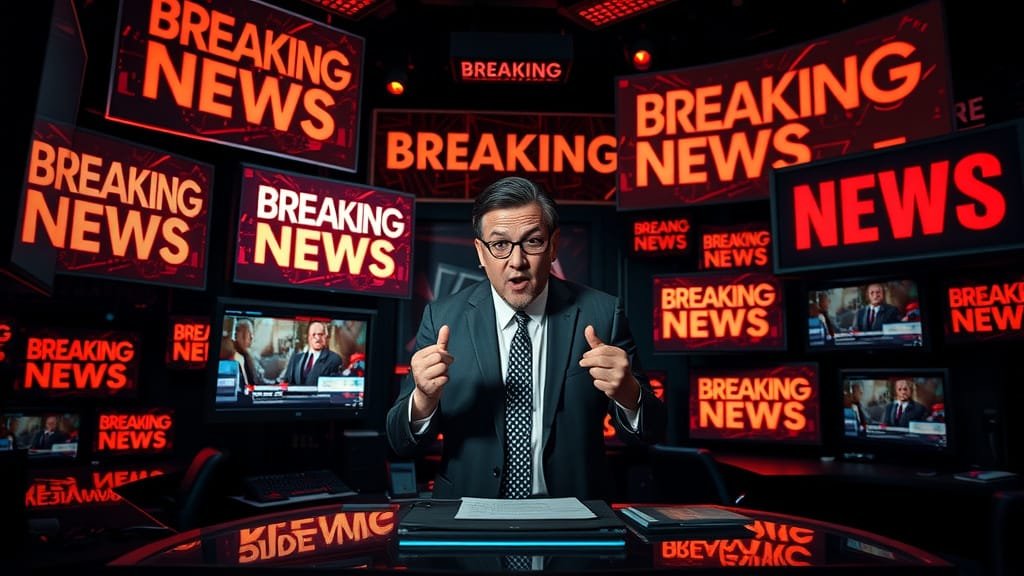
Something closer to theatre performed with a microphone and a red “BREAKING” banner.
You’ve seen it. The flashing graphics. The breathless tone. The host leaning forward as if he’s about to reveal that civilisation has roughly four minutes left to live.
I stumbled across one of these little performances earlier today… a YouTube broadcast confidently announcing that the world was suddenly on “high alert” after a warning from Donald Trump about Iran.
Apparently everything changed.
Apparently the clock started ticking.
Apparently the planet was holding its breath.
Right.
Let’s unpack that.
Because once you scrape away the dramatic soundtrack and the oversized typography… the whole thing collapses faster than a politician’s campaign promise.
The Theatre of Urgency
The first trick is always the same.
Urgency.
Everything is urgent. Everything is breaking. Everything is historic. The world is perpetually one speech away from collapse.
The host repeats phrases like:
“World on high alert.”
“Urgent warning.”
“Major escalation.”
Now, to be clear… the Middle East is genuinely tense. The United States and Iran have been circling each other like boxers who both know the other one can hit very hard.
But tension is not the same thing as immediate global catastrophe.
Geopolitics does not work like a fire alarm.
Real escalation looks boring. It involves logistics, intelligence briefings, diplomatic backchannels, and military planners arguing over maps for six hours.
It does not normally arrive accompanied by a YouTube host dramatically widening his eyes.
The Myth of the World-Changing Speech
The second piece of nonsense is the idea that a single speech suddenly flips the entire strategic board.
The video pushes the notion that Trump issuing a warning somehow changed the global situation overnight.
It didn’t.
The reality is far less cinematic.
The United States, Iran, and Israel have been involved in an escalating pattern of strikes, counter-strikes, threats, and signalling for months.
Naval manoeuvres.
Sanctions.
Missile attacks.
Intelligence operations.
In other words, the machine is already running.
One speech does not suddenly make the world “wake up”.
The world was already awake.
What speeches actually do in situations like this is send signals.
They are messages to adversaries. Messages to allies. Messages to domestic voters. Messages to financial markets.
They are theatre with a strategic purpose.
They are not the moment the chessboard suddenly flips over.
Confusing Political Rhetoric With Military Reality
Then comes the third problem.
The host treats rhetorical threats as if they are operational battle plans.
Trump says Iran will face overwhelming consequences if it disrupts oil shipping routes.
Cue dramatic music.
Cue the phrase “military retaliation”.
Cue the implication that aircraft carriers are already warming their engines.
But leaders threaten things constantly.
That’s how deterrence works.
You tell the other side the consequences will be catastrophic in the hope that nobody actually has to find out if you meant it.
It’s a messaging game.
Not a countdown clock.
The Panic Economy
Here’s the uncomfortable truth.
This type of coverage exists for one reason.
Fear sells.
If the headline said:
“Complex geopolitical tensions continue with uncertain outcomes”
…nobody would click.
But if you write:
“URGENT WARNING SHOCKS THE WORLD”
Suddenly the algorithm lights up like a Christmas tree.
The internet has quietly created an entire panic economy, where attention is harvested through constant crisis.
The world must always be about to explode… because calm analysis does terrible numbers.
The Missing Context
What’s fascinating in these videos is not what’s said.
It’s what’s missing.
There’s almost never discussion of:
- long-term strategic interests
- energy market pressures
- regional power balances
- internal political dynamics within Iran
- the economic calculations behind sanctions
All the complicated bits vanish.
Because complexity doesn’t travel well inside a ten-minute video with dramatic music.
The Real Situation
The reality is serious enough without the circus.
The Middle East sits on some of the most strategically important oil routes on Earth.
The Strait of Hormuz alone carries a massive share of global energy supply.
Any conflict involving Iran risks destabilising that entire corridor… which is why major powers treat escalation very carefully.
That doesn’t mean nothing will happen.
It means the people making decisions understand the stakes are enormous.
Which is exactly why the situation unfolds slowly, cautiously, and often invisibly.
The Algorithm Loves a Crisis
There is a strange side-effect to living inside the attention economy.
The louder someone sounds… the less they usually know.
Real analysts speak cautiously.
Real intelligence briefings are full of uncertainty.
But the internet rewards certainty.
So the quiet professionals get drowned out by the digital town criers announcing the end of the world every afternoon at half past three.
Breaking News Is Mostly Broken
None of this means the world is safe.
It simply means you should be very suspicious of anyone who sounds excited about the apocalypse.
Serious events deserve serious thinking.
Not dramatic thumbnails.
Not flashing red graphics.
Not a presenter leaning forward as if he’s about to reveal that Armageddon is scheduled for Tuesday.
Because when every day is treated like the end of civilisation…
Eventually you realise something uncomfortable.
The crisis isn’t the news.
The crisis is how the news now works.
Until Next Time

Discover more from Dominus Owen Markham
Subscribe to get the latest posts sent to your email.